Cui Panpan, Chang Shuying, Tian Gang, Li Zhen, Cheng Chunyan, Chang Lu, Zhang Junmei, Zhang Hongmei, Hu Hengyu
Department of Nursing, Henan Provincial People's Hospital, Zhengzhou University People's Hospital, Zhengzhou, China.
Henan Provincial Intelligent Nursing and Transformation Engineering Research Center, Henan Provincial Key Medicine Laboratory of Nursing, No. 7 Weiwu Road, Zhengzhou, China.
BMC Nurs. 2025 Jul 22;24(1):961. doi: 10.1186/s12912-025-03616-6.
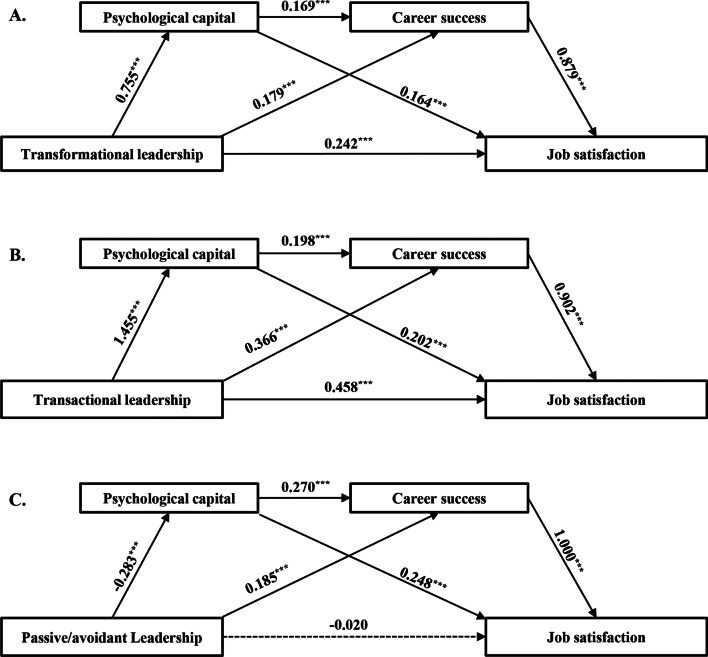
Nursing managers' leadership styles significantly influence their job satisfaction, yet the underlying mechanisms remain unclear. This study explores the mediating roles of psychological capital and career success in the relationship between leadership styles-transformational (TFL), transactional (TSL), and passive/avoidant (PAL)-and job satisfaction (JS).
A cross-sectional study was conducted in May 2024 with nurse managers from 20 hospitals in Henan Province, China. Of 810 contacted, 784 participated. Participants completed validated instruments, including the Multifactor Leadership Questionnaire, Psychological Capital Scale, Career Success Scale, and Minnesota Satisfaction Questionnaire. Pearson's correlation and serial mediation analyses were performed using IBM SPSS (version 21) and the PROCESS macro (version 3.4).
Both TFL and TSL had direct and positive effects on JS, with psychological capital and career success serving as partial mediators. Significant sequential mediation effects were found for both styles-for example, TFL→ psychological capital → career success →JS (β = 0.112, 95% CI [0.073, 0.155]) and TSL→ psychological capital → career success →JS (β = 0.260, 95% CI [0.188, 0.339]). In contrast, PAL showed no significant direct or total indirect effect on JS, though the sequential mediation pathway via psychological capital and career success was significant (β =-0.077, 95% CI [-0.122, -0.035]).
This study demonstrates that both TFL and TSL significantly influence nurse managers' job satisfaction, not only through direct effects but also indirectly via psychological capital and career success, including their sequential mediation. These findings highlight the critical role of leadership in enhancing psychological resources and career development. Strengthening effective leadership styles may serve as a strategic pathway to fostering a more supportive work environment and improving job satisfaction in healthcare settings.
护理管理者的领导风格对其工作满意度有显著影响,但其潜在机制尚不清楚。本研究探讨心理资本和职业成功在变革型领导(TFL)、交易型领导(TSL)和被动/回避型领导(PAL)与工作满意度(JS)之间关系中的中介作用。
2024年5月对中国河南省20家医院的护理管理者进行了一项横断面研究。在联系的810人中,784人参与。参与者完成了经过验证的量表,包括多因素领导问卷、心理资本量表、职业成功量表和明尼苏达满意度问卷。使用IBM SPSS(21版)和PROCESS宏(3.4版)进行Pearson相关性分析和序列中介分析。
TFL和TSL对JS均有直接正向影响,心理资本和职业成功起到部分中介作用。两种领导风格均发现了显著的序列中介效应——例如,TFL→心理资本→职业成功→JS(β = 0.112,95%CI[0.073,0.155])和TSL→心理资本→职业成功→JS(β = 0.260,95%CI[0.188,0.339])。相比之下,PAL对JS没有显著的直接或总间接影响,尽管通过心理资本和职业成功的序列中介路径是显著的(β = -0.077,95%CI[-0.122,-0.035])。
本研究表明,TFL和TSL不仅通过直接效应,还通过心理资本和职业成功的间接效应(包括序列中介)显著影响护理管理者的工作满意度。这些发现凸显了领导在增强心理资源和职业发展方面的关键作用。加强有效的领导风格可能是营造更具支持性的工作环境和提高医疗环境中工作满意度 的战略途径。