Parra-Rivas Leonardo A, Sharma Rohan, Rust Trinity E, Bazick Hannah O, Carlson-Stevermer Jared, Zylka Mark J, Ogawa Yuki, Roy Subhojit
Department of Pathology, University of California, San Diego, 9500 Gilman Drive, La Jolla, CA, USA; Aligning Science Across Parkinson's (ASAP) Collaborative Research Network, Chevy Chase, MD 20815, USA.
Department of Pathology, University of California, San Diego, 9500 Gilman Drive, La Jolla, CA, USA.
STAR Protoc. 2025 Jul 21;6(3):103945. doi: 10.1016/j.xpro.2025.103945.
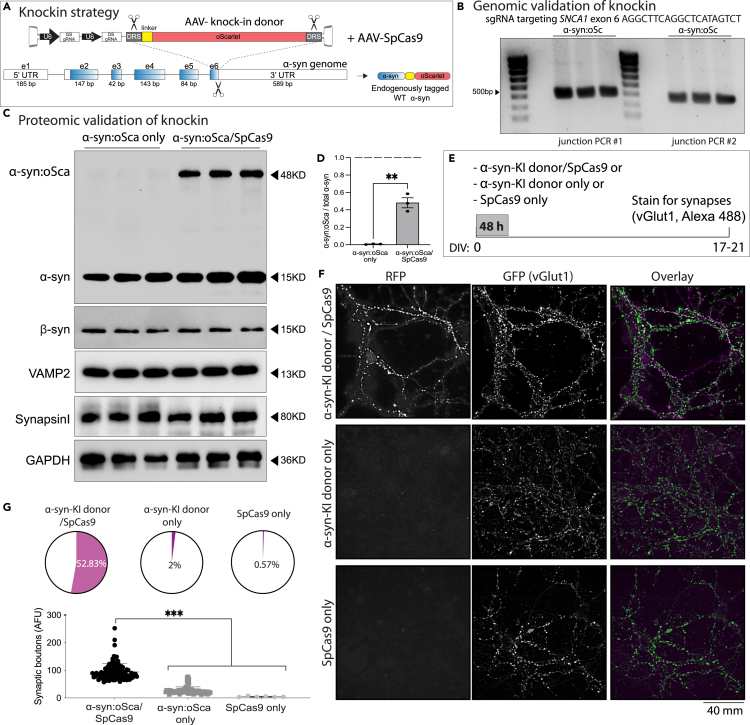
CRISPR-Cas9 technology enables acute gene knockdown and endogenous tagging to study single-synapse function. Here, we present a protocol for depleting alpha-synuclein (α-syn) or visualizing native α-syn with an endogenously inserted fluorescent tag in cultured mouse hippocampal neurons. We describe detailed steps, including CRISPR design, virus packaging/transduction (delivery), and validation of on-/off-target editing. This protocol should be useful for assigning precise function to contentious synaptic proteins and for visualizing protein trafficking without overexpression in cultured hippocampal neurons-an established model system for synaptic biology. For complete details on the use and execution of this protocol, please refer to Parra-Rivas et al..
CRISPR-Cas9技术能够实现急性基因敲低和内源性标记,以研究单突触功能。在此,我们介绍一种在培养的小鼠海马神经元中耗尽α-突触核蛋白(α-syn)或通过内源性插入荧光标签可视化天然α-syn的方案。我们描述了详细步骤,包括CRISPR设计、病毒包装/转导(递送)以及脱靶编辑的验证。该方案对于确定有争议的突触蛋白的精确功能以及在培养的海马神经元(一种成熟的突触生物学模型系统)中可视化蛋白质运输而不过度表达应该是有用的。有关此方案使用和执行的完整详细信息,请参考帕拉-里瓦斯等人的研究。