Poret Alexandra J, Schaefers Matthew, Merakou Christina, Mansour Kathryn E, Ahern Connor D, Lagoudas Georgia K, Haynes Alyssa, Cross Ashley R, Goldberg Joanna B, Kishony Roy, Uluer Ahmet Z, McAdam Alexander J, Blainey Paul C, Vargas Sara O, Lieberman Tami D, Priebe Gregory P
Institute for Medical Engineering and Sciences, Massachusetts Institute of Technology, Cambridge, MA, USA.
Department of Civil and Environmental Engineering, Massachusetts Institute of Technology, Cambridge, MA, USA.
Nat Commun. 2025 Jul 23;16(1):6799. doi: 10.1038/s41467-025-61168-4.
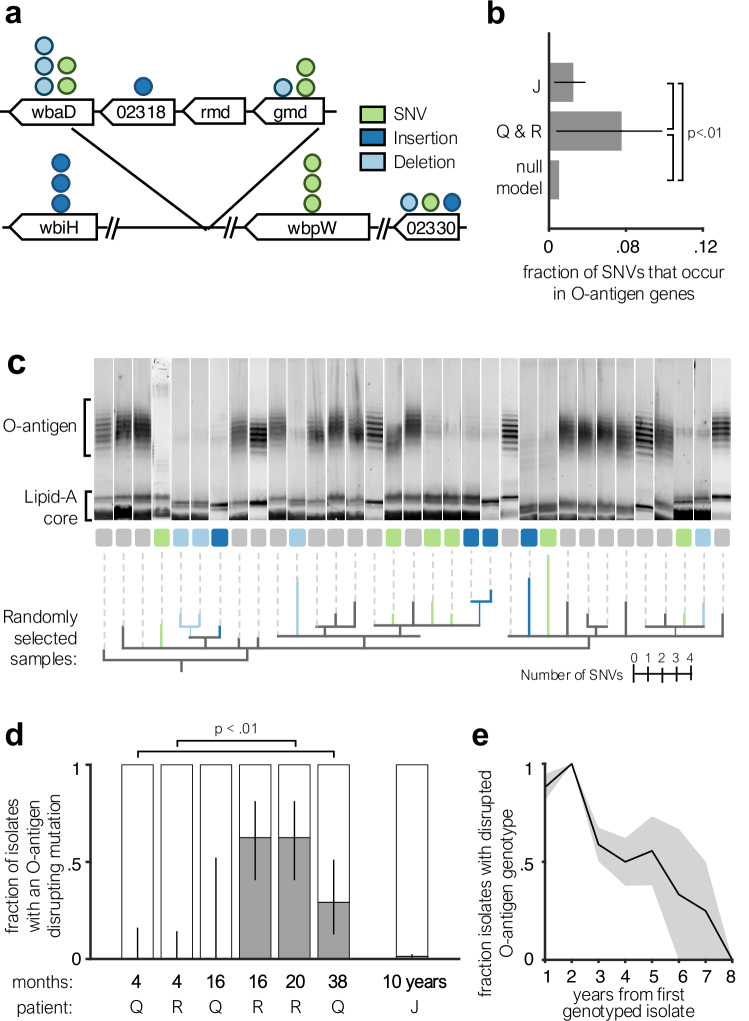
Bacteria evolving within human hosts encounter selective tradeoffs that render mutations adaptive in one context and deleterious in another. Here, we report that the cystic fibrosis-associated pathogen Burkholderia dolosa overcomes in-human selective tradeoffs by acquiring successive point mutations that alternate phenotypes. We sequenced the whole genomes of 931 respiratory isolates from two recently infected cystic fibrosis patients and an epidemiologically-linked, chronically-infected patient. These isolates are contextualized using 112 historical genomes from the same outbreak strain. Within both newly infected patients, convergent mutations that disrupt O-antigen expression quickly arose, comprising 29% and 63% of their B. dolosa communities by 3 years. The selection for loss of O-antigen starkly contrasts with our previous observation of parallel O-antigen-restoring mutations after many years of chronic infection in the historical outbreak. Experimental characterization reveals that O-antigen loss increases uptake in immune cells while decreasing competitiveness in the mouse lung. We propose that the balance of these pressures, and thus whether O-antigen expression is advantageous, depends on tissue localization and infection duration. These results suggest that mutation-driven phenotypic alternation may be underestimated without dense temporal sampling, particularly for microbes with prolonged infection or colonization.
在人类宿主内进化的细菌会面临选择性权衡,使得突变在一种情况下具有适应性,而在另一种情况下则具有有害性。在此,我们报告囊性纤维化相关病原体多氏伯克霍尔德菌通过获得交替改变表型的连续点突变,克服了在人体内的选择性权衡。我们对来自两名近期感染的囊性纤维化患者以及一名有流行病学关联的慢性感染患者的931份呼吸道分离株进行了全基因组测序。这些分离株使用来自同一暴发菌株的112个历史基因组进行背景分析。在两名新感染患者中,破坏O抗原表达的趋同突变迅速出现,到3年时分别占其多氏伯克霍尔德菌群的29%和63%。对O抗原缺失的选择与我们之前在历史暴发中对慢性感染多年后平行出现的O抗原恢复突变的观察形成鲜明对比。实验表征表明,O抗原缺失增加了在免疫细胞中的摄取,同时降低了在小鼠肺部的竞争力。我们提出,这些压力的平衡,以及因此O抗原表达是否有利,取决于组织定位和感染持续时间。这些结果表明,如果没有密集的时间采样,突变驱动的表型交替可能被低估,特别是对于具有长期感染或定植的微生物。