
早期纳米颗粒干预可在颈脊髓损伤后保留运动功能。
Early nanoparticle intervention preserves motor function following cervical spinal cord injury.
作者信息
Hocevar Sarah E, Ross Brian C, Wang Yinghao, Crowther Cecelia R, Schwartz Samantha R, Cummings Brain J, Anderson Aileen J, Shea Lonnie D
机构信息
Neuroscience Graduate Program University of Michigan Medical School Ann Arbor Michigan USA.
Department of Biomedical Engineering University of Michigan Ann Arbor Michigan USA.
出版信息
Bioeng Transl Med. 2025 Apr 29;10(4):e70011. doi: 10.1002/btm2.70011. eCollection 2025 Jul.
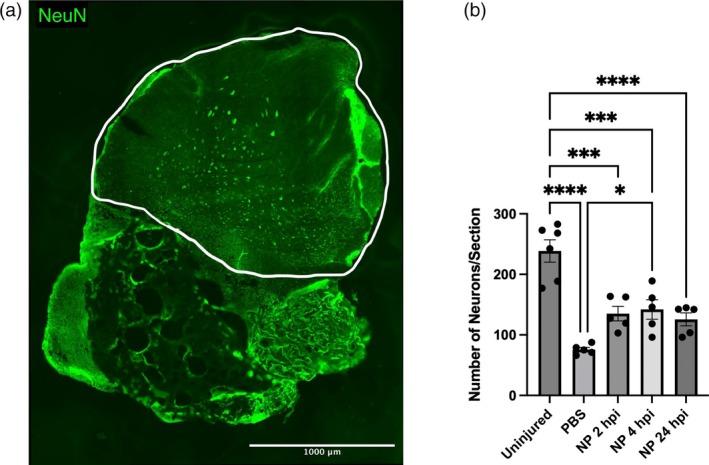
Spinal cord injury (SCI) triggers an immediate influx of immune cells that secrete pro-inflammatory cytokines and reactive oxygen species that cause tissue damage that is secondary to the initial physical trauma. We aim to reprogram these immune cells to promote a less inflammatory and more pro-regenerative environment. Herein, we investigated the window in time during which poly(lactide-co-glycolide) nanoparticles (NPs) administration can successfully modulate the immune response and promote functional sparing. The dynamics of immune cell infiltration and secondary tissue damage were studied following the injection of NPs intravenously every 24 h for 7 days following injury, with the first injection starting at 2, 4, or 24 hours post-injury (hpi). At 7 days post-injury (dpi), early NP intervention decreased the number of infiltrating macrophages and neutrophils, but delaying treatment until 24 hpi increased the number of neutrophils above control. All mice that received NPs had greater neuronal sparing contralateral to the injury, but mice that received NPs at early timepoints had greater neuromuscular junction innervation and motor endplate sparing. The increased sparing of neurons and neural circuits in the 2 hpi NP group corresponded with increased motor function, as measured by a ladder beam test. Collectively, these results suggest that early intervention with NPs can modulate the inflammatory response and preserve motor function and circuits following SCI.
脊髓损伤(SCI)会立即引发免疫细胞的涌入,这些免疫细胞会分泌促炎细胞因子和活性氧,从而导致继发于初始物理创伤的组织损伤。我们旨在对这些免疫细胞进行重编程,以促进炎症较轻且再生能力更强的环境。在此,我们研究了聚(丙交酯 - 乙交酯)纳米颗粒(NPs)给药能够成功调节免疫反应并促进功能保留的时间窗口。在损伤后每24小时静脉注射NPs,持续7天,首次注射在损伤后2、4或24小时(hpi)开始,之后研究免疫细胞浸润和继发性组织损伤的动态变化。在损伤后7天(dpi),早期NP干预减少了浸润的巨噬细胞和中性粒细胞数量,但将治疗延迟至24 hpi会使中性粒细胞数量高于对照组。所有接受NPs的小鼠在损伤对侧的神经元保留情况更好,但在早期时间点接受NPs的小鼠神经肌肉接头支配和运动终板保留情况更好。通过阶梯梁试验测量,2 hpi NP组中神经元和神经回路保留的增加与运动功能的改善相对应。总体而言,这些结果表明,NPs的早期干预可以调节SCI后的炎症反应,并保留运动功能和神经回路。



 Zotero 插件