Suzuki Tomoko, Iwata Sachiko, Hanai Chinami, Fukaya Satoko, Watanabe Yuka, Nakane Shigeharu, Okamura Hisayoshi, Saitoh Shinji, Iwata Osuke
Center for Human Development and Family Science, Department of Pediatrics and Neonatology, Nagoya City University Graduate School of Medical Sciences, Nagoya 467-8601, Japan.
Centre for Developmental and Cognitive Neuroscience, Kurume University School of Medicine, Kurume 830-0011, Japan.
Biosensors (Basel). 2025 Jul 1;15(7):420. doi: 10.3390/bios15070420.
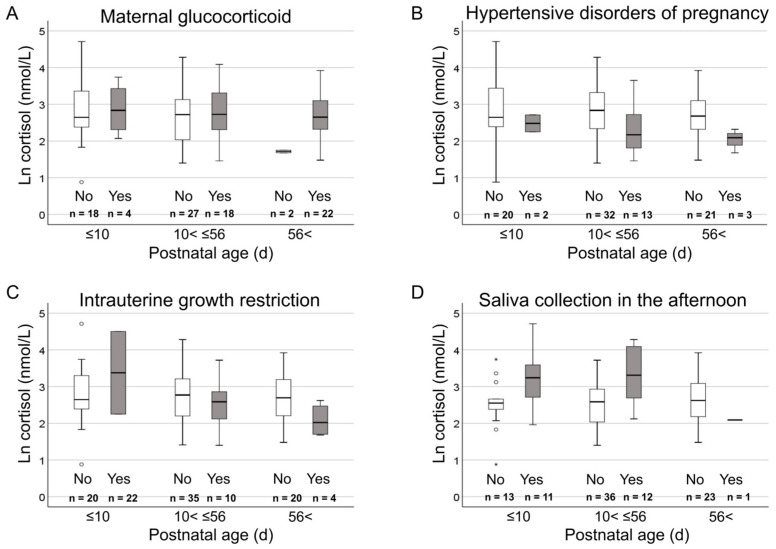
Salivary cortisol is widely used to assess stress and circadian rhythms, yet its control variables in neonates, particularly regarding postnatal age, remain poorly understood. To elucidate age-specific effects of clinical variables on cortisol levels, 91 neonates with a mean (standard deviation) gestational age of 34.2 (3.8) weeks and postnatal age of 38.3 (35.4) days were categorised into Early, Medium, and Late groups by quartiles (days 10 and 56). Interactions with postnatal age were evaluated by comparing Early-to-Medium or Early-to-Late differences in regression coefficients between independent variables and cortisol levels. In the whole cohort, maternal hypertensive disorders of pregnancy and morning sampling were associated with reduced cortisol levels (both = 0.001). Mean regression coefficients (95% CI) between variables and cortisol levels were as follows: for postconceptional age, Early, -0.102 (-0.215, 0.010) and Late, 0.065 (-0.203, 0.332) ( = 0.035); for feeding duration, Early, 0.796 (-0.134, 1.727) and Late, -0.702 (-2.778, 1.376) ( = 0.010); for time elapsed since feeding, Early, -0.748 (-1.275, -0.221) and Late, -0.071 (-1.230, 1.088) ( = 0.036); and for blood lactate, Early, 0.086 (0.048 to 0.124), Medium, 0.022 (-0.063, 0.108), and Late, -0.018 (-0.106, 0.070) ( = 0.008 and <0.001 vs. Medium and Late, respectively). The influence of postconceptional age, oral feeding, and anaerobic metabolism on salivary cortisol levels was observed during the birth transition period but not beyond 10 days of life. Given the age-specific dependence of cortisol levels on clinical variables, including postconceptional age, feeding, and oxygen metabolism, caution is warranted when interpreting findings from studies on salivary cortisol in newborn infants.
唾液皮质醇被广泛用于评估应激和昼夜节律,然而其在新生儿中的控制变量,尤其是关于出生后年龄的变量,仍知之甚少。为了阐明临床变量对皮质醇水平的年龄特异性影响,将91例平均(标准差)胎龄为34.2(3.8)周、出生后年龄为38.3(35.4)天的新生儿按四分位数(第10天和第56天)分为早期、中期和晚期组。通过比较自变量与皮质醇水平之间回归系数的早期至中期或早期至晚期差异来评估与出生后年龄的相互作用。在整个队列中,母亲妊娠期高血压疾病和早晨采样与皮质醇水平降低相关(均P = 0.001)。变量与皮质醇水平之间的平均回归系数(95%CI)如下:对于孕龄,早期为-0.102(-0.215,0.010),晚期为0.065(-0.203,0.332)(P = 0.035);对于喂养持续时间,早期为0.796(-0.134,1.727),晚期为-0.702(-2.778,1.376)(P = 0.010);对于进食后经过的时间,早期为-0.748(-1.275,-0.221),晚期为-0.071(-1.230,1.088)(P = 0.036);对于血乳酸,早期为0.086(0.048至0.124),中期为0.022(-0.063,0.108),晚期为-0.018(-0.106,0.070)(分别与中期和晚期相比,P = 0.008和<0.001)。在出生过渡期观察到孕龄、经口喂养和无氧代谢对唾液皮质醇水平的影响,但在出生后10天以后未观察到。鉴于皮质醇水平对包括孕龄、喂养和氧代谢在内的临床变量具有年龄特异性依赖性,在解释新生儿唾液皮质醇研究结果时应谨慎。