Umair Zobia, Nawaz Zahid, Hasnain Sumaiya, Fischle Wolfgang
Bioscience Program, Biological and Environmental Science and Engineering Division, King Abdullah University of Science and Technology (KAUST), Thuwal, 23955, Kingdom of Saudi Arabia.
Cell Mol Life Sci. 2025 Jul 25;82(1):286. doi: 10.1007/s00018-025-05825-3.
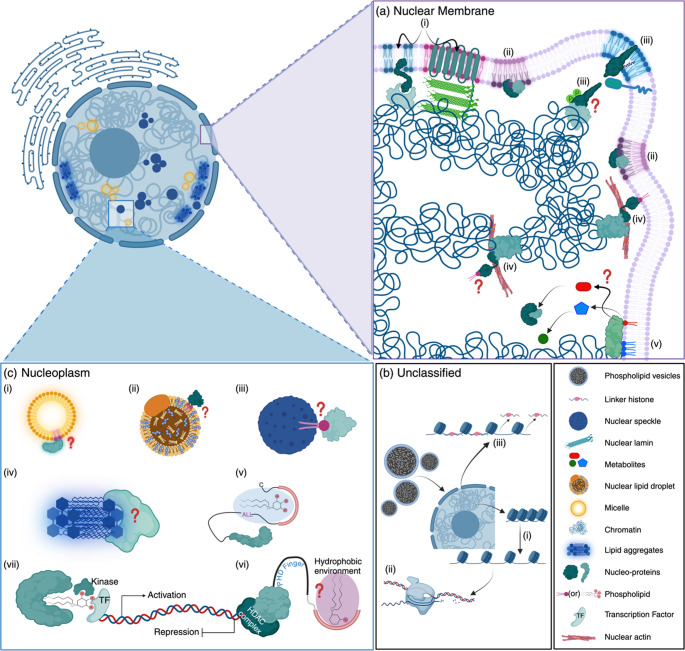
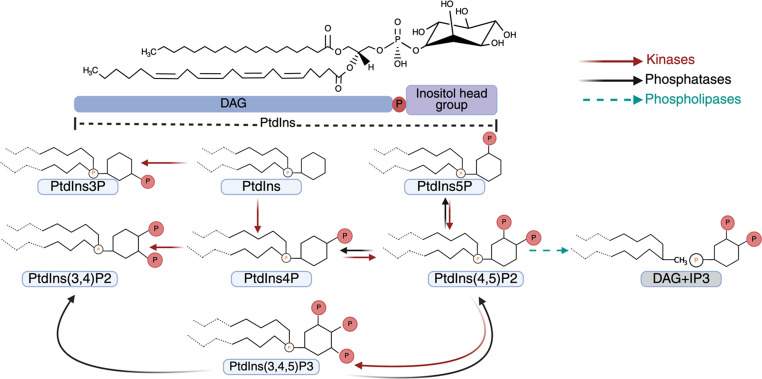
Phospholipids, widely known for their structural role in cellular membranes, are now also recognized to play pivotal roles in signal transduction, metabolism, and cellular homeostasis. However, the nucleus is often overlooked in the context of phospholipid biology. The dynamic abundance and precise management of the turnover of nuclear phospholipids by dedicated kinases, phosphatases, and phospholipases implies specialized functions. Like the cytoplasm, many of these biological roles occur or are initiated within the nuclear membrane. However, several aspects of nuclear phospholipid biology appear to be based in the nucleoplasm and are mediated by dynamic and soluble lipoprotein complexes. In many cases, the exact working spaces and molecular mechanisms of action of nuclear phospholipids are not yet clearly defined, and their physiology is likely underestimated due to technical challenges. Nonetheless, in recent years, the impact of nuclear phospholipids on the structure and function of the genome has been found to be more multifaceted and complex. In this review, we summarize recent insights into the interactions and biological roles of phospholipids with respect to chromatin, gene regulation, and nuclear physiology, and discuss these roles in the context of two broad functional domains - the nuclear membrane and the nucleoplasm. We argue that a more detailed understanding of the molecular working modes of nuclear phospholipids is crucial to enable their full scientific comprehension, especially when the exploration of the biology of nuclear phospholipids and their dysregulation may offer promising avenues for diagnosis and therapeutic interventions for various genome-linked diseases.
磷脂以其在细胞膜中的结构作用而广为人知,现在人们也认识到它在信号转导、新陈代谢和细胞内稳态中发挥着关键作用。然而,在磷脂生物学的背景下,细胞核常常被忽视。由特定的激酶、磷酸酶和磷脂酶对核磷脂周转进行动态丰度调控和精确管理意味着其具有特殊功能。与细胞质一样,这些生物学作用中的许多都发生在核膜内或由核膜启动。然而,核磷脂生物学的几个方面似乎基于核质,并由动态的可溶性脂蛋白复合物介导。在许多情况下,核磷脂的确切作用空间和分子作用机制尚未明确界定,由于技术挑战,它们的生理学意义可能被低估。尽管如此,近年来,人们发现核磷脂对基因组结构和功能的影响更加多面和复杂。在这篇综述中,我们总结了磷脂在染色质、基因调控和核生理学方面的相互作用及生物学作用的最新见解,并在两个广泛的功能域——核膜和核质的背景下讨论这些作用。我们认为,更详细地了解核磷脂的分子作用模式对于全面科学理解它们至关重要,尤其是当探索核磷脂生物学及其失调可能为各种与基因组相关疾病的诊断和治疗干预提供有前景的途径时。