Avargil Shirly, Saleh Abir, Kerem Nogah C
Faculty of Education in Science and Technology, Technion Israel Institute of Technology, Technion City, Haifa, 3200003, Israel.
Rappaport Faculty of Medicine, Technion Israel Institute of Technology, Haifa, 3109601, Israel.
BMC Med Educ. 2025 Jul 25;25(1):1111. doi: 10.1186/s12909-025-07611-y.
Professional identity formation (PIF) is a critical component of medical education, involving the transformation of medical students into skilled physicians. Despite its importance, there is limited research on the specific aspects of professional identity that develop during different stages of medical training.
This study aims to identify the aspects of professional identity formation during the years medical students rotate in different medical departments and to characterize the reflective expressions that support this development.
A descriptive case-study methodology was employed, involving five medical students participating in a course designed to foster PIF. Data were collected from reflective journals and semi-structured interviews over three years. Directed content analysis was used to identify categories and subcategories of professional identity and reflective expressions.
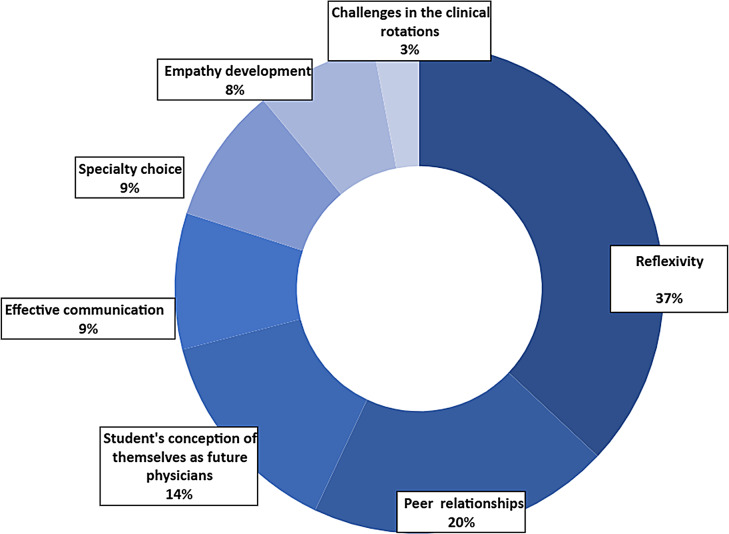
Seven main categories of professional identity were identified: Reflexivity, Peer relationships, Student's conception of themselves as future physicians, Effective communication, Specialty choice, Empathy development, and Challenges in the clinical rotations. Reflexivity emerged as the most prominent category, with subcategories including personal emotions, clinical experience, decision-making processes, cultural beliefs, and perceptions of medical hierarchy. Reflective writing evolved over time, showing an increased ability for interpretation and critical reflections.
This study contributes to the existing knowledge by highlighting specific aspects of professional identity formation (PIF) as observed through the reflective expressions of medical students during their clinical rotations. The medical education community could benefit from systematically cultivating aspects of professional identity at each stage of medical studies and throughout their careers.
职业身份形成(PIF)是医学教育的关键组成部分,涉及将医学生转变为熟练的医生。尽管其很重要,但关于医学培训不同阶段职业身份发展的具体方面的研究有限。
本研究旨在确定医学生在不同医学科室轮转期间职业身份形成的方面,并描述支持这种发展的反思性表达。
采用描述性案例研究方法,涉及五名医学生参加一门旨在促进职业身份形成的课程。在三年时间里从反思性日志和半结构化访谈中收集数据。使用定向内容分析法确定职业身份和反思性表达的类别及子类别。
确定了职业身份的七个主要类别:反思性、同伴关系、学生对自己作为未来医生的概念、有效沟通、专业选择、同理心发展以及临床轮转中的挑战。反思性成为最突出的类别,其子类别包括个人情感、临床经验、决策过程、文化信仰以及对医学等级制度的认知。反思性写作随时间演变,显示出解释和批判性反思能力的提高。
本研究通过突出医学生临床轮转期间反思性表达所观察到的职业身份形成(PIF)的具体方面,为现有知识做出了贡献。医学教育界可以从在医学学习的每个阶段以及整个职业生涯中系统地培养职业身份的各个方面中受益。