Brunecky Roman, Li Yudong, Decker Stephen R, Himmel Michael E
Biosciences Center, National Renewable Energy Laboratory, 15013 Denver West Parkway, Golden, CO, 80401, USA.
Catalytic Carbon Transformation and Scale-Up Center, National Renewable Energy Laboratory, 15013 Denver West Parkway, Golden, CO, 80401, USA.
Biotechnol Biofuels Bioprod. 2025 Jul 25;18(1):82. doi: 10.1186/s13068-025-02680-z.
A deployable, continuous enzymatic hydrolysis (CEH) process can address cost and commercialization risks associated with second-generation (Gen2) biorefinery sugar/lignin/ethanol production while contributing to energy supply and security. Developments in commercial enzymatic hydrolysis formulations targeting Gen2 pretreated biomass such as deacetylated mechanically refined (DMR) biomass necessitate a reassessment of the existing hybrid simultaneous saccharification and fermentation (SSF) approach. Notably, the practice of "finishing hydrolysis" in SSF has become problematic with the introduction of oxidative enzymes, such as lytic polysaccharide monooxygenases (LPMOs), into commercial cellulase formulations as these require specific redox conditions and cofactor. Moreover, continuous SSF has not been demonstrated at commercial scale, limiting deployment and the associated economic benefits to farmers, producers, and support industries.
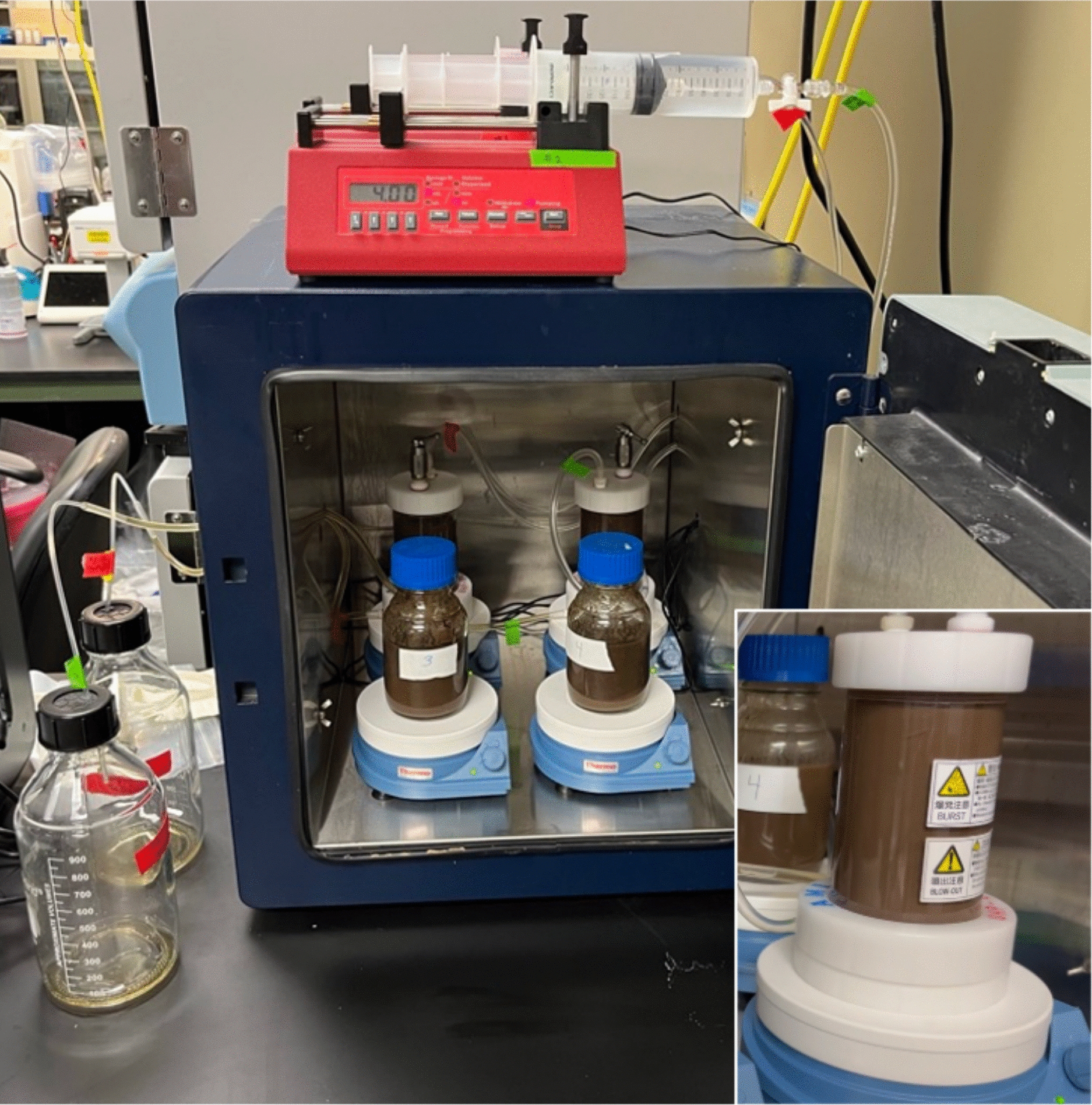
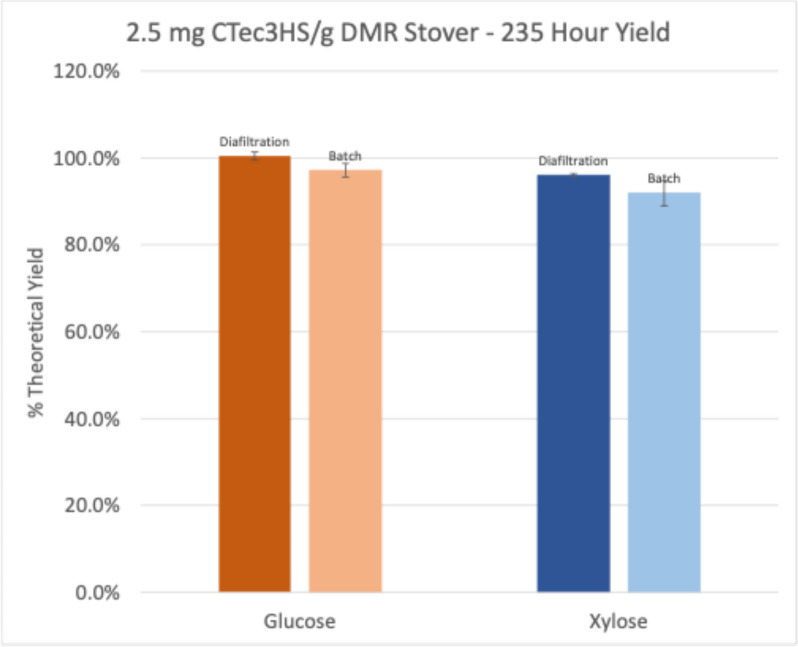
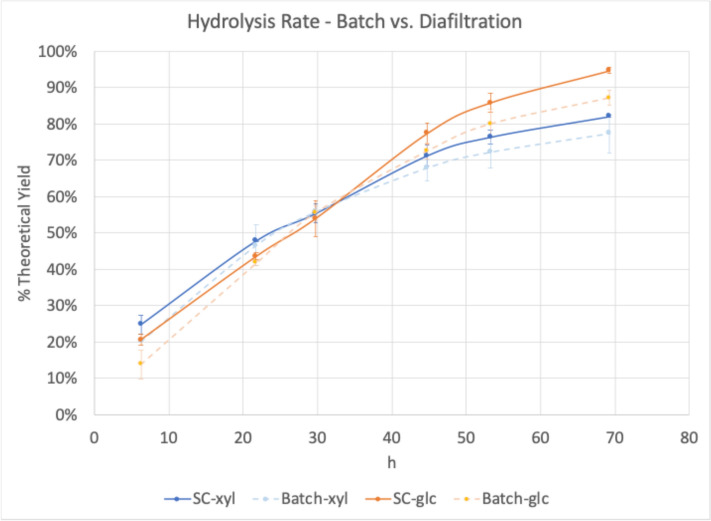
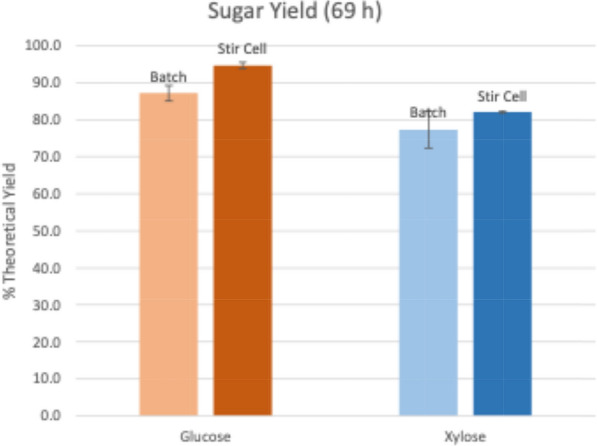
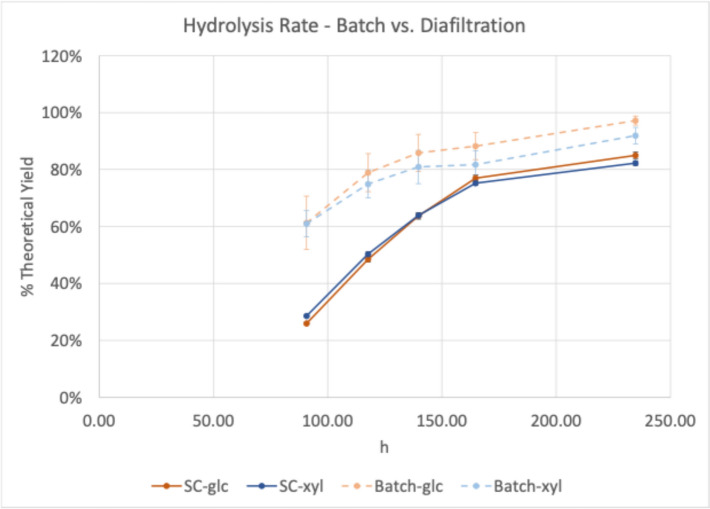
Continuous enzymatic hydrolysis (CEH) was demonstrated at bench scale to enable optimal saccharification performance of deacetylated mechanically refined (DMR) pretreated biomass. Diafiltration was demonstrated to retain pretreated biomass solids and enzymes for continuous reaction while removing solubilized product sugars in situ. A significant breakthrough afforded by the CEH process is its ability to achieve equivalent endpoint conversions with approximately 50% lower enzyme loading. Yields of glucose and xylose were increased ~ 15% and ~ 4%, respectively, over batch hydrolysis. Unlike SSF using yeast or Zymomonas, CEH allows precise optimization of pH, temperature, oxygen tension, LPMO mediator concentration, and removal of end-product inhibitors.
Advanced CEH holds promise as a transformational, process-intensified, and cost-effective method for producing soluble clarified biomass sugars and insoluble lignin-rich streams. Enhancing saccharification performance, optimizing operating parameters, and employing membrane filtration will help overcome existing challenges and enable the efficient production of valuable biomaterials from lignocellulosic biomass.
一种可部署的连续酶水解(CEH)工艺能够解决与第二代(Gen2)生物精炼厂糖/木质素/乙醇生产相关的成本和商业化风险,同时有助于能源供应和安全。针对Gen2预处理生物质(如脱乙酰机械精制(DMR)生物质)的商业酶水解配方的发展,需要重新评估现有的混合同步糖化发酵(SSF)方法。值得注意的是,随着氧化酶(如裂解多糖单加氧酶(LPMO))被引入商业纤维素酶配方中,SSF中的“完成水解”做法已成为问题,因为这些酶需要特定的氧化还原条件和辅因子。此外,则连续SSF尚未在商业规模上得到验证,这限制了其应用以及给农民、生产商和支持产业带来的相关经济效益。
在实验室规模上证明了连续酶水解(CEH)能够实现脱乙酰机械精制(DMR)预处理生物质的最佳糖化性能。证明了渗滤能够保留预处理生物质固体和酶以进行连续反应,同时原位去除溶解的产物糖。CEH工艺的一个重大突破是其能够在酶负载量降低约50%的情况下实现相同的终点转化率。与分批水解相比,葡萄糖和木糖的产量分别提高了约15%和约4%。与使用酵母或运动发酵单胞菌的SSF不同,CEH允许精确优化pH、温度、氧张力、LPMO介质浓度以及去除终产物抑制剂。
先进的CEH有望成为一种变革性的、过程强化的且具有成本效益的方法,用于生产可溶性澄清生物质糖和不溶性富含木质素的物流。提高糖化性能、优化操作参数以及采用膜过滤将有助于克服现有挑战,并能够从木质纤维素生物质中高效生产有价值的生物材料。