Gao Zitong, Nasu Masaki, Devendra Gehan, Abdul-Ghani Ayman A, Herrera Anthony J, Borgia Jeffrey A, Seder Christopher W, Kuehu Donna Lee, Feng Zhuokun, Chen Yu, Gong Ting, Zhang Zao, Chan Owen, Yang Hua, Yu Jianhua, Fu Yuanyuan, Wu Lang, Deng Youping
Department of Quantitative Health Sciences, John A. Burns School of Medicine, University of Hawaii at Manoa, Honolulu, Hawai'i, USA.
Molecular Biosciences and Bioengineering Program, College of Tropical Agriculture and Human Resources, University of Hawaii at Manoa, Honolulu, Hawai'i, USA.
Clin Transl Med. 2025 Aug;15(8):e70418. doi: 10.1002/ctm2.70418.
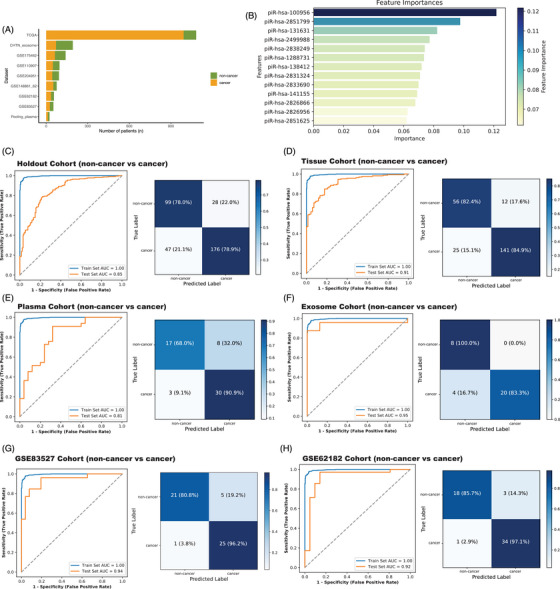
Nonsmall cell lung cancer (NSCLC) is a lethal cancer and lacks robust biomarkers for noninvasive clinical diagnosis. Detecting NSCLC at the early stage can decrease the mortality rate and minimise harm caused by various treatments. We curated 2050 samples from public tissue and plasma datasets including both invasive and noninvasive types, then supplemented with in-house pooled plasma and exosome samples. Eleven independent transcriptome datasets were utilised to develop a new machine learning model by integrating PIWI-interacting RNA (piRNA) to predict NSCLC. Five piRNA signatures derived from ribosomal subunits identified to be tumour-specific exhibited robust diagnostic ability and were combined into a piRNA-Based Tumour Probability Index (pi-TPI) risk evaluation model. pi-TPI effectively distinguished NSCLC patients from healthy individuals and showed efficacy in identifying early-stage cancers with Area under the ROC Curve (AUC) values over .80. Plasma cohorts exhibited the diagnosis efficacy of pi-TPI with an AUC value of .85. Experimental exosomal data enhances the accuracy of diagnosing noncancerous, benign, and cancer cases. The pi-TPI marker in the noncancer/cancer subgroup exhibited superior predictive performance with an AUC value of .96. These findings underscore the significant clinical potential of the five piRNA signatures as a powerful diagnostic tool for NSCLC, particularly of noninvasive cancer diagnostics.
非小细胞肺癌(NSCLC)是一种致命性癌症,缺乏用于非侵入性临床诊断的可靠生物标志物。早期检测NSCLC可降低死亡率,并将各种治疗造成的伤害降至最低。我们从包括侵入性和非侵入性类型的公共组织和血浆数据集中筛选了2050个样本,然后补充了内部混合血浆和外泌体样本。利用11个独立的转录组数据集,通过整合PIWI相互作用RNA(piRNA)开发了一种新的机器学习模型来预测NSCLC。从核糖体亚基中鉴定出的五个肿瘤特异性piRNA特征表现出强大的诊断能力,并被整合到基于piRNA的肿瘤概率指数(pi-TPI)风险评估模型中。pi-TPI能有效区分NSCLC患者和健康个体,在识别早期癌症方面显示出有效性,其受试者工作特征曲线下面积(AUC)值超过0.80。血浆队列显示pi-TPI的诊断效能,AUC值为0.85。实验性外泌体数据提高了诊断非癌、良性和癌症病例的准确性。非癌/癌亚组中的pi-TPI标志物表现出卓越的预测性能,AUC值为0.96。这些发现强调了这五个piRNA特征作为NSCLC强大诊断工具,特别是非侵入性癌症诊断工具的巨大临床潜力。