Koltcheva Nadia, Popivanov Ivo D
Department of Cognitive Science and Psychology, New Bulgarian University, 1618 Sofia, Bulgaria.
Clinic of Neurology, University Hospital "Alexandrovska", 1431 Sofia, Bulgaria.
Children (Basel). 2025 Jun 21;12(7):816. doi: 10.3390/children12070816.
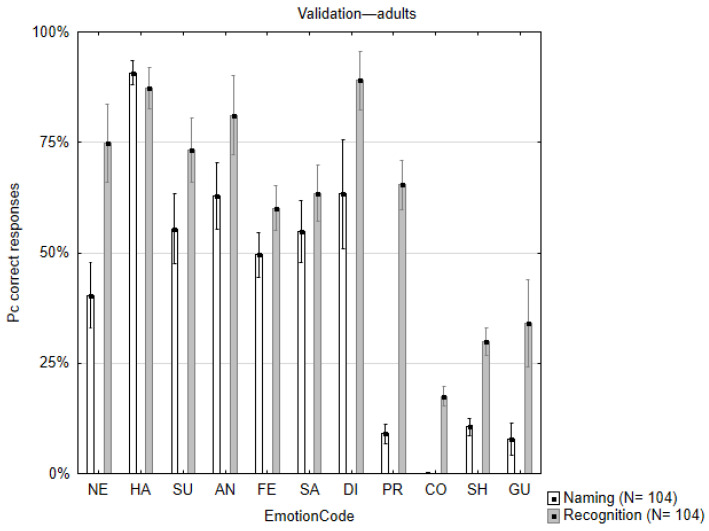
. Emotions are a crucial part of our human nature. The recognition of emotions is an essential component of our social and emotional skills. Facial expressions serve as a key element in discerning others' emotions. Different databases of images of facial emotion expressions exist worldwide; however, most of them are limited to only adult faces and include only the six basic emotions, as well as neutral faces, ignoring more complex emotional expressions. Here, we present the Children's Emotions Database (CED), a novel repository featuring both basic and complex facial expressions captured from preschool-aged children. The CED is one of the first databases to include complex emotional expressions in preschoolers. Our aim was to develop such a database that can be used further for research and applied purposes. Three 6-year-old children (one female) were photographed while showing different facial emotional expressions. The photos were taken under standardized conditions. The children were instructed to express each of the following basic emotions: happiness, pleasant surprise, sadness, fear, anger, disgust; a neutral face; and four complex emotions: pride, guilt, compassion, and shame; this resulted in a total of eleven expressions for each child. Two photos per child were reviewed and selected for validation. The photo validation was performed with a sample of 104 adult raters (94 females; aged 19-70 years; M = 29.9; SD = 11.40) and a limited sample of 32 children at preschool age (17 girls; aged 4-7 years; M = 6.5; SD = 0.81). The validation consisted of two tasks-free emotion labeling and emotion recognition (with predefined labels). Recognition accuracy for each expression was calculated. While basic emotions and neutral expressions were recognized with high accuracy, complex emotions were less accurately identified, consistent with the existing literature on the developmental challenges in recognizing such emotions. The current work is a promising new database of preschoolers' facial expressions consisting of both basic and complex emotions. This database offers a valuable resource for advancing research in emotional development, educational interventions, and clinical applications tailored to early childhood.
情感是我们人性的重要组成部分。情感认知是我们社交和情感技能的重要组成部分。面部表情是辨别他人情感的关键要素。全球存在不同的面部情感表情图像数据库;然而,它们中的大多数仅限于成人面部,仅包括六种基本情感以及中性表情,忽略了更复杂的情感表达。在此,我们展示儿童情感数据库(CED),这是一个新颖的库,其特点是包含从学龄前儿童捕捉到的基本和复杂面部表情。CED是首批包含学龄前儿童复杂情感表达的数据库之一。我们的目标是开发这样一个可进一步用于研究和应用目的的数据库。三名6岁儿童(一名女性)在展示不同面部情感表情时被拍照。照片是在标准化条件下拍摄的。孩子们被要求表达以下每种基本情感:快乐、惊喜、悲伤、恐惧、愤怒、厌恶;一张中性脸;以及四种复杂情感:自豪、内疚、同情和羞耻;这使得每个孩子总共产生了十一种表情。每个孩子的两张照片经过审查并挑选用于验证。照片验证由104名成年评分者(94名女性;年龄在19至70岁之间;M = 29.9;SD = 11.40)和32名学龄前儿童的有限样本(17名女孩;年龄在4至7岁之间;M = 6.5;SD = 0.81)进行。验证包括两项任务——自由情感标签和情感识别(带有预定义标签)。计算每种表情的识别准确率。虽然基本情感和中性表情的识别准确率很高,但复杂情感的识别准确率较低,这与关于识别此类情感的发展挑战的现有文献一致。当前的工作是一个有前景的新的学龄前儿童面部表情数据库,包含基本和复杂情感。该数据库为推进情感发展研究、教育干预以及针对幼儿的临床应用提供了宝贵资源。