Cao Yang, Wang Wenbin
Department of Sociology, Jilin University, Changchun 130012, China.
Behav Sci (Basel). 2025 Jun 28;15(7):885. doi: 10.3390/bs15070885.
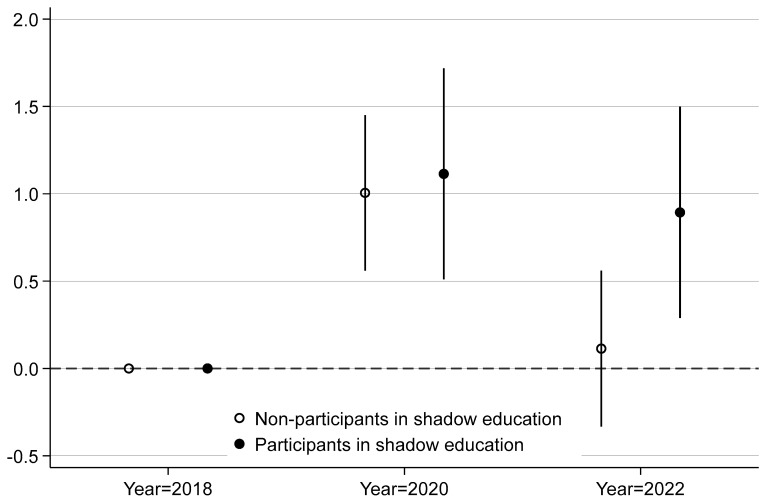
Shadow education refers to supplementary educational activities outside of the formal school system, typically provided by private institutions to enhance students' academic performance. This phenomenon has become increasingly prominent worldwide, drawing significant attention from both scholars and the public. While shadow education is often associated with improved academic outcomes, its potential mental health implications for adolescents remain underexplored. Based on four large-scale surveys conducted in China from 2016 to 2022, this study examines the association between the duration of shadow education and adolescent depressive symptoms, with particular attention being paid to differences across family backgrounds and policy environments. Utilizing multilevel regression models that incorporate individual, family, and community factors, as well as inverse probability weighting regression adjustment and sensitivity analyses, this study yields three main findings. First, the relationship between shadow education duration and adolescent depressive symptoms demonstrates a U-shaped pattern: moderate engagement is associated with lower depressive symptoms, while both limited and excessive participation are linked to higher symptom levels. Second, adolescents from higher-income families are more likely to maintain shadow education participation within an optimal range and report fewer depressive symptoms. Third, following the implementation of regulatory policies on shadow education in China after 2021, the duration of shadow education among adolescents has generally shifted toward a more balanced level, accompanied by a decrease in depressive symptoms. These results underscore the need to consider the nonlinear mental health effects of shadow education in both research and policymaking. In particular, contextual factors, such as socioeconomic background and policy interventions, should be taken into account when formulating and regulating supplementary educational activities. By addressing these dimensions, policymakers can better balance the academic benefits of shadow education with its potential risks for adolescent mental health.
影子教育是指正规学校系统之外的补充性教育活动,通常由私立机构提供,以提高学生的学业成绩。这一现象在全球范围内日益突出,引起了学者和公众的广泛关注。虽然影子教育通常与学业成绩的提高有关,但其对青少年心理健康的潜在影响仍未得到充分探索。基于2016年至2022年在中国进行的四项大规模调查,本研究考察了影子教育时长与青少年抑郁症状之间的关联,特别关注了家庭背景和政策环境的差异。本研究利用纳入个人、家庭和社区因素的多层次回归模型,以及逆概率加权回归调整和敏感性分析,得出了三个主要发现。第一,影子教育时长与青少年抑郁症状之间的关系呈现出U形模式:适度参与与较低的抑郁症状相关,而参与有限和过度参与都与较高的症状水平相关。第二,来自高收入家庭的青少年更有可能将影子教育参与维持在最佳范围内,并报告较少的抑郁症状。第三,2021年后中国实施影子教育监管政策后,青少年的影子教育时长总体上趋于更加平衡的水平,同时抑郁症状有所减少。这些结果强调了在研究和政策制定中需要考虑影子教育对心理健康的非线性影响。特别是,在制定和规范补充性教育活动时,应考虑社会经济背景和政策干预等背景因素。通过解决这些问题,政策制定者可以更好地平衡影子教育的学业益处与其对青少年心理健康的潜在风险。