Nadda Anuradha, Kapoor Neha, Sharma Sahil, Sharma Nikita, Viswanathan Viyusha T, Soni Anamika, Attri Ritu, Kaur Taranjot, Gupta Nishu, Govil Nikhil, Goel Kapil, Gupta Rahul
Department of Community Medicine, Dr. B. R. Ambedkar State Institute of Medical Sciences, Mohali, Punjab, India.
Department of Community and Family Medicine, AIIMS, Bilaspur, Himachal Pradesh, India.
J Family Med Prim Care. 2025 Jun;14(6):2307-2312. doi: 10.4103/jfmpc.jfmpc_1714_24. Epub 2025 Jun 6.
Breakthrough infections (BTI) threaten the progress of the COVID-19 vaccination program towards pandemic control. To better understand the future vaccine, knowing the BTI in the general population over a while is important.
The study aimed to compare the BTI among the general population after 1 year of completion of the primary series of Covishield and Covaxin.
This hospital-based prospective study was conducted among the general population beneficiaries of a COVID-19 vaccination center. Clients aged 18 years or above who had completed second vaccine dose were enrolled using systematic random sampling and followed up for 1 year. Using a semi-structured questionnaire, participants were telephonically interviewed within 1 month, 6 months, and 12 months of the second vaccine dose.
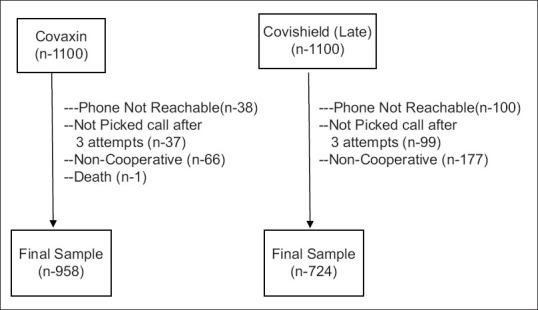
Out of 1682 participants who completed the study, 958 (57.0%) and 724 (43.0%) participants received Covaxin and Covishield, respectively. Twenty-nine (3.0%) Covaxin recipients and 25 (3.5%) Covishield recipients reported BTI after 1 year of follow-up with no statistically significant difference among both groups (-0.624). The binary logistic regression model showed that participants with either diabetes or hypertension had 1.22 times the risk of BTI compared to those without comorbidities (aOR: 1.219, CI: 0.072-20.716, -0.891). BTI was not significantly associated with the type of vaccine, sex, employment status, and age category of the participants.
The study suggests that regardless of the type of vaccine received, the population will be at the same risk and require similar future containment strategies.
突破性感染(BTI)威胁着新冠疫苗接种计划在控制疫情方面的进展。为了更好地了解未来的疫苗,了解一段时间内普通人群中的突破性感染情况很重要。
本研究旨在比较接种Covishield和Covaxin首剂系列疫苗1年后普通人群中的突破性感染情况。
这项基于医院的前瞻性研究在一个新冠疫苗接种中心的普通人群受益者中进行。采用系统随机抽样方法,纳入18岁及以上已完成第二剂疫苗接种的受种者,并随访1年。使用半结构化问卷,在第二剂疫苗接种后的1个月、6个月和12个月对参与者进行电话访谈。
在完成研究的1682名参与者中,分别有958名(57.0%)和724名(43.0%)参与者接种了Covaxin和Covishield。随访1年后,29名(3.0%)接种Covaxin的受种者和25名(3.5%)接种Covishield的受种者报告发生了突破性感染,两组之间无统计学显著差异(-0.624)。二元逻辑回归模型显示,患有糖尿病或高血压的参与者发生突破性感染的风险是无合并症者的1.22倍(调整后比值比:1.219;可信区间:0.072 - 20.716;-0.891)。突破性感染与疫苗类型、性别、就业状况和参与者年龄类别均无显著关联。
该研究表明,无论接种何种疫苗,人群面临的风险相同,未来需要采取类似的防控策略。