Ristić Mioljub, Ilić Svetlana, Rajčević Smiljana, Štrbac Mirjana, Medić Snežana, Pustahija Tatjana, Vuković Vladimir, Koprivica Marko, Dragovac Gorana, Petrović Vladimir
Institute of Public Health of Vojvodina, 21000 Novi Sad, Serbia.
Department of Epidemiology, Faculty of Medicine, University of Novi Sad, 21000 Novi Sad, Serbia.
Vaccines (Basel). 2025 Jun 30;13(7):711. doi: 10.3390/vaccines13070711.
Despite ongoing global elimination efforts, measles remains a persistent public health threat.
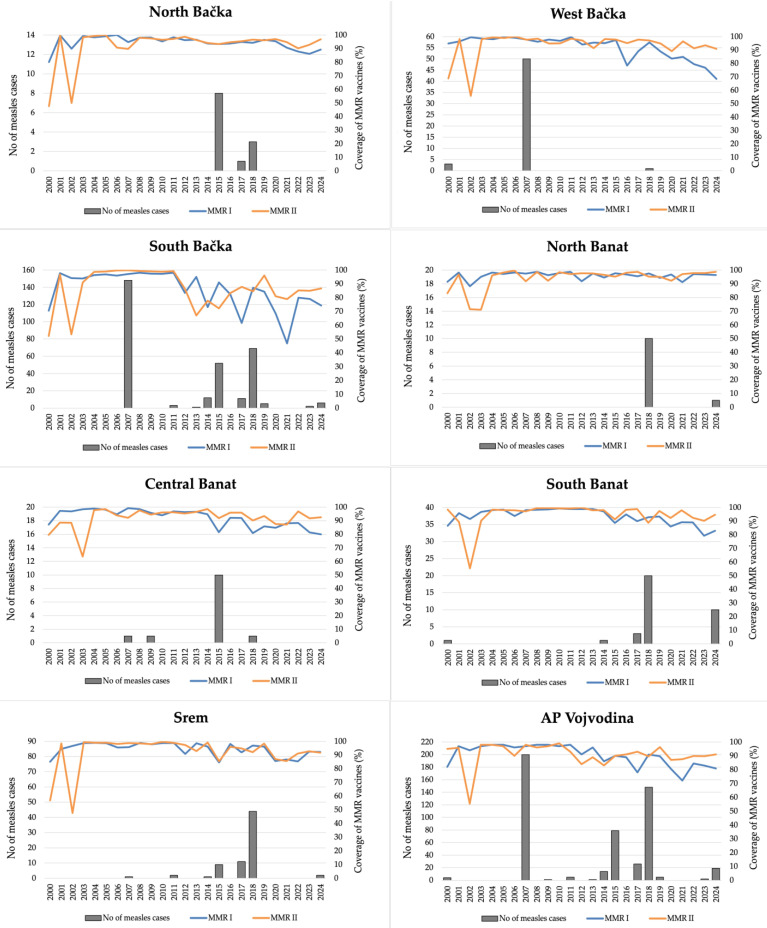
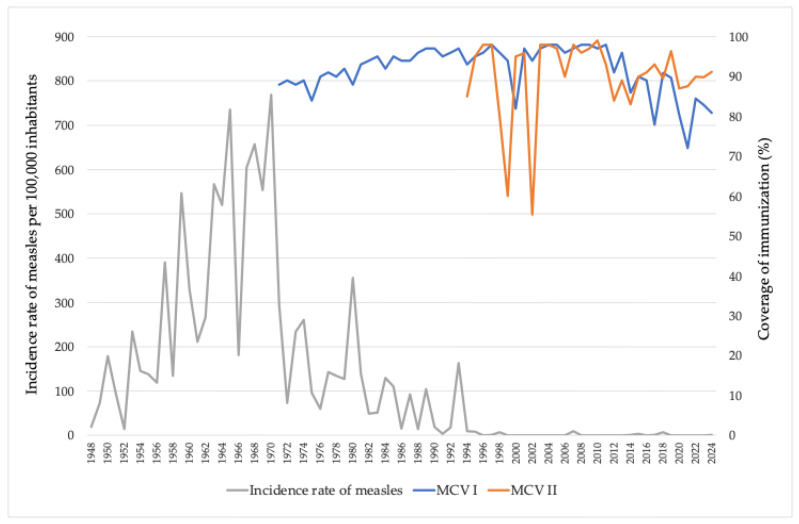
This retrospective observational study examines trends in crude measles incidence and vaccination coverage from 1948 to 2024 in the northern region of Serbia-Autonomous Province of Vojvodina (AP Vojvodina)-which accounts for 26.9% of the national population. This study further explores measles vaccination coverage across the province's seven districts, along with the number of reported measles cases, age distribution, and vaccination status of affected individuals from 2000 to 2024. Data were obtained from official annual immunization records maintained by public health institutions within the framework of Serbia's national mandatory immunization program.
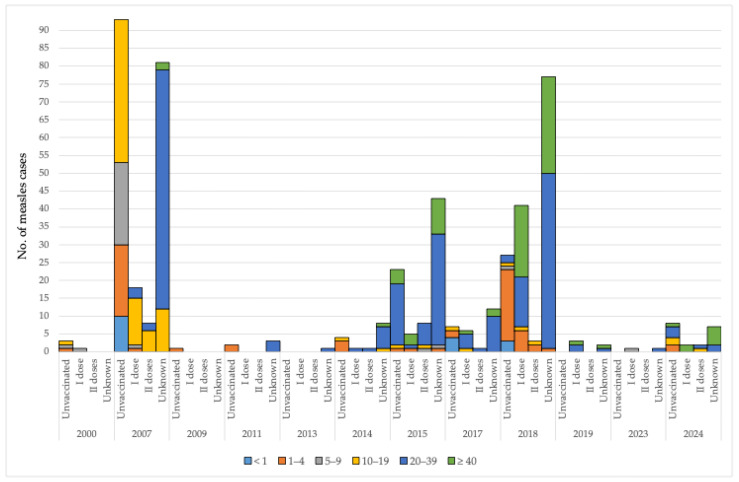
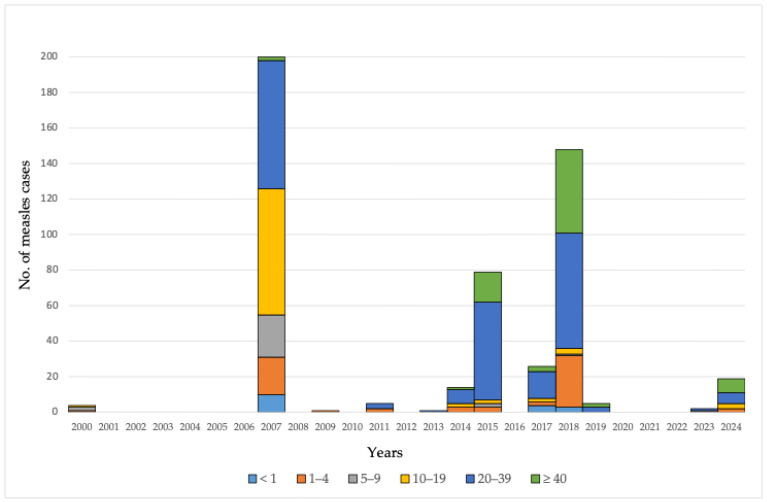
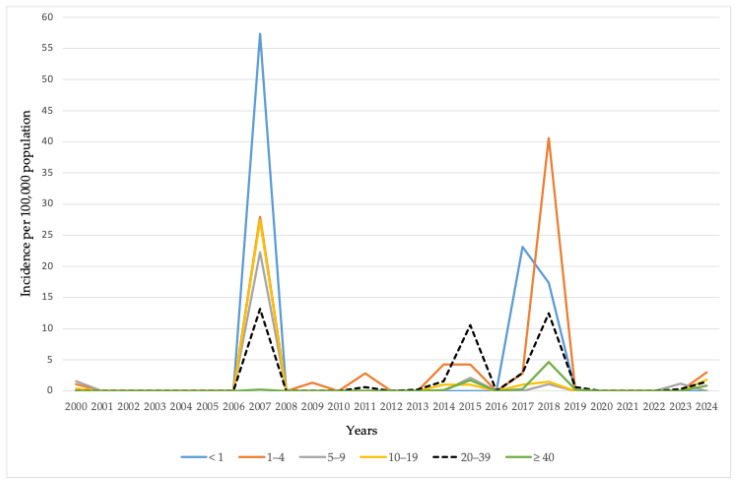
A notable resurgence of measles occurred in Serbia during 2017-2018, following a decline in vaccination coverage. In AP Vojvodina, outbreaks were recorded in 2007, 2014-2015, and 2017-2018, predominantly affecting unvaccinated children and adults aged 20-39 years. Since 2019, the measles incidence has significantly declined. During the 2018 outbreak, the highest incidence was observed among children aged 1-4 years (40.6 per 100,000), followed by infants under 1 year (17.3 per 100,000) and adults aged 20-39 years (12.5 per 100,000). An analysis of the data from 2000 to 2024 revealed substantial age- and dose-related differences in measles incidence, particularly among unvaccinated individuals, those who had received one or two doses of a measles-containing vaccine (MCV), and those with unknown vaccination status. During the 2017-2018 epidemic, unvaccinated children under 1 year and those aged 1-4 years were the most affected. A marked increase in cases among single-dose recipients was noted in 2018, especially in adults aged 20-39 years (9.5%) and those ≥40 years (13.5%). A considerable proportion of measles cases in these age groups had unknown vaccination status: 33.1% among individuals aged 20-39 years and 18.2% among those aged ≥ 40 years. Epidemiological investigation linked the 2007 and 2014-2015 outbreaks in AP Vojvodina to importations from Bosnia and Herzegovina. No specific source was identified for the 2017-2018 outbreak, suggesting possible endemic transmission.
These findings underscore the impact of fluctuating vaccination coverage on measles resurgence. Sustaining high two-dose MCV coverage, strengthening routine immunization programs, enhancing surveillance systems, and ensuring timely outbreak preparedness are critical measures for achieving effective measles control.
尽管全球一直在努力消除麻疹,但麻疹仍然是持续存在的公共卫生威胁。
这项回顾性观察性研究调查了1948年至2024年塞尔维亚北部伏伊伏丁那自治省(伏伊伏丁那省)的麻疹粗发病率和疫苗接种覆盖率趋势,该省人口占全国人口的26.9%。本研究进一步探讨了2000年至2024年该省七个区的麻疹疫苗接种覆盖率,以及报告的麻疹病例数、年龄分布和受影响个体的疫苗接种状况。数据来自塞尔维亚国家强制免疫计划框架内公共卫生机构保存的官方年度免疫记录。
在疫苗接种覆盖率下降之后,2017 - 2018年塞尔维亚麻疹显著复发。在伏伊伏丁那省,2007年、2014 - 2015年和2017 - 2018年记录到麻疹暴发,主要影响未接种疫苗的儿童和20 - 39岁的成年人。自2019年以来,麻疹发病率显著下降。在2018年的暴发中,1 - 4岁儿童的发病率最高(每10万人中40.6例),其次是1岁以下婴儿(每10万人中17.3例)和20 - 39岁成年人(每10万人中12.5例)。对2000年至2024年数据的分析显示,麻疹发病率在年龄和剂量方面存在显著差异,特别是在未接种疫苗的个体、接种过一剂或两剂含麻疹疫苗(MCV)的个体以及疫苗接种状况未知的个体中。在2017 - 2018年疫情期间,1岁以下未接种疫苗的儿童和1 - 4岁儿童受影响最大。2018年单剂接种者中的病例显著增加,特别是20 - 39岁成年人(9.5%)和40岁及以上成年人(13.5%)。这些年龄组中相当一部分麻疹病例的疫苗接种状况未知:20 - 39岁个体中为33.1%,40岁及以上个体中为18.2%。流行病学调查将伏伊伏丁那省2007年和2014 - 2015年的麻疹暴发与从波斯尼亚和黑塞哥维那输入病例联系起来。未确定2017 - 2018年暴发的具体来源,表明可能存在本地传播。
这些发现强调了疫苗接种覆盖率波动对麻疹复发的影响。维持高两剂MCV覆盖率、加强常规免疫计划、加强监测系统以及确保及时做好疫情应对准备是实现有效麻疹控制的关键措施。