Guadano-Procesi Isabel, Bosco Antonio, Ciuca Lavinia, Pepe Paola, Sangiovanni Camilla, Di Cave David, Rinaldi Laura, Berrilli Federica
Department of Clinical Sciences and Translational Medicine, Tor Vergata University of Rome, 00133 Rome, Italy.
Department of Veterinary Medicine and Animal Production, University of Napoli Federico II, 80137 Napoli, Italy.
Food Waterborne Parasitol. 2025 Jun 20;40:e00273. doi: 10.1016/j.fawpar.2025.e00273. eCollection 2025 Sep.
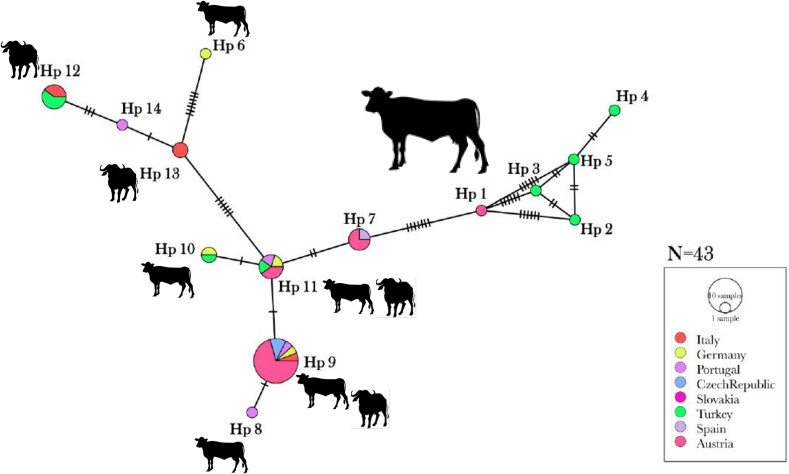
Microsporidia are an important group of emerging opportunistic parasites in human and non-human animals, with possible zoonotic potential; however, no data are currently available on their presence in commonly farmed species in Italy, particularly regarding in water buffalo (). This preliminary study investigated the prevalence and genetic variability of in water buffalo calves in southern Italy. Additionally, given its spread among other members of the Bovidae family, a haplotype-level network analysis was performed using sequences available in GenBank from two of the most commonly farmed Bovidae species in Europe: cattle () and water buffalo (). The survey was conducted on four farms between September and December 2023 for a total of 37 buffaloes sampled. DNA extracted from collected faeces was subjected to molecular analysis amplifying ITS region. For the molecular characterization, a phylogenetic analysis was performed by Maximum Likelihood method. For the comparison between our sequences and those available from water buffaloes and cattle from Europe, a haplotype analysis was conducted to obtain a network calculation. Five samples from Italian tested positive for with an overall prevalence value of 13.5 %. Phylogenetic analysis assigned isolates to three genotypes (YNDCEB-90; A; I) which were shared among different hosts, including humans and clustering in the phylogenetic Group 1 and Group 2. The network analysis identified Hp9 as the most frequently detected haplotype, distributed across multiple countries, including Italy. The second most common haplotype, Hp12, was exclusively found in Italy and Turkey from . The differences in haplotype patterns observed between and could shed light on the species-specific interactions of . The prevalence observed, along with the detection of zoonotic genotypes in water buffaloes, could pose a potential public health concern. The associated risk extends beyond the direct contact with infected animals or their faeces, encompassing possible contamination of the food chain and the environment, including ground and surface water sources.
微孢子虫是人和非人类动物中一类重要的新兴机会性寄生虫,具有潜在的人畜共患病风险;然而,目前尚无关于其在意大利常见养殖物种中存在情况的数据,特别是关于水牛()的情况。这项初步研究调查了意大利南部水牛犊中微孢子虫的流行率和遗传变异性。此外,鉴于其在牛科其他成员中的传播情况,利用来自欧洲两种最常见养殖牛科物种(牛()和水牛())的GenBank中可用的序列进行了单倍型水平的网络分析。该调查于2023年9月至12月在四个农场进行,共采集了37头水牛的样本。从收集的粪便中提取的DNA进行分子分析,扩增ITS区域。为了进行分子特征分析,采用最大似然法进行系统发育分析。为了比较我们的序列与欧洲水牛和牛的可用序列,进行了单倍型分析以获得网络计算结果。来自意大利微孢子虫的五个样本检测呈阳性,总体流行率为13.5%。系统发育分析将分离株分为三种基因型(YNDCEB - 90;A;I),这些基因型在包括人类在内的不同宿主中共享,并聚类在系统发育组1和组2中。网络分析确定Hp9是最常检测到的单倍型,分布在包括意大利在内的多个国家。第二常见的单倍型Hp12仅在来自意大利和土耳其的微孢子虫中发现。微孢子虫和牛之间观察到的单倍型模式差异可能有助于揭示微孢子虫的物种特异性相互作用。观察到的流行率以及水牛中检测到的人畜共患病基因型可能构成潜在的公共卫生问题。相关风险不仅限于与受感染动物或其粪便的直接接触,还包括食物链和环境(包括地下水和地表水水源)可能受到的污染。