Cao Fengming, Sørensen Søren S, Christensen Anders K R, Mollick Samraj, Ge Xuan, Sun Daming, Nielsen Anders B, Nielsen Niels Chr, Lock Nina, Lu Ronghui, Klemmt Rebekka, Kristensen Peter K, Jensen Lars R, Dallari Francesco, Baglioni Jacopo, Monaco Giulio, Karlsen Martin A, Baran Volodymyr, Smedskjaer Morten M
Department of Chemistry and Bioscience, Aalborg University, Aalborg, Denmark.
Department of Chemistry, Aarhus University, Aarhus, Denmark.
Nat Commun. 2025 Jul 30;16(1):7001. doi: 10.1038/s41467-025-62143-9.
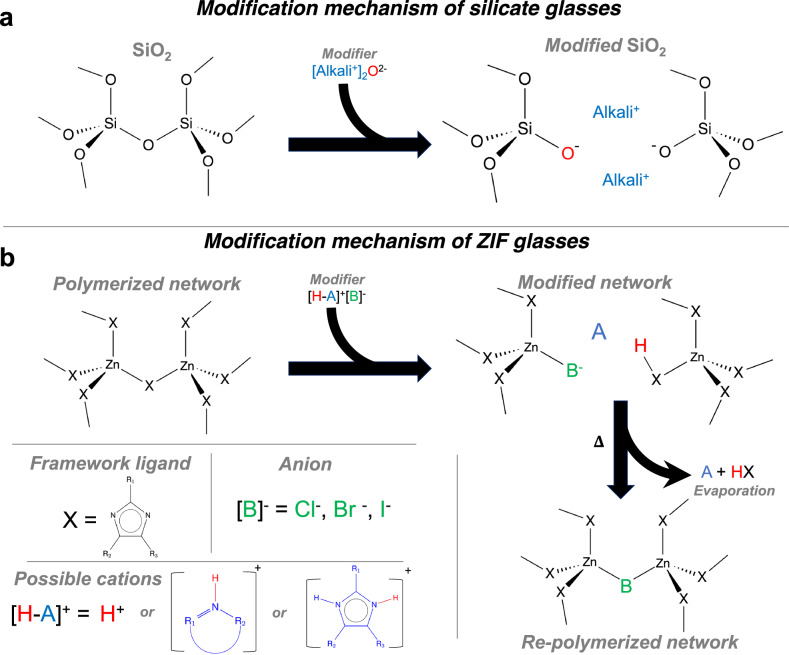
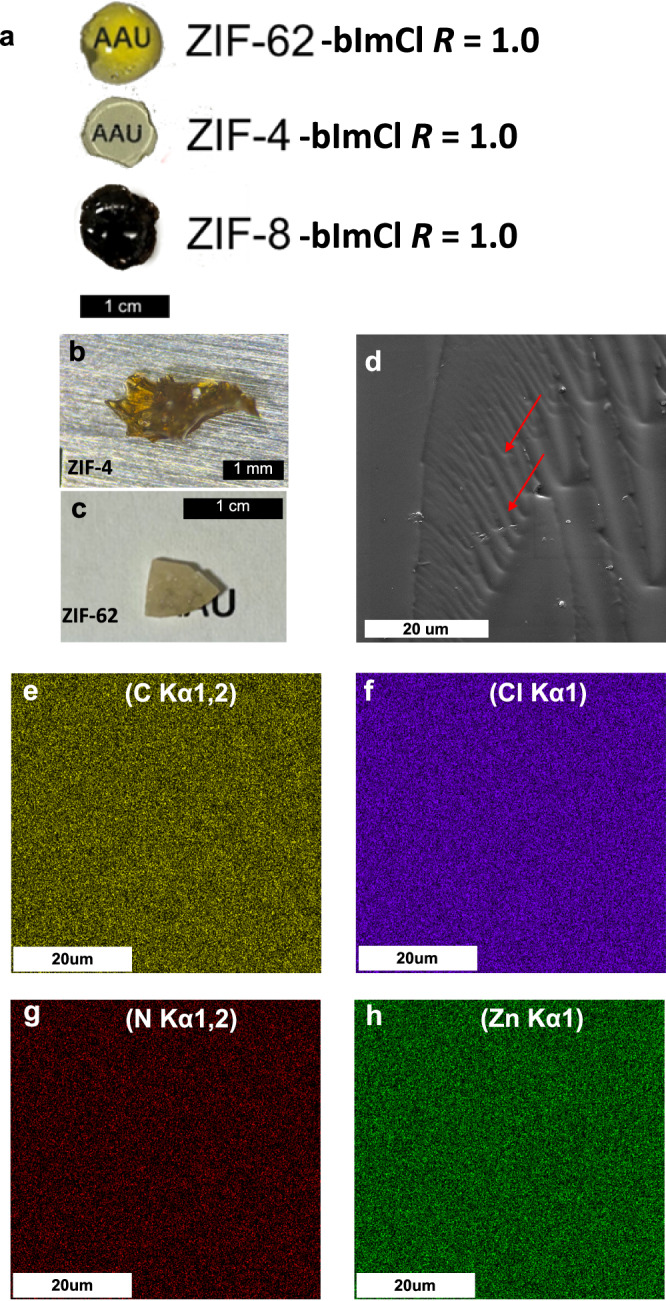
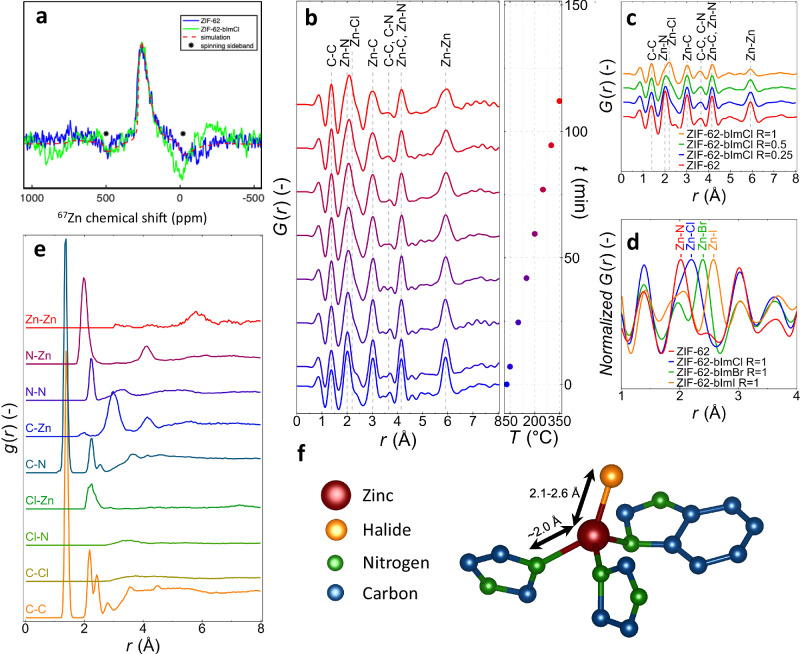
Melting and glass formation of metal-organic frameworks (MOFs) allow them to be processed into bulk materials. However, two major challenges remain: only a small fraction of MOF crystals undergo melting and glass-formation, and no well-established strategies exist for tuning MOF glass structures and properties. Here, we address both challenges through co-melting of zeolitic imidazole frameworks (ZIFs), a subset of MOFs, with heterocycle-based halide salts. The salt acts as a chemical "modifier", akin to the role of alkali modifiers in traditional silicate glasses, e.g., allowing the melting of ZIF-8 that otherwise decomposes prior to melting. Through experimental and computational analyses, we show that the salts depolymerize the ZIFs, enabling continuous tuning of the fraction of bridging to non-bridging imidazolate linkers and, thereby, the thermal and mechanical properties. The proposed strategy enables diversification of MOF glass chemistry, tunable structures and properties, and ultimately an increased number of glass-forming MOFs with improved functionalities.
金属有机框架材料(MOF)的熔化和玻璃形成使其能够被加工成块状材料。然而,仍然存在两个主要挑战:只有一小部分MOF晶体能够发生熔化和玻璃形成,并且不存在成熟的策略来调控MOF玻璃的结构和性能。在此,我们通过将沸石咪唑框架材料(ZIFs,MOF的一个子集)与基于杂环的卤化物盐共熔来应对这两个挑战。该盐充当化学“改性剂”,类似于传统硅酸盐玻璃中碱改性剂的作用,例如,使原本在熔化前就会分解的ZIF-8得以熔化。通过实验和计算分析,我们表明这些盐使ZIFs解聚,从而能够连续调节桥连咪唑盐连接体与非桥连咪唑盐连接体的比例,进而调控热性能和机械性能。所提出的策略能够实现MOF玻璃化学的多样化、可调控的结构和性能,最终增加具有改进功能的玻璃形成MOF的数量。