Li Dongkai, Hou Jiatong, Shi Zhan, Li Xiao, Zhang Jiahui, Zhao Guoyu, Lei Xianli, Xie Yawen, Wang Yuefu, Wang Hao, Chang Zhigang, Cui Na
Department of Critical Care Medicine, Peking Union Medical College Hospital, Beijing, China.
Surgical Intensive Care Unit, Beijing Shijitan Hospital, Capital Medical University, Beijing, China.
Front Immunol. 2025 Jul 16;16:1624655. doi: 10.3389/fimmu.2025.1624655. eCollection 2025.
Frailty is associated with poor outcomes in elderly sepsis patients. This study investigated the relationship between Frailty Index-laboratory (FI-lab) and lymphocyte patterns in predicting 28-day mortality among elderly sepsis patients.
We conducted a multicenter prospective observational study in four tertiary hospitals in Beijing, China. FI-lab was calculated using 24 laboratory parameters. Peripheral blood lymphocyte subsets were measured at ICU admission. Lymphocyte count trajectories were classified into four phenotypes based on patterns during the first 72 hours. The primary outcome was 28-day mortality.
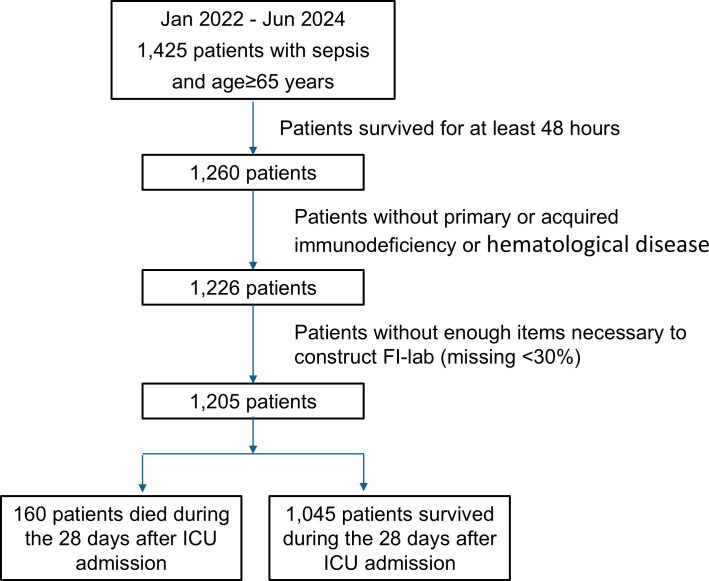
Among 1,197 patients (mean age 74.6 ± 7.4 years), those with high FI-lab risk showed higher mortality (22.2%) than intermediate (12.0%) and low-risk groups (6.1%). Age-stratified analysis demonstrated consistent FI-lab prognostic value in both 65-79 years (OR 2.18) and ≥80 years (OR 2.47) groups. All lymphocyte subset counts were lower in non-survivors, particularly natural killer cells. In multivariable analysis, high FI-lab risk (OR 2.31), APACHE-II scores (OR 1.08), heart rate (OR 1.01), NK cell count (OR 0.994), and pulmonary infection (OR 1.96) independently predicted 28-day mortality. A combined model incorporating these variables showed superior discriminative ability (AUC=0.788) with excellent internal validation (optimism-corrected AUC=0.775).
FI-lab independently predicts mortality in elderly sepsis patients and correlates with lymphocyte abnormalities. When comprehensive immune assessment is unavailable, lymphocyte trajectory patterns offer a practical approach for risk stratification.
衰弱与老年脓毒症患者的不良预后相关。本研究调查了衰弱指数-实验室指标(FI-lab)与淋巴细胞模式在预测老年脓毒症患者28天死亡率中的关系。
我们在中国北京的四家三级医院进行了一项多中心前瞻性观察研究。FI-lab使用24项实验室参数计算得出。在重症监护病房(ICU)入院时测量外周血淋巴细胞亚群。根据最初72小时内的模式,将淋巴细胞计数轨迹分为四种表型。主要结局是28天死亡率。
在1197例患者(平均年龄74.6±7.4岁)中,FI-lab高风险组的死亡率(22.2%)高于中风险组(12.0%)和低风险组(6.1%)。年龄分层分析表明,FI-lab在65 - 79岁(OR 2.18)和≥80岁(OR 2.47)组中均具有一致的预后价值。非存活者的所有淋巴细胞亚群计数均较低,尤其是自然杀伤细胞。在多变量分析中,FI-lab高风险(OR 2.31)、急性生理与慢性健康状况评分系统-II(APACHE-II)评分(OR 1.08)、心率(OR 1.01)、自然杀伤细胞计数(OR ...... 显示全部内容
请注意,你提供的原文中“NK cell count (OR 0.994)”这里似乎不完整,翻译时保留了原文格式。完整译文为:
衰弱与老年脓毒症患者的不良预后相关。本研究调查了衰弱指数-实验室指标(FI-lab)与淋巴细胞模式在预测老年脓毒症患者28天死亡率中的关系。
我们在中国北京的四家三级医院进行了一项多中心前瞻性观察研究。FI-lab使用24项实验室参数计算得出。在重症监护病房(ICU)入院时测量外周血淋巴细胞亚群。根据最初72小时内的模式,将淋巴细胞计数轨迹分为四种表型。主要结局是28天死亡率。
在1197例患者(平均年龄74.6±7.4岁)中,FI-lab高风险组的死亡率(22.2%)高于中风险组(12.0%)和低风险组(6.1%)。年龄分层分析表明,FI-lab在65 - 79岁(OR 2.18)和≥80岁(OR 2.47)组中均具有一致的预后价值。非存活者的所有淋巴细胞亚群计数均较低,尤其是自然杀伤细胞。在多变量分析中,FI-lab高风险(OR 2.31)、急性生理与慢性健康状况评分系统-II(APACHE-II)评分(OR 1.08)、心率(OR 1.01)、自然杀伤细胞计数(OR 0.994)和肺部感染(OR 1.96)独立预测28天死亡率。包含这些变量的联合模型显示出更好的判别能力(AUC = 0.788),且具有出色的内部验证(乐观校正AUC = 0.775)。
FI-lab可独立预测老年脓毒症患者的死亡率,并与淋巴细胞异常相关。当无法进行全面的免疫评估时,淋巴细胞轨迹模式为风险分层提供了一种实用方法。