Uchiyama Masanobu, Inoue Takafumi, Kojima Daibo, Watanabe Masato, Miyazaki Motoyasu, Nakano Takafumi, Yamashina Takuya, Imakyure Osamu, Matsuo Koichi
Department of Oncology and Infectious Disease Pharmacy, Faculty of Pharmaceutical Sciences, Fukuoka University, 8-19-1 Nanakuma, Jonan- ku, Fukuoka, 814-0180, Japan.
Department of Pharmacy, Fukuoka University Hospital, 7-45-1 Nanakuma, Jonan-ku, Fukuoka, 814-0180, Japan.
J Pharm Health Care Sci. 2025 Jul 31;11(1):63. doi: 10.1186/s40780-025-00476-9.
Hyponatremia is an electrolyte abnormality that is often caused by the syndrome of inappropriate antidiuretic hormone secretion (SIADH) and frequently encountered in the field of oncology. Although SIADH is a known complication of certain chemotherapeutic agents, its occurrence with oxaliplatin is rare. We report a case of SIADH in a patient with colon cancer who was undergoing treatment comprising capecitabine and oxaliplatin (CAPOX) plus bevacizumab.
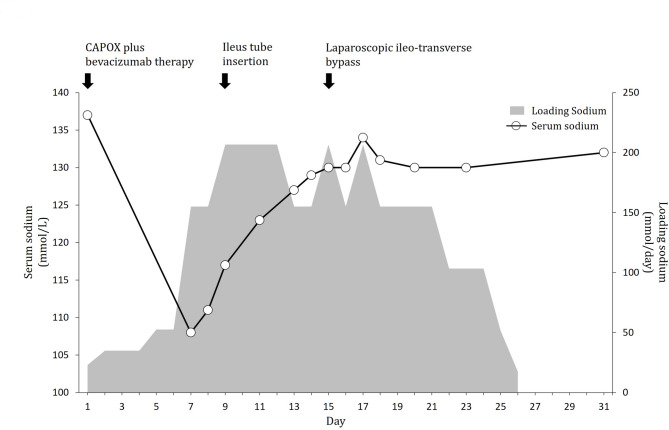
A 70-year-old man with stage cT4bN2M0 colon cancer underwent chemotherapy with CAPOX plus bevacizumab. On day 7 of treatment, the patient developed severe hyponatremia (serum sodium level, 108 mmol/L) accompanied by nausea and ileus. Laboratory test results were consistent with SIADH, including low serum osmolality, elevated urine osmolality, elevated sodium concentration, and elevated antidiuretic hormone levels. The condition improved with 3% saline infusion and fluid restriction. No other underlying causes, such as central nervous system lesions or adrenal or thyroid dysfunction, were identified. CAPOX-induced SIADH was diagnosed based on clinical findings and the exclusion of other etiologies. Transition to second-line therapy was performed without SIADH recurrence.
Oxaliplatin-based regimens may rarely induce SIADH. Clinicians should be vigilant of electrolyte disturbances during chemotherapy and promptly manage hyponatremia to avoid severe complications.
低钠血症是一种电解质异常,常由抗利尿激素分泌不当综合征(SIADH)引起,在肿瘤学领域较为常见。虽然SIADH是某些化疗药物已知的并发症,但与奥沙利铂相关的情况罕见。我们报告一例接受卡培他滨和奥沙利铂(CAPOX)联合贝伐单抗治疗的结肠癌患者发生SIADH的病例。
一名70岁的cT4bN2M0期结肠癌男性患者接受了CAPOX联合贝伐单抗化疗。治疗第7天,患者出现严重低钠血症(血清钠水平为108 mmol/L),伴有恶心和肠梗阻。实验室检查结果与SIADH一致,包括低血清渗透压、高尿渗透压、高钠浓度和高抗利尿激素水平。通过输注3%盐水和限制液体摄入,病情得到改善。未发现其他潜在病因,如中枢神经系统病变或肾上腺或甲状腺功能障碍。根据临床表现及排除其他病因,诊断为CAPOX诱导的SIADH。在未出现SIADH复发的情况下进行了二线治疗转换。
基于奥沙利铂的方案可能很少诱发SIADH。临床医生在化疗期间应警惕电解质紊乱,并及时处理低钠血症以避免严重并发症。