Hu Xiaoxin, Qi Jiao, Cheng Kaiwen, He Wenwen, Du Yu, Zhang Keke, Lu Yi, Zhu Xiangjia
Eye Institute and Department of Ophthalmology, Eye & ENT Hospital, Fudan University, Shanghai, China.
NHC Key Laboratory of Myopia and Related Eye Diseases, Key Laboratory of Myopia and Related Eye Diseases, Chinese Academy of Medical Sciences, Shanghai, China.
Adv Ophthalmol Pract Res. 2025 Jun 4;5(3):212-219. doi: 10.1016/j.aopr.2025.06.001. eCollection 2025 Aug-Sep.
To investigate the efficacy of image-guided accurate limbal relaxing incisions (LRIs) for astigmatism correction during cataract surgery.
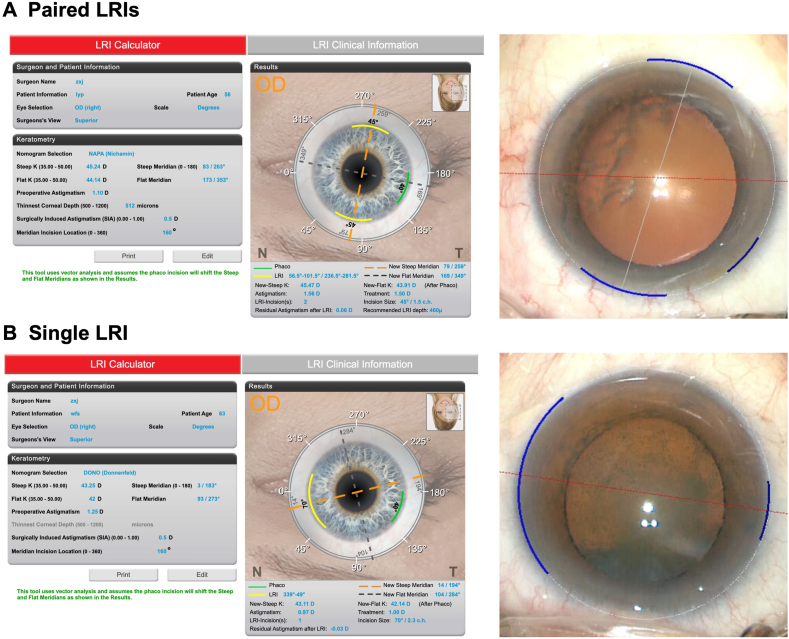
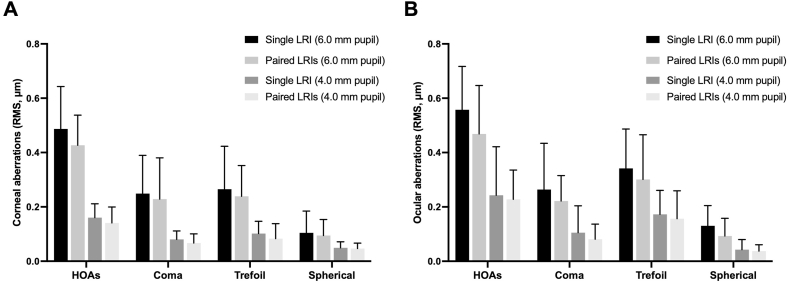
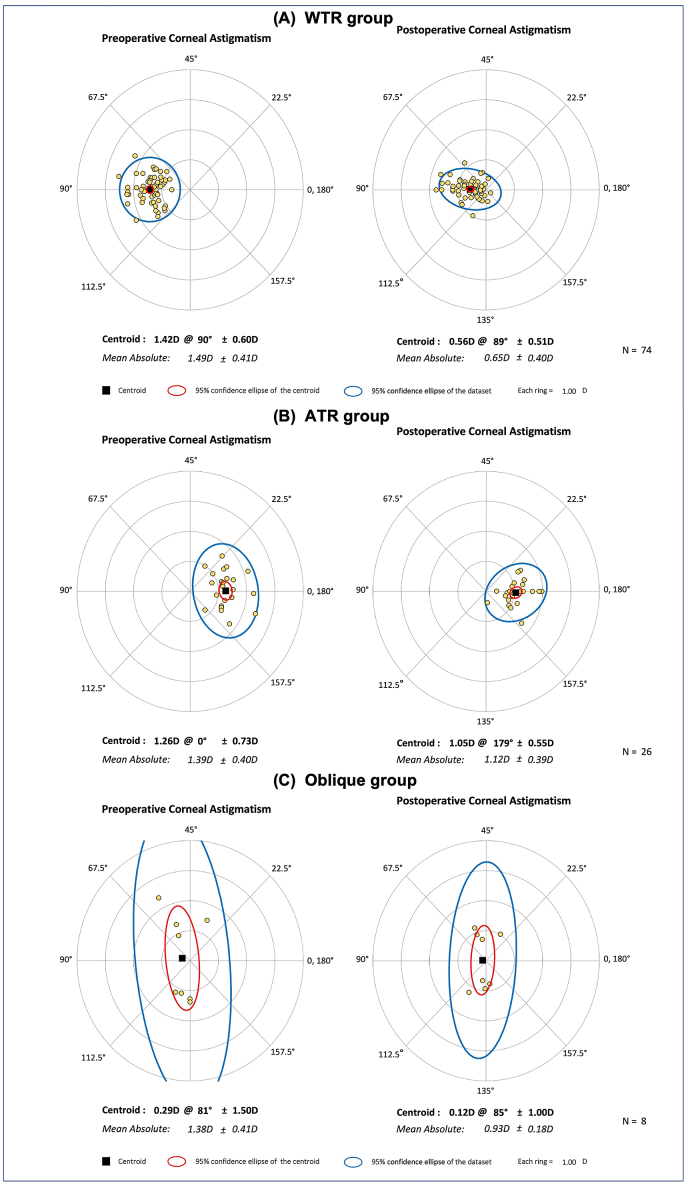
Consecutive cataract patients with regular corneal astigmatism ranging from 0.75 to 2.50 D, intended for cataract surgery with image-guided LRIs, were recruited in this prospective cohort study. The efficacy of astigmatism correction was evaluated 3 months after surgery, and compared among eyes with preoperative corneal with-the-rule (WTR), against-the-rule (ATR) and oblique astigmatism. Higher-order aberrations and visual quality indices obtained with iTrace were further compared between eyes with single and paired LRIs.
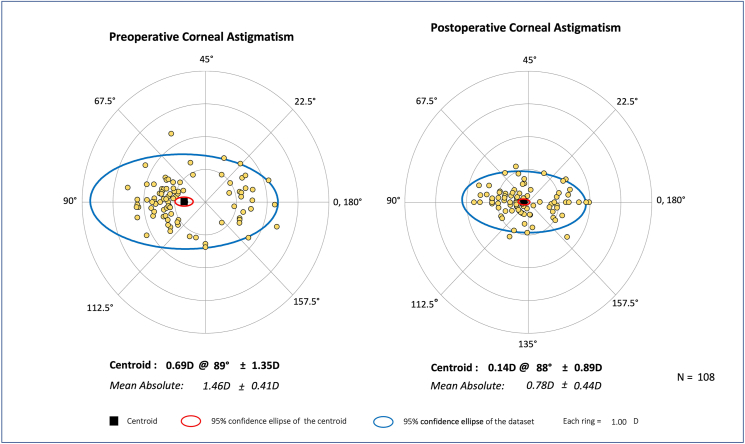
Totally, 108 eyes of 108 patients were analyzed. The mean total surgical induced astigmatism (tSIA) vector of all participants was 0.76 ± 0.38 D (range: 0.11-1.79 D, preoperative vs. postoperative astigmatism: 1.46 ± 0.41 vs. 0.78 ± 0.44 D, < 0.001). Eyes with WTR astigmatism showed higher tSIA (0.89 ± 0.32 D vs. 0.42 ± 0.21 D vs. 0.48 ± 0.36 D, respectively, < 0.001), as well as higher correction index and lower difference vector and index of success than ATR and oblique astigmatism groups (all < 0.05). Eyes with paired LRIs exhibited better corneal average height of modulation transfer function, a better corneal performance index and a better quality of vision index than those with single LRI (all < 0.05).
Image-guided LRIs can effectively correct low-to-moderate corneal astigmatism during cataract surgery, especially in eyes with WTR astigmatism.
探讨在白内障手术中,图像引导下精确角膜缘松解切口(LRIs)矫正散光的疗效。
本前瞻性队列研究纳入了连续的白内障患者,这些患者角膜规则散光度数在0.75至2.50 D之间,拟行图像引导下LRIs的白内障手术。术后3个月评估散光矫正效果,并在术前角膜顺规(WTR)、逆规(ATR)和斜向散光的患眼中进行比较。进一步比较单切口和双切口LRIs患眼的高阶像差和iTrace获得的视觉质量指标。
共分析了108例患者的108只眼。所有参与者的平均总手术源性散光(tSIA)向量为0.76±0.38 D(范围:0.11 - 1.79 D,术前与术后散光:1.46±0.41 vs. 0.78±0.44 D,P<0.001)。WTR散光患眼的tSIA更高(分别为0.89±0.32 D vs. 0.42±0.21 D vs. 0.48±0.36 D,P<0.001),与ATR和斜向散光组相比,其矫正指数更高,差异向量和成功指数更低(均P<0.05)。双切口LRIs患眼的角膜调制传递函数平均高度、角膜性能指数和视觉质量指数均优于单切口LRIs患眼(均P<0.05)。
图像引导下的LRIs可在白内障手术中有效矫正中低度角膜散光,尤其是在WTR散光的患眼中。