Lin Chi-Fong, Hsu Yu-An, Chou Yung-Lan, Chen Ying-Chi, Lin En-Shyh, Tien Peng-Tai, Chen Jamie Jiin-Yi, Wu Ming-Yen, Lin Chia-Hung, Lin Hui-Ju, Wan Lei
Health Science and Industry, China Medical University, Taichung, Taiwan.
School of Chinese Medicine, China Medical University, Taichung, Taiwan.
Gut Microbes. 2025 Dec;17(1):2534677. doi: 10.1080/19490976.2025.2534677. Epub 2025 Aug 1.
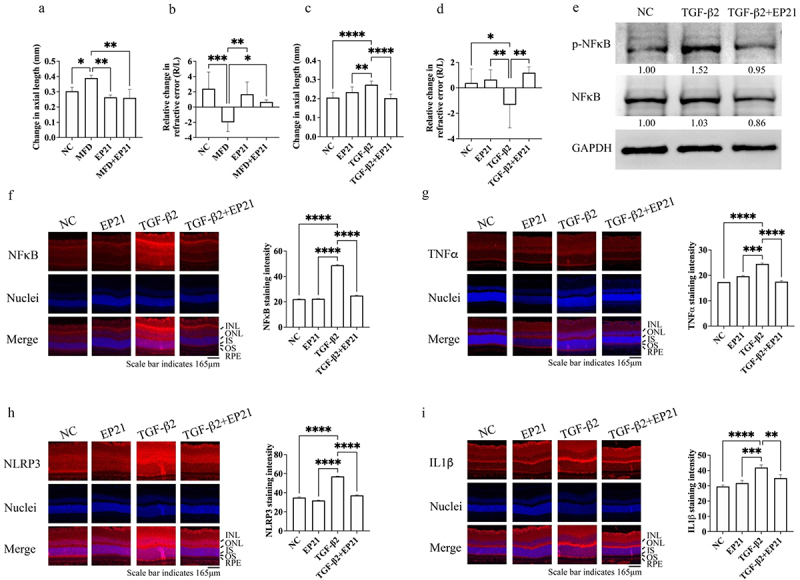
, a probiotic that is frequently found in fermented foods, is well known for its numerous health-enhancing properties. This study explored the potential of EP21 and its membrane vesicles (MVs) in mitigating myopia progression. In animal models of form-deprivation and TGF-β2-induced myopia, EP21 reduced axial elongation and refractive error shifts. EP21 administration suppressed retinal inflammation by inhibiting nuclear factor-κB activation and decreasing expression levels of tumor necrosis factor-α, NLR family pyrin-domain-containing-3, and interleukin (IL)-1β, while upregulating the expression of anti-inflammatory IL-10 in retinal tissues. To identify the molecular mechanism by which EP21 inhibits myopia, purified MVs were administered by intraperitoneal or intravenous injection or applied directly onto the ocular surface. The MVs crossed the blood - retinal barrier and accumulated in the outer segment of the retina. The MVs exhibited anti-myopic properties, indicated by a reduction in axial length elongation and a corresponding upregulation of refractive error. Mechanistic investigations revealed that EP21-MVs contain bacterial miRNAs that inhibit inflammatory responses and retinal structural remodeling. Furthermore, MV and its miRNAs upregulated genes that are associated with ubiquitination (TNF alpha-induced protein 3, TNFAIP3-interacting protein 1, and Tax1 binding protein 1), which are crucial for maintaining ocular proteostasis and regulating inflammation. EP21 administration, besides MV release, altered systemic metabolites, including tryptophan derivatives and short-chain fatty acids. The findings suggest a role of the gut - eye axis in the development of myopia and elucidate a biological pathway whereby gut-derived probiotics and their vesicles can influence ocular health. This research highlights the potential of EP21- and EP21-derived MVs as noninvasive agents for myopia management, and thereby enhances the comprehension of the gut - eye axis. By targeting inflammation and retinal remodeling, probiotics such as EP21 may contribute to addressing the global myopia epidemic, which offers a promising pathway for both preventive and therapeutic strategies.
一种常见于发酵食品中的益生菌,因其众多增强健康的特性而闻名。本研究探讨了EP21及其膜泡(MVs)在减轻近视进展方面的潜力。在形觉剥夺和转化生长因子-β2诱导的近视动物模型中,EP21减少了眼轴伸长和屈光不正变化。给予EP21可通过抑制核因子-κB激活和降低肿瘤坏死因子-α、含NLR家族吡啉结构域蛋白3和白细胞介素(IL)-1β的表达水平来抑制视网膜炎症,同时上调视网膜组织中抗炎性IL-10的表达。为了确定EP21抑制近视的分子机制,通过腹腔或静脉注射或直接应用于眼表给予纯化的MVs。MVs穿过血视网膜屏障并积聚在视网膜的外段。MVs表现出抗近视特性,表现为眼轴长度伸长减少和屈光不正相应上调。机制研究表明,EP21-MVs含有抑制炎症反应和视网膜结构重塑的细菌微小RNA。此外,MV及其微小RNA上调了与泛素化相关的基因(肿瘤坏死因子α诱导蛋白3、TNFAIP3相互作用蛋白1和Tax1结合蛋白1),这些基因对于维持眼部蛋白质稳态和调节炎症至关重要。除了释放MVs外,给予EP21还改变了全身代谢产物,包括色氨酸衍生物和短链脂肪酸。这些发现表明了肠-眼轴在近视发展中的作用,并阐明了肠道来源的益生菌及其囊泡影响眼部健康的生物学途径。本研究强调了EP21及其衍生的MVs作为近视管理的非侵入性药物的潜力,从而增进了对肠-眼轴的理解。通过靶向炎症和视网膜重塑,诸如EP21这样的益生菌可能有助于应对全球近视流行,这为预防和治疗策略提供了一条有前景的途径。