Long Li, Zhang Miao, Qin Hui-Zhen, Xu Li-Ba, Wang Bing-Bing, Wu Wen-Yuan, Zhu Hua, Lin Si
Guangxi International Zhuang Medicine Hospital, Guangxi University of Chinese Medicine, Nanning, 530201, China.
Guangxi Key Laboratory of Zhuang and Yao Ethnic Medicine, Guangxi University of Chinese Medicine, Nanning, 530200, China.
BMC Complement Med Ther. 2025 Aug 2;25(1):297. doi: 10.1186/s12906-025-04949-0.
Acute liver injury (ALI), which can progress to cirrhosis, hepatocellular carcinoma and acute liver failure, has become a global concern and a serious threat to human life and health. Isorhamnetin (ISO) is an O-methylated flavonol from the class of flavonoids. It has a protective effect on various organs, but its effect on ALI is still unclear in current studies.
This study aimed to investigate the protective effect of ISO against D-galactosamine (D-GalN)/lipopolysaccharide (LPS)-induced ALI and to explore the underlying molecular mechanisms.
Ninety-six male Kunming mice were randomly divided into six groups and given the appropriate drug administration for 14 days. The ALI mouse model was established by intraperitoneal injection of 700 mg/kg D-GalN and 10 µg/kg LPS. Hematoxylin-eosin (HE) staining was performed to observe the histopathological changes. Enzyme-linked immunosorbent assay (ELISA) and quantitative Real-time Polymerase Chain Reaction (qRT-PCR) were performed to detect the expression of genes related to oxidative stress and inflammation. Inflammation and apoptosis related factors were detected by western blot.
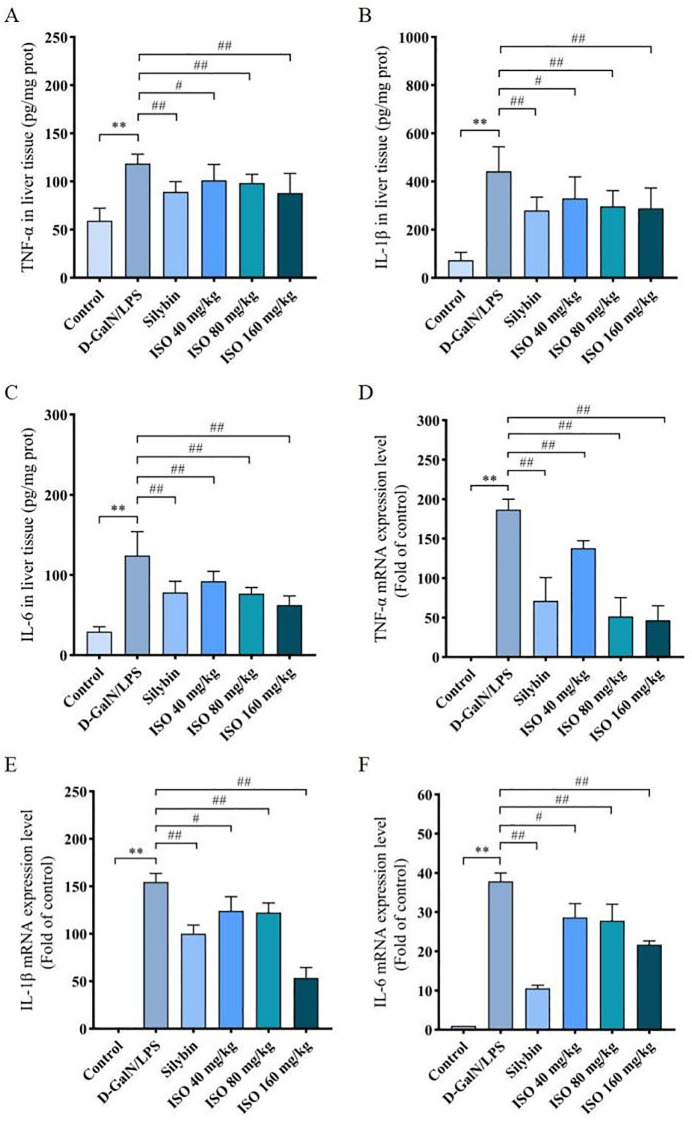
ISO alleviated D-GalN/LPS-induced ALI, reducing the alanine transaminase (ALT), aspartate transaminase (AST), and malondialdehyde (MDA) levels (P < 0.01), while improving histopathology (P < 0.05). Additionally, ISO elevated the superoxide dismutase (SOD) level, and improved the survival rate of mice (P < 0.01). Moreover, ISO reduced the nitric oxide (NO), interleukin-1β (IL-1β), tumor necrosis factor-α (TNF-α), interleukin-6 (IL-6) levels (P < 0.05), while increasing the glutathione (GSH), and catalase (CAT) levels (P < 0.05). ISO also decreased the expression of nuclear factor-kappa B alpha (IκBα), Nuclear factor kappa-B (NF-κB) p65, IL-1β, IL-6, TNF-α, nitric oxide synthase (iNOS), and toll-like receptor 4 (TLR4) at the messenger ribonucleic acid (mRNA) level (P < 0.05). Furthermore, western blot showed that ISO decreased the expression of NF-κB p-p65, cysteine aspartate protease-3 (caspase-3), and B-cell lymphoma 2-associated X protein (Bax) proteins and elevated the expression of B-cell lymphoma 2 (Bcl-2) and B-cell lymphoma 2-like protein (Bcl-xL) proteins (P < 0.05).
ISO could alleviate D-GalN/LPS-induced ALI by attenuating oxidative stress and inflammatory cytokines, enhancing the expression of anti-apoptotic proteins, reducing hepatocyte apoptosis, and inhibiting the activation of the NF-κB signaling pathway. Our study will provide some new references for treating ALI with ISO.
急性肝损伤(ALI)可进展为肝硬化、肝细胞癌和急性肝衰竭,已成为全球关注的问题,对人类生命健康构成严重威胁。异鼠李素(ISO)是黄酮类中的一种O-甲基化黄酮醇。它对各种器官具有保护作用,但目前研究中其对ALI的作用仍不明确。
本研究旨在探讨ISO对D-氨基半乳糖(D-GalN)/脂多糖(LPS)诱导的ALI的保护作用,并探索其潜在的分子机制。
将96只雄性昆明小鼠随机分为6组,给予适当药物处理14天。通过腹腔注射700mg/kg D-GalN和10μg/kg LPS建立ALI小鼠模型。进行苏木精-伊红(HE)染色以观察组织病理学变化。采用酶联免疫吸附测定(ELISA)和定量实时聚合酶链反应(qRT-PCR)检测与氧化应激和炎症相关基因的表达。通过蛋白质免疫印迹法检测炎症和凋亡相关因子。
ISO减轻了D-GalN/LPS诱导的ALI,降低了丙氨酸转氨酶(ALT)、天冬氨酸转氨酶(AST)和丙二醛(MDA)水平(P<0.01),同时改善了组织病理学(P<0.05)。此外,ISO提高了超氧化物歧化酶(SOD)水平,并提高了小鼠存活率(P<0.01)。而且,ISO降低了一氧化氮(NO)、白细胞介素-1β(IL-1β)、肿瘤坏死因子-α(TNF-α)、白细胞介素-6(IL-6)水平(P<0.05),同时提高了谷胱甘肽(GSH)和过氧化氢酶(CAT)水平(P<0.05)。ISO还在信使核糖核酸(mRNA)水平降低了核因子-κBα(IκBα)、核因子κB(NF-κB)p65、IL-1β、IL-6、TNF-α、一氧化氮合酶(iNOS)和Toll样受体4(TLR4)的表达(P<0.05)。此外,蛋白质免疫印迹法显示ISO降低了NF-κB p-p65、半胱氨酸天冬氨酸蛋白酶-3(caspase-3)和B细胞淋巴瘤-2相关X蛋白(Bax)蛋白的表达,并提高了B细胞淋巴瘤-2(Bcl-2)和B细胞淋巴瘤-2样蛋白(Bcl-xL)蛋白的表达(P<0.05)。
ISO可通过减轻氧化应激和炎性细胞因子、增强抗凋亡蛋白表达、减少肝细胞凋亡以及抑制NF-κB信号通路的激活来减轻D-GalN/LPS诱导的ALI。我们的研究将为用ISO治疗ALI提供一些新的参考。