Pournaghdali Ali, Eich Teal S
Leonard Davis School of Gerontology, University of Southern California, Los Angeles, CA, United States.
Front Psychol. 2025 Jul 21;16:1565846. doi: 10.3389/fpsyg.2025.1565846. eCollection 2025.
Research suggests that older adults have deficits in selective attention, a cognitive process often queried through the Stroop task. To tease apart whether this is due to failures to inhibit distracting information or to upregulate attention towards target information, younger and older adults completed a task called the Shape Stroop.
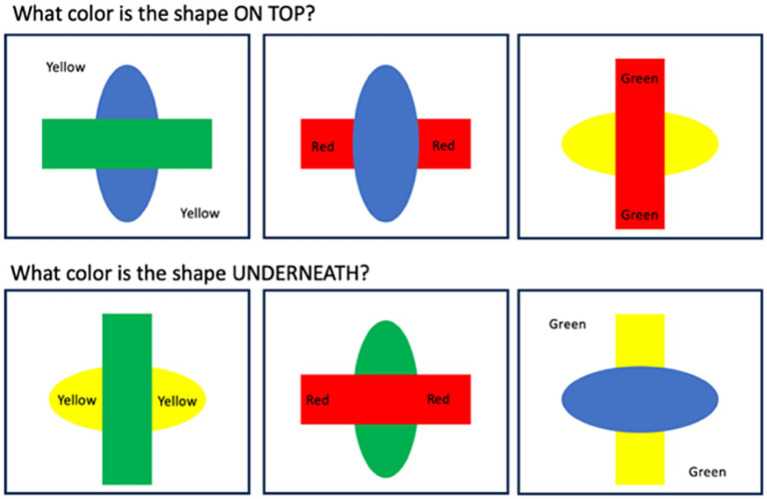
In this task, participants had to name the color of a shape that was occluded by another shape. Critically, congruent or incongruent Stroop words were placed in either the target shape, the occluding (distractor) shape or in the background. We first modeled performance as a function of age-group, Stroop word congruency, and location.
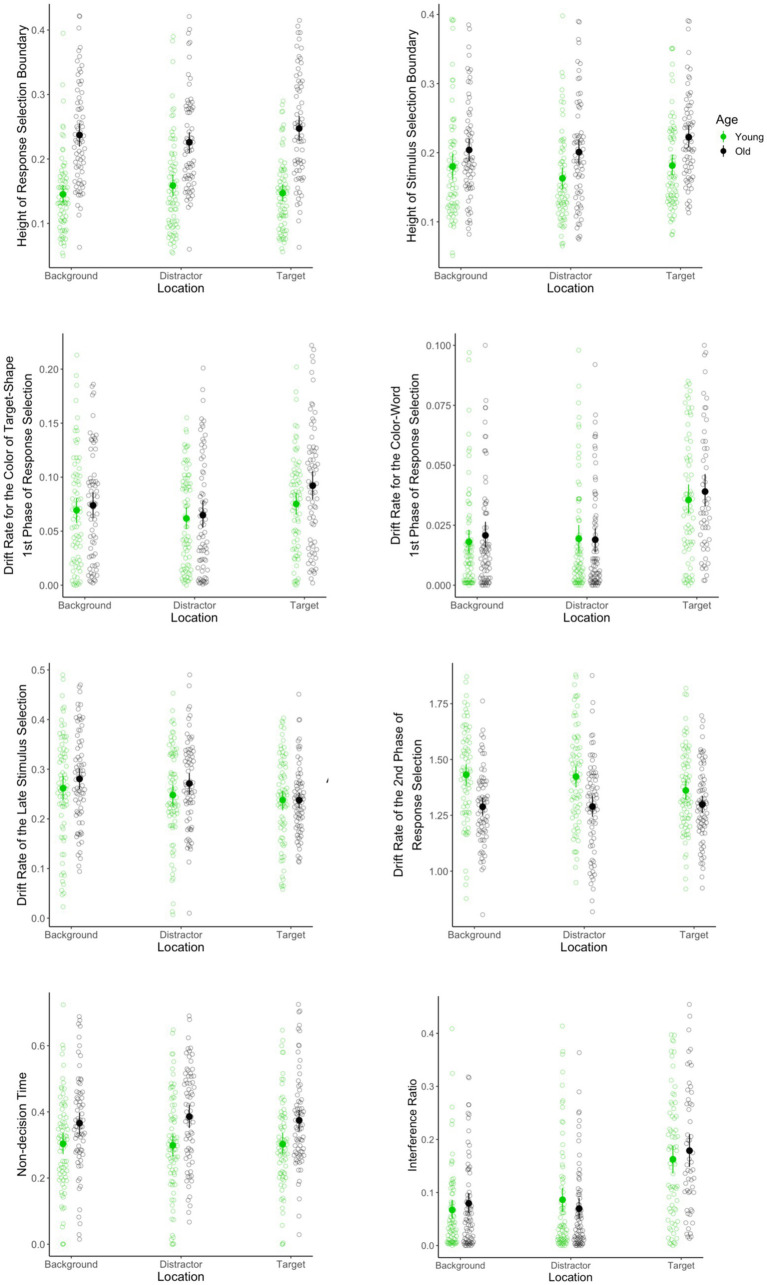
The results indicate that older adults were more accurate but slower than younger adults to choose the correct shape color. For both younger and older adults, incongruent words induced slower reaction times when words were in the target location, indicating age-invariance in the Stroop effect. To further probe how early and/or late attentional processes contribute to performance and to interrogate the decision strategies adopted across different conditions, we also fit the dual-stage two-phase model of selective attention to our data.
Our results indicate that older adults tend to be more cautious and require more information before choosing a stimulus to attend to or making a decision. Although older adults' ability to inhibit irrelevant information seems intact, they show signs of slower information processing in the later stages of attentional processing.
研究表明,老年人在选择性注意方面存在缺陷,这是一种常通过斯特鲁普任务来探究的认知过程。为了弄清楚这是由于无法抑制干扰信息还是无法上调对目标信息的注意力,年轻和年长的成年人完成了一项名为形状斯特鲁普的任务。
在这项任务中,参与者必须说出被另一个形状遮挡的形状的颜色。关键的是,一致或不一致的斯特鲁普单词被放置在目标形状、遮挡(干扰)形状或背景中。我们首先将表现建模为年龄组、斯特鲁普单词一致性和位置的函数。
结果表明,老年人在选择正确的形状颜色时比年轻人更准确,但速度更慢。对于年轻和年长的成年人来说,当单词位于目标位置时,不一致的单词会导致反应时间变慢,这表明斯特鲁普效应在年龄上是不变的。为了进一步探究早期和/或晚期注意过程如何影响表现,并审视在不同条件下采用的决策策略,我们还将选择性注意的双阶段两阶段模型应用于我们的数据。
我们的结果表明,老年人在选择要关注的刺激或做出决定之前往往更加谨慎,需要更多信息。虽然老年人抑制无关信息的能力似乎完好无损,但他们在注意处理的后期阶段表现出信息处理速度较慢的迹象。