Graham Jennifer N, Islam Shams Sohel, Sazgari Vahid, Li Yongka, Deng Hanbin, Janka Gianluca, Zhong Yigui, Gerguri Orion, Král Petr, Doll Andrin, Biało Izabela, Chang Johan, Salman Zaher, Suter Andreas, Prokscha Thomas, Yao Yugui, Okazaki Kozo, Luetkens Hubertus, Khasanov Rustem, Wang Zhiwei, Yin Jia-Xin, Guguchia Zurab
PSI Center for Neutron and Muon Sciences CNM, Villigen PSI, Switzerland.
Key Laboratory of Advanced Optoelectronic Quantum Architecture and Measurement, Ministry of Education, School of Physics, Beijing Institute of Technology, Beijing, China.
Commun Phys. 2025;8(1):318. doi: 10.1038/s42005-025-02235-6. Epub 2025 Aug 2.
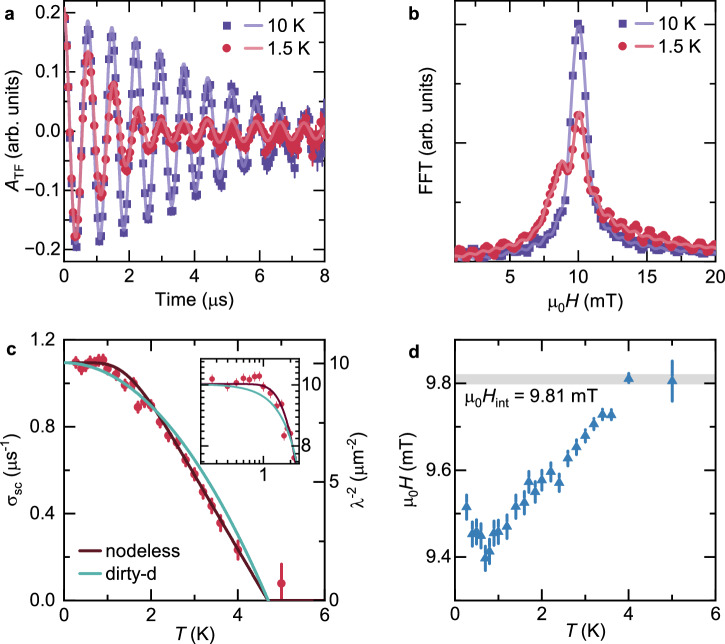
Understanding how time-reversal symmetry (TRS) breaks in quantum materials is key to uncovering new states of matter and advancing quantum technologies. However, unraveling the interplay between TRS breaking, charge order, and superconductivity in kagome metals continues to be a compelling challenge. Here, we investigate the kagome metal Cs(V Nb )Sb with = 0.07 using muon spin rotation (SR), alternating current (AC) magnetic susceptibility, and scanning tunneling microscopy (STM), under combined tuning by chemical doping, hydrostatic pressure, magnetic field, and depth from the surface. We find that TRS breaking in the bulk emerges below 40 K-lower than the charge order onset at 58 K-while near the surface, TRS breaking onsets at 58 K and is twice as strong. Niobium doping raises the superconducting critical temperature from 2.5 K to 4.4 K. Under pressure, both the critical temperature and superfluid density double, with TRS-breaking superconductivity appearing above 0.85 GPa. These findings reveal a depth-tunable TRS-breaking state and unconventional superconducting behavior in kagome systems.
理解量子材料中时间反演对称性(TRS)如何破缺是揭示新物态和推动量子技术发展的关键。然而,阐明三角晶格金属中TRS破缺、电荷序和超导性之间的相互作用仍然是一个极具挑战性的问题。在此,我们使用μ子自旋旋转(SR)、交流(AC)磁化率和扫描隧道显微镜(STM),在化学掺杂、静水压力、磁场和表面深度的联合调控下,研究了化学计量比为x = 0.07的三角晶格金属Cs(V1−x Nbx)3Sb5。我们发现,体材料中的TRS破缺出现在40 K以下,低于58 K时电荷序的起始温度,而在表面附近,TRS破缺在58 K时开始,强度是体材料中的两倍。铌掺杂将超导临界温度从2.5 K提高到4.4 K。在压力作用下,临界温度和超流密度都增加了一倍,在0.85 GPa以上出现TRS破缺的超导性。这些发现揭示了三角晶格体系中深度可调的TRS破缺态和非常规超导行为。