Junod Samuel L, Rush Coby, Tingey Mark, Yang Weidong
Department of Biology, Temple University, Philadelphia, PA 19122.
Proc Natl Acad Sci U S A. 2025 Aug 12;122(32):e2502687122. doi: 10.1073/pnas.2502687122. Epub 2025 Aug 7.
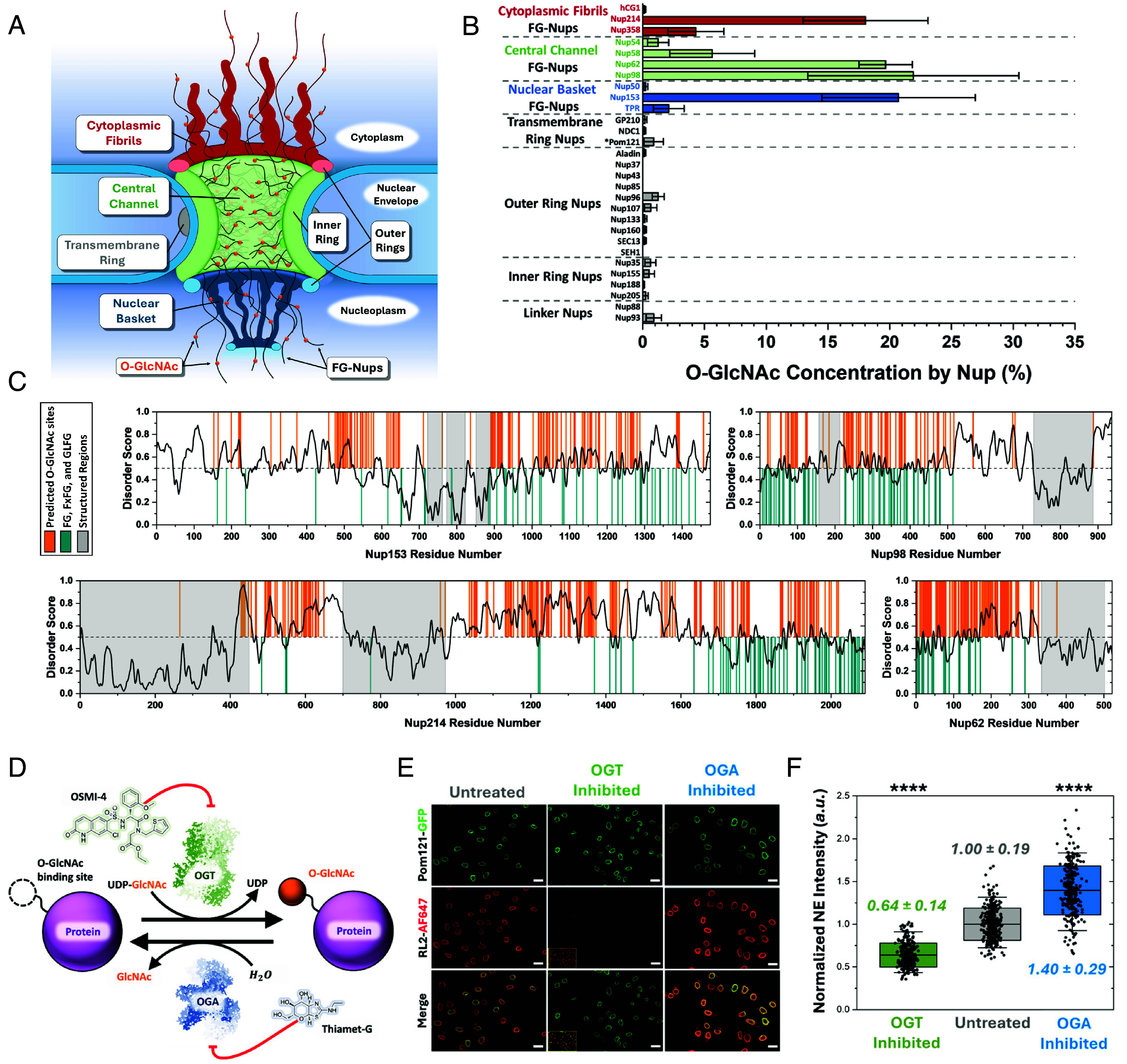
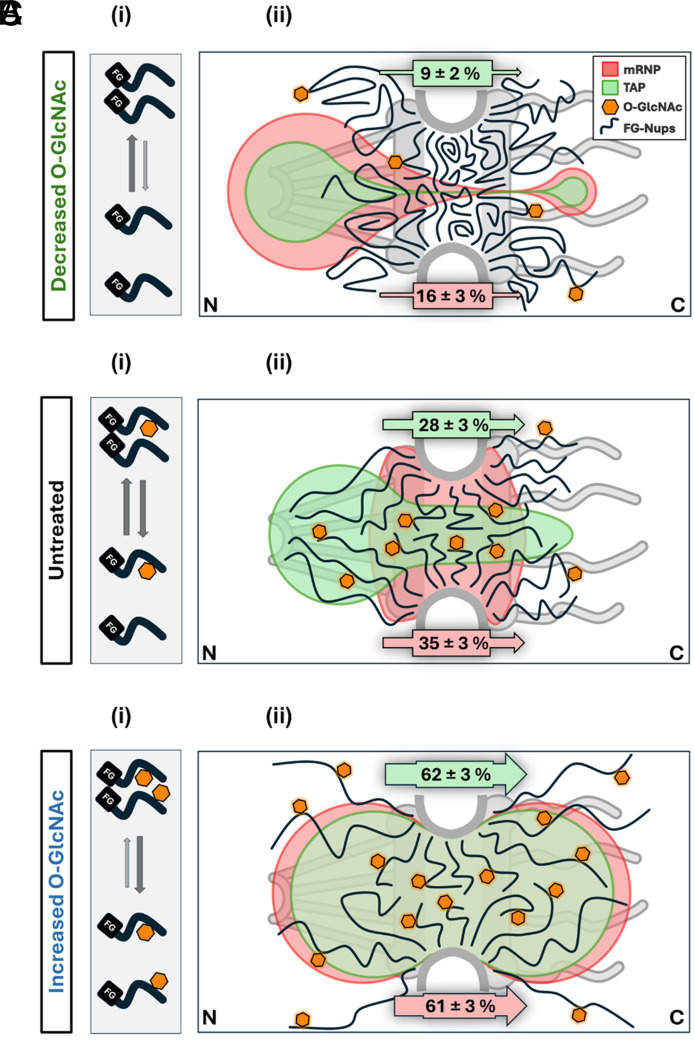
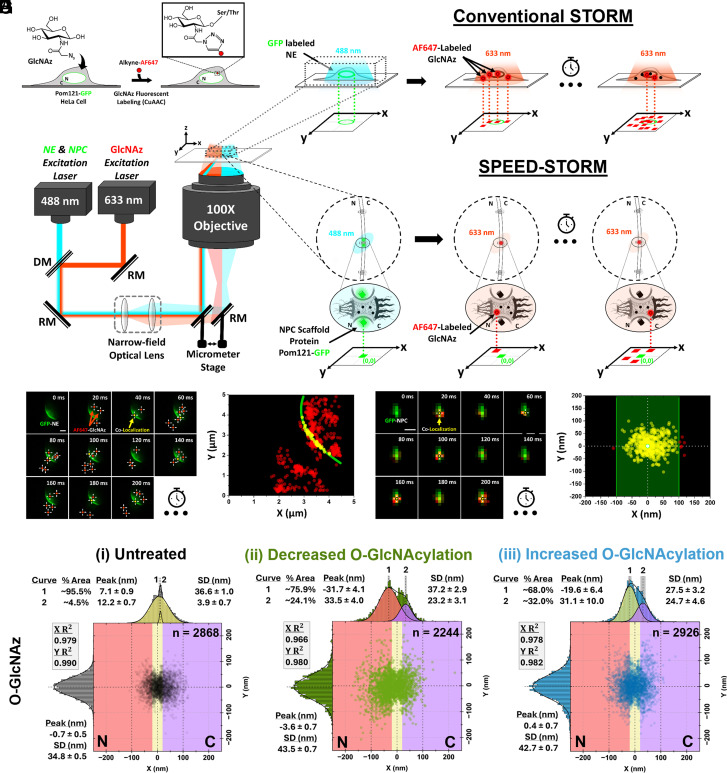
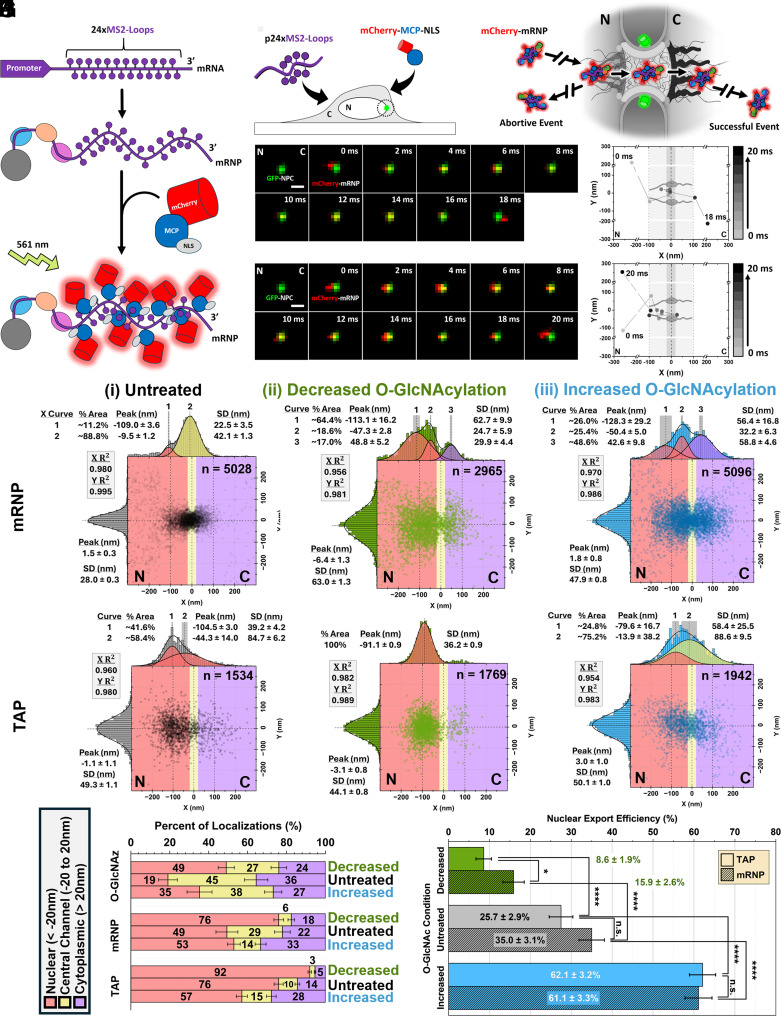
Efficient gene expression depends on the tightly regulated export of messenger RNA (mRNA) through nuclear pore complexes (NPCs), which are densely modified by O-linked N-acetylglucosamine (O-GlcNAc). Although dysregulated O-GlcNAcylation has been linked to a variety of human diseases, the precise distribution of O-GlcNAc within the NPC and its effects on mRNA export remain poorly understood. Here, we combined single-point edge-excitation subdiffraction (SPEED) microscopy with stochastic optical reconstruction microscopy (STORM) to map the nanometer-scale distribution of an O-GlcNAc analog (GlcNAz) within NPCs and to quantify the export kinetics of mRNA-protein complexes (mRNPs) under both normal and perturbed O-GlcNAcylation conditions. Under basal conditions, GlcNAz is predominantly localized around the central channel of the NPC. However, both hypo- and hyper-O-GlcNAcylation cause GlcNAz to redistribute toward the nuclear and cytoplasmic peripheries. This shift is paralleled by changes in mRNP localization and altered distributions of key, highly O-GlcNAcylated, phenylalanine-glycine nucleoporins. These architectural rearrangements are accompanied by functional consequences: Elevated O-GlcNAcylation nearly doubles mRNA export efficiency (~61%), while reduced O-GlcNAcylation lowers it to ~16%, along with reduced NPC engagement. The transport receptor TAP exhibits analogous efficiency changes, reinforcing the role of O-GlcNAcylation as a key regulator of nucleocytoplasmic transport. Together, these results suggest that O-GlcNAcylation modulates NPC architecture and transport dynamics to fine-tune mRNA export, and indicate that targeted modulation of NPC O-GlcNAc levels may offer a promising strategy for addressing diseases associated with nuclear transport dysfunction.
高效的基因表达依赖于信使核糖核酸(mRNA)通过核孔复合体(NPC)的严格调控输出,而核孔复合体被O-连接的N-乙酰葡糖胺(O-GlcNAc)高度修饰。尽管O-GlcNAc糖基化失调与多种人类疾病有关,但O-GlcNAc在核孔复合体内的精确分布及其对mRNA输出的影响仍知之甚少。在这里,我们将单点边缘激发亚衍射(SPEED)显微镜与随机光学重建显微镜(STORM)相结合,以绘制O-GlcNAc类似物(GlcNAz)在核孔复合体内的纳米级分布,并量化正常和受干扰的O-GlcNAc糖基化条件下mRNA-蛋白质复合物(mRNP)的输出动力学。在基础条件下,GlcNAz主要定位于核孔复合体的中央通道周围。然而,低O-GlcNAc糖基化和高O-GlcNAc糖基化都会导致GlcNAz重新分布到核周和胞质周边。这种转变与mRNP定位的变化以及关键的、高度O-GlcNAc糖基化的苯丙氨酸-甘氨酸核孔蛋白的分布改变平行。这些结构重排伴随着功能后果:O-GlcNAc糖基化升高使mRNA输出效率几乎翻倍(约61%),而O-GlcNAc糖基化降低则使其降至约16%,同时核孔复合体的结合减少。转运受体TAP表现出类似的效率变化,强化了O-GlcNAc糖基化作为核质运输关键调节因子的作用。总之,这些结果表明,O-GlcNAc糖基化调节核孔复合体结构和运输动力学以微调mRNA输出,并表明靶向调节核孔复合体的O-GlcNAc水平可能为解决与核运输功能障碍相关的疾病提供一种有前景的策略。