Wu Xue, Yang Qi, Liu Shanshan, Yang Peng, Liu Zhengqi, Zhu Zhitu
Guizhou University of Traditional Chinese Medicine, Guiyang, 550025, Guizhou, China.
The Second Affiliated Hospital of Guizhou, University of Traditional Chinese Medicine, Guiyang, 550003, Guizhou, China.
Sci Rep. 2025 Aug 7;15(1):28887. doi: 10.1038/s41598-025-12994-5.
Rheumatoid arthritis (RA) presents as pain, swelling and leads to irreversible damage in joint, and adversely affects the quality of life of patients with RA. However, the etiology of RA is still unclear, and novel biomarkers are demanded for the early prediction and diagnosis of RA and dissecting disease mechanisms.
This study aimed at profiling the disordered metabolic pathways in RA and selecting potential biomarkers to distinguish RA patients from healthy individuals, and systematically investigated the associations between metabolites and the risk of RA.
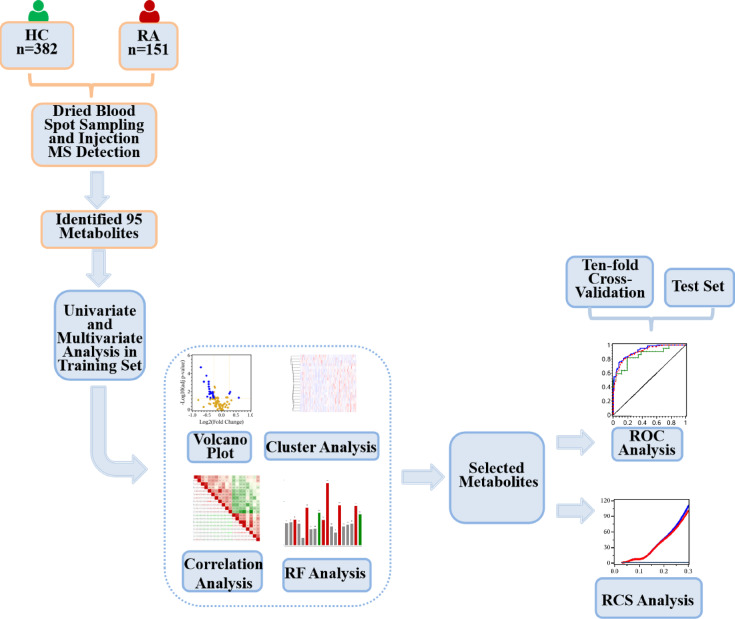
A total of 533 participants, including 382 healthy individuals and 151 RA patients, were recruited to explore altered metabolic profiles through the analysis of dried blood spot samples by mass spectrometry. Multiple algorithms were applied to identify potential biomarkers. Dose-response relationships were investigated by binary logistic regression and restricted cubic spline (RCS) analysis.
There were different metabolic profiles between RA and healthy individuals. After systematic selection, a metabolic panel consisting of C20, C5, Leu, C14:1/C16, Arg/(Orn + Cit), and C2/C0 was used to differentiate the two groups. Ten-fold cross-validation and test set were employed to evaluate prediction models. The receiver operating characteristic analysis demonstrated an area under the curve of 0.920(95%CI: 0.851-0.990) in test set to distinguish the two groups. The strong correlations between the 6 metabolites and RA were observed in RCS regression model.
The selected biomarkers have the potential to improve the detection of RA, and may offer insights into the intervention strategies to susceptible at-risk populations of developing RA.
类风湿性关节炎(RA)表现为疼痛、肿胀,并会导致关节不可逆损伤,对类风湿性关节炎患者的生活质量产生不利影响。然而,RA的病因仍不明确,需要新的生物标志物用于RA的早期预测、诊断以及剖析疾病机制。
本研究旨在剖析RA中紊乱的代谢途径,筛选能够区分RA患者与健康个体的潜在生物标志物,并系统研究代谢物与RA风险之间的关联。
共招募了533名参与者,包括382名健康个体和151名RA患者,通过质谱分析干血斑样本以探索代谢谱的改变。应用多种算法识别潜在的生物标志物。通过二元逻辑回归和受限立方样条(RCS)分析研究剂量反应关系。
RA患者与健康个体之间存在不同的代谢谱。经过系统筛选,由C20、C5、亮氨酸、C14:1/C16、精氨酸/(鸟氨酸+瓜氨酸)和C2/C0组成的代谢指标用于区分两组。采用十折交叉验证和测试集评估预测模型。受试者工作特征分析显示,测试集中区分两组的曲线下面积为0.920(95%CI:0.851-0.990)。在RCS回归模型中观察到6种代谢物与RA之间存在强相关性。
所筛选的生物标志物具有改善RA检测的潜力,并可能为RA易感高危人群的干预策略提供见解。