Wicherski Julia, Peltner Jonas, Becker Cornelia, Schüssel Katrin, Brückner Gabriela, Schlotmann Andreas, Schröder Helmut, Kern Winfried V, Haenisch Britta
Research Division, Pharmacoepidemiology, Federal Institute for Drugs and Medical Devices (BfArM), 53175, Bonn, Germany.
German Center for Neurodegenerative Diseases (DZNE), Pharmacoepidemiology in Neurodegenerative Disorders, 53127, Bonn, Germany.
BMC Ophthalmol. 2025 Aug 7;25(1):447. doi: 10.1186/s12886-025-04284-5.
Real-world evidence on fluoroquinolone-associated retinal detachment is contradictory. Therefore, we aim to examine the association between newly prescribed fluoroquinolones and the occurrence of retinal detachment with recent data from a large central European country.
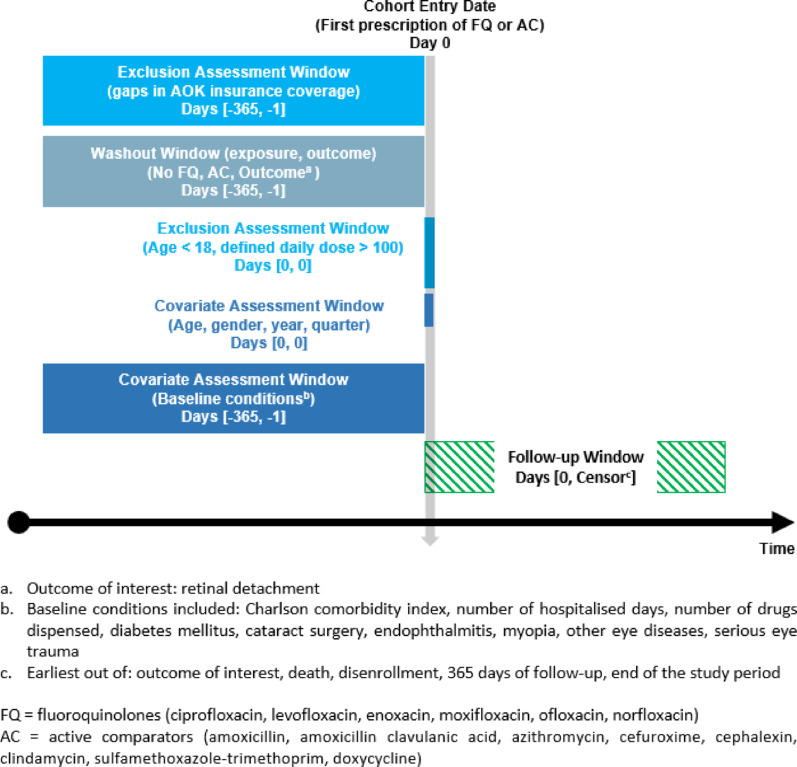
A cohort study with an active comparator new user design was conducted. Dispensings of fluoroquinolone episodes were compared to a group of reference antibiotic episodes (amoxicillin, amoxicillin clavulanic acid, azithromycin, cefuroxime, cephalexin, clindamycin, sulfamethoxazole-trimethoprim, and doxycycline). Data from one of the largest statutory health insurances in Germany, the AOK, were used to follow up individuals with new antibiotic dispensing during the years 2014-2018 for the occurrence of retinal detachment. Piece-wise exponential additive mixed models adjusted for person-time, age, gender, comorbidities, year, and quarter at index were applied to estimate adjusted hazard ratios (aHR) with corresponding 95% confidence intervals (95% CI).
In total, 15,232,585 antibiotic episodes were included in the cohort of which 0.05% episodes had an incident retinal detachment. The covariate-adjusted hazard ratio for fluoroquinolone episodes was 1.01 [0.95;1.08]. Likewise, in the propensity score-matched cohort the covariate-adjusted hazard ratio was 0.99 [0.92;1.07]. Moreover, there was little evidence for differences in age and gender subgroups, by follow-up time, selection of active comparator agent, dosage category, or censoring approach.
This large German cohort study found no meaningful real-world evidence for the association between fluoroquinolones and retinal detachment compared to a group of active comparator antibiotics.
关于氟喹诺酮类药物相关视网膜脱离的真实世界证据相互矛盾。因此,我们旨在利用来自中欧一个大国的最新数据,研究新开具的氟喹诺酮类药物与视网膜脱离发生之间的关联。
进行了一项采用活性对照新使用者设计的队列研究。将氟喹诺酮类药物使用情况与一组对照抗生素使用情况(阿莫西林、阿莫西林克拉维酸、阿奇霉素、头孢呋辛、头孢氨苄、克林霉素、磺胺甲恶唑-甲氧苄啶和多西环素)进行比较。利用德国最大的法定健康保险公司之一AOK的数据,对2014年至2018年期间新使用抗生素的个体进行随访,以观察视网膜脱离的发生情况。应用针对个体时间、年龄、性别合并症、年份和索引季度进行调整的分段指数加法混合模型,来估计调整后的风险比(aHR)及相应的95%置信区间(95%CI)。
该队列共纳入15,232,585次抗生素使用情况,其中0.05%的使用情况发生了视网膜脱离。氟喹诺酮类药物使用情况的协变量调整风险比为1.01[0.95;1.08]。同样,在倾向评分匹配队列中,协变量调整风险比为0.99[0.92;1.07]。此外,在年龄和性别亚组、随访时间、活性对照药物选择、剂量类别或删失方法方面,几乎没有证据表明存在差异。
这项大型德国队列研究发现,与一组活性对照抗生素相比,没有有意义的真实世界证据表明氟喹诺酮类药物与视网膜脱离之间存在关联。