Wazurkar Saee, Patel Aditya, Chandak Manoj, Pawar Lalit, Deshmukh Sharvari
Department of Conservative Dentistry and Endodontics, Sharad Pawar Dental College and Hospital, Datta Meghe Institute of Higher Education and Research, Wardha, India.
BMC Oral Health. 2025 Aug 7;25(1):1299. doi: 10.1186/s12903-025-06656-1.
The objective of this research was to evaluate and compare the effect of 38% Silver Diamine Fluoride(SDF) on the sealing ability of Biodentine (BD) and MTA (Mineral Trioxide Aggregate) Angelus when utilized as a perforation repair material for human-extracted mandibular molars.
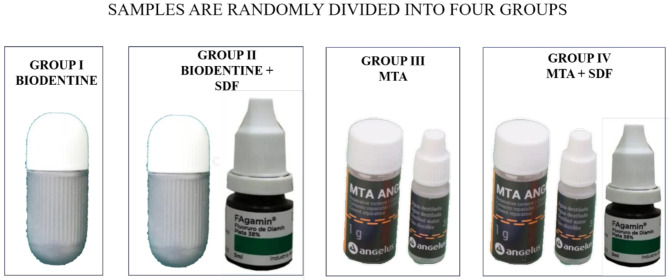
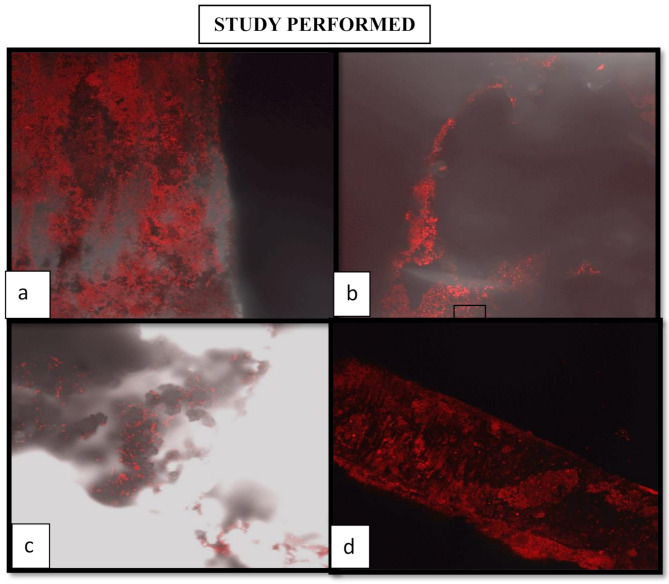
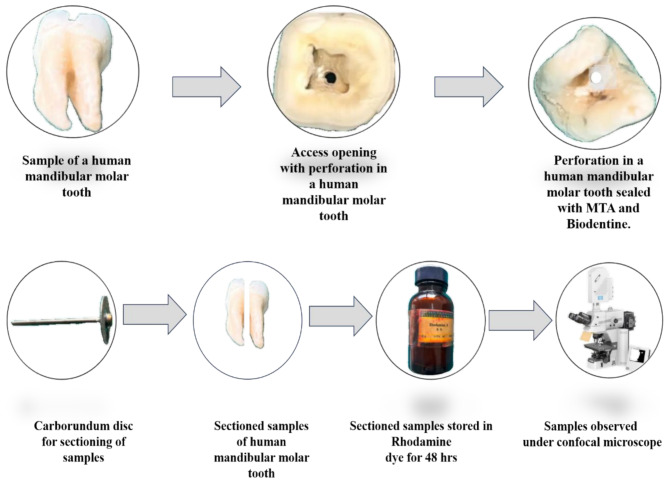
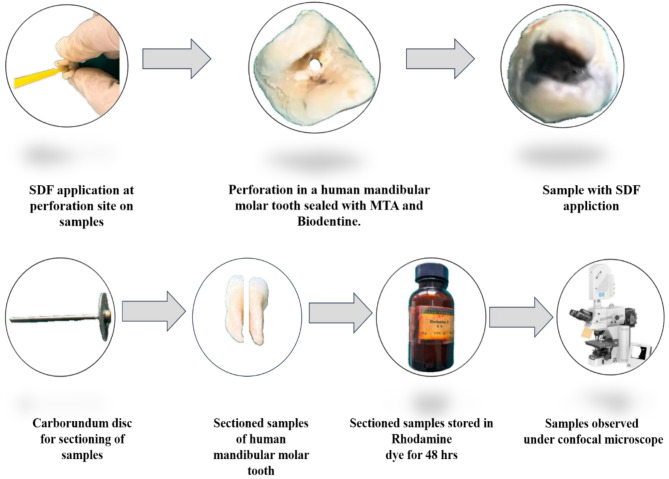
Forty human mandibular molars were extracted and divided into four groups (N = 10): Group 1 (BD), Group 2 (BD + SDF), Group 3 (MTA), and Group 4 (MTA + SDF). Standardized access cavities were prepared, and a 2 mm perforation was created at the pulpal floor. In Groups 2 and 4, SDF was applied for three minutes, followed by rinsing and air drying before placing BD or MTA. The restorations were then left to set for 48 h under humid conditions. Afterward, the specimens were immersed in a 0.6% rhodamine B dye solution for another 48 h. Each tooth was sectioned longitudinally, and dye penetration along the interface was examined under a confocal laser microscope at 40X magnification. Statistical analysis was performed using SPSS software, with one-way ANOVA and post hoc Tukey tests applied to determine significance (p < 0.05).
The intergroup analysis showed significant differences in dye penetration (p < 0.01). Group 3 (MTA) exhibited the least dye penetration followed by Group 2 (BD + SDF) and Group 4 (MTA + SDF). Group 1 (BD) demonstrated the highest dye penetration indicating the weakest sealing ability. The post hoc Tukey test confirmed that Group 1 had significantly higher microleakage than Groups 2, 3, and 4 (p < 0.001). While SDF significantly improved BD's sealing ability (Group 2 vs. Group 1, p < 0.001), its effect on MTA was not statistically significant (Group 4 vs. Group 3, p = 0.530).
MTA and BD, the primary materials used for perforation repair, face challenges related to solubility. Since SDF is nearly insoluble, it has the potential to form a protective barrier, enhancing marginal sealing and minimizing microleakage. However, there is currently no research examining how SDF influences the microleakage of MTA and BD in perforation repair. This in vitro study seeks to assess the impact of SDF on the sealing properties of these calcium silicate-based materials, providing valuable insights into improving perforation repair techniques.
本研究的目的是评估和比较38%的氟化银氨(SDF)对生物陶瓷(BD)和天使us矿物三氧化物凝聚体(MTA)作为人下颌磨牙穿孔修复材料时密封能力的影响。
拔除40颗人下颌磨牙并分为四组(每组n = 10):第1组(BD)、第2组(BD + SDF)、第3组(MTA)和第4组(MTA + SDF)。制备标准化的进入腔,在髓室底制造一个2mm的穿孔。在第2组和第4组中,应用SDF三分钟,然后冲洗并吹干,再放置BD或MTA。然后将修复体在潮湿条件下放置48小时。之后,将标本再浸入0.6%的罗丹明B染料溶液中48小时。将每颗牙齿纵向切片,在共聚焦激光显微镜下以40倍放大率检查沿界面的染料渗透情况。使用SPSS软件进行统计分析,应用单因素方差分析和事后Tukey检验确定显著性(p < 0.05)。
组间分析显示染料渗透存在显著差异(p < 0.01)。第3组(MTA)的染料渗透最少,其次是第2组(BD + SDF)和第4组(MTA + SDF)。第1组(BD)的染料渗透最高,表明密封能力最弱。事后Tukey检验证实,第1组的微渗漏显著高于第2、3和4组(p < 0.001)。虽然SDF显著提高了BD的密封能力(第2组与第1组相比,p < 0.001),但其对MTA的影响无统计学意义(第4组与第3组相比,p = 0.530)。
用于穿孔修复的主要材料MTA和BD面临与溶解性相关的挑战。由于SDF几乎不溶,它有可能形成一个保护屏障,增强边缘密封并使微渗漏最小化。然而,目前尚无研究探讨SDF如何影响穿孔修复中MTA和BD的微渗漏。这项体外研究旨在评估SDF对这些硅酸钙基材料密封性能的影响,为改进穿孔修复技术提供有价值的见解。