Singh Shishir, Podar Rajesh, Dadu Shifali, Kulkarni Gaurav, Purba Rucheet
Department of Conservative Dentistry and Endodontics, Terna Dental College, Nerul, Navi Mumbai, Maharashtra, India.
J Conserv Dent. 2015 Mar-Apr;18(2):149-53. doi: 10.4103/0972-0707.153053.
The purpose of this study was to compare solubility of a new calcium silicate-based cement, Biodentine with three commonly used root-end filling materials viz. glass-ionomer cement (GIC), intermediate restorative material (IRM), and mineral trioxide aggregate (MTA).
Twenty stainless steel ring molds were filled with cements corresponding to four groups (n = 5). The weight of 20 dried glass bottles was recorded. Samples were transferred to bottles containing 5 ml of distilled water and stored for 24 h. The bottles were dried at 105C and weighed. This procedure was repeated for 3, 10, 30, and 60 days. Data was analyzed with one-way analysis of variance (ANOVA) test (P < 0.05).
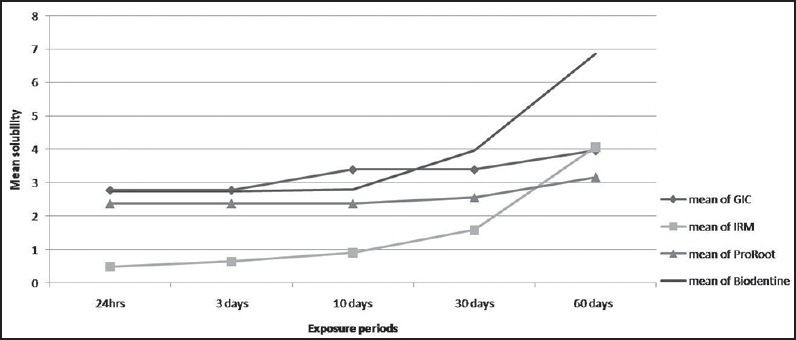
Biodentine demonstrated significantly higher solubility than MTA for 30- and 60-day immersion periods. Statistical difference was noted between the solubility values of Biodentine samples amongst each of the five time intervals.
Biodentine exhibited higher solubility in comparison with all other cements.
本研究的目的是比较一种新型硅酸钙基水门汀——生物陶瓷(Biodentine)与三种常用的根尖充填材料,即玻璃离子水门汀(GIC)、中间修复材料(IRM)和三氧化矿物凝聚体(MTA)的溶解性。
将20个不锈钢环形模具填充对应四组(n = 5)的水门汀。记录20个干燥玻璃瓶的重量。将样品转移至装有5毫升蒸馏水的瓶子中并储存24小时。将瓶子在105℃下干燥并称重。此过程在第3、10、30和60天重复进行。数据采用单因素方差分析(ANOVA)检验进行分析(P < 0.05)。
在浸泡30天和60天时,生物陶瓷的溶解性显著高于MTA。在五个时间间隔中的每个间隔内,生物陶瓷样品的溶解度值之间存在统计学差异。
与所有其他水门汀相比,生物陶瓷表现出更高的溶解性。