Bizzozero-Peroni Bruno, Tremblay Mark S, Aubert Salomé, González Silvia A, Silva Diego Augusto Santos, López-Taylor Juan, Lobo Pablo, De Roia Gabriela, Sarmiento Olga L, Aguilar-Farias Nicolas, Tenesaca Susana Andrade, Galaviz Karla I, Brazo-Sayavera Javier
Instituto Superior de Educación Física Universidad de la República Rivera Uruguay Instituto Superior de Educación Física, Universidad de la República, Rivera, Uruguay.
Children's Hospital of Eastern Ontario Research Institute OttawaOntario Canada Children's Hospital of Eastern Ontario Research Institute, Ottawa, Ontario, Canada.
Rev Panam Salud Publica. 2025 Aug 8;49:e87. doi: 10.26633/RPSP.2025.87. eCollection 2025.
To synthesize the grades of physical activity (PA) indicators for children and adolescents (5-17 years) in Latin American countries; explore the social determinants of health (SDoH) for PA indicators; and identify strengths, weaknesses, opportunities, and threats to improve PA levels.
Participating Latin American countries graded a set of common PA indicators following the harmonized methodology established by the Global Matrix initiative. Cross-sectional (2014, 2016, 2018, 2022) and time trend (2018-2022) data were synthesized within and between countries for each PA indicator. PA data were also synthesized according to their SDoH. Report card team leaders completed a questionnaire to identify strengths, weaknesses, opportunities, and threats (SWOT) to improve PA grades.
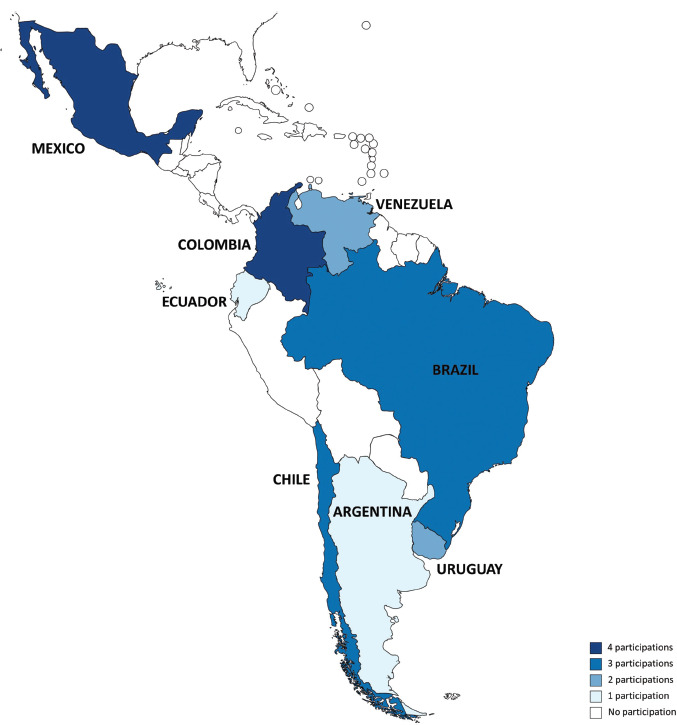
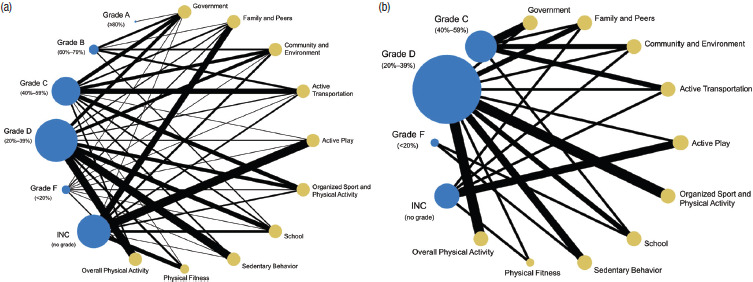
Eight Latin American countries (Argentina, Brazil, Chile, Colombia, Ecuador, Mexico, Uruguay, and Venezuela) participated in at least one of the four editions of the Global Matrix initiative. Across all PA indicator grades in the region ( = 193), 35.2% received a "D" (20%-39% success rate), the most frequent grade. Incomplete information was reported in 27.5% of the indicators. A 9.3% improvement was observed in the regional average score of all PA indicators analyzed over time. While source-of-influence indicators improved by 28.1%, behavioral indicators declined by 6.2%. The need for further analyses disaggregated by SDoH, such as sex, was identified.
Latin American countries reported poor grades on PA indicators for children and adolescents. Contrasted progress was observed between the behavioral and source of influence indicator groups. Improved surveillance systems and greater country-level investment in PA data collection are urgently needed to enhance comparability and guide regional action.
综合拉丁美洲国家儿童和青少年(5 - 17岁)身体活动(PA)指标的等级;探索PA指标的健康社会决定因素(SDoH);并确定提高PA水平的优势、劣势、机会和威胁。
参与的拉丁美洲国家按照全球矩阵倡议建立的统一方法对一组常见的PA指标进行分级。在每个PA指标的国家内部和国家之间综合了横断面(2014年、2016年、2018年、2022年)和时间趋势(2018 - 2022年)数据。PA数据也根据其SDoH进行了综合。报告卡团队负责人完成了一份问卷,以确定提高PA等级的优势、劣势、机会和威胁(SWOT)。
八个拉丁美洲国家(阿根廷、巴西、智利、哥伦比亚、厄瓜多尔、墨西哥、乌拉圭和委内瑞拉)参与了全球矩阵倡议四个版本中的至少一个。在该地区所有PA指标等级中(n = 193),35.2%获得了“D”(成功率为20% - 39%),这是最常见的等级。27.5%的指标报告信息不完整。随着时间的推移,分析的所有PA指标的区域平均得分提高了9.3%。虽然影响源指标提高了28.1%,但行为指标下降了6.2%。确定了需要进一步按SDoH(如性别)进行分类分析。
拉丁美洲国家报告称儿童和青少年的PA指标等级较差。行为指标组和影响源指标组之间观察到了对比鲜明的进展。迫切需要改进监测系统,并在国家层面加大对PA数据收集的投入,以提高可比性并指导区域行动。