Kitaka Sabrina B, Rujumba Joseph, Zalwango Sarah K, Pfeffer Betsy, Kizza Lubega, Nattimba Juliane P, Stephens Ashley B, Nabukeera-Barungi Nicolette, Wynn Chelsea S, Babirye Juliet N, Mukisa John, Mupere Ezekiel, Stockwell Melissa S
Department of Pediatrics and Child Health, School of Medicine, College of Health Sciences, Makerere University, Kampala, Uganda.
Kampala Capital City Authority, Kampala, Uganda.
JMIR Mhealth Uhealth. 2025 May 5;13:e63527. doi: 10.2196/63527.
Cervical cancer is currently the leading female cancer in Uganda. Most women are diagnosed with late-stage disease. Human papillomavirus (HPV) vaccination is the single most important primary preventive measure. While research regarding text message vaccine reminder use is strong in the United States, their use has not yet been demonstrated in a preteen and adolescent population in subSaharan Africa or other low- and middle-income countries.
The objective of this pilot randomized controlled trial was to assess the impact of vaccine reminders with embedded interactive educational information on timeliness of HPV vaccination in Kampala, Uganda.
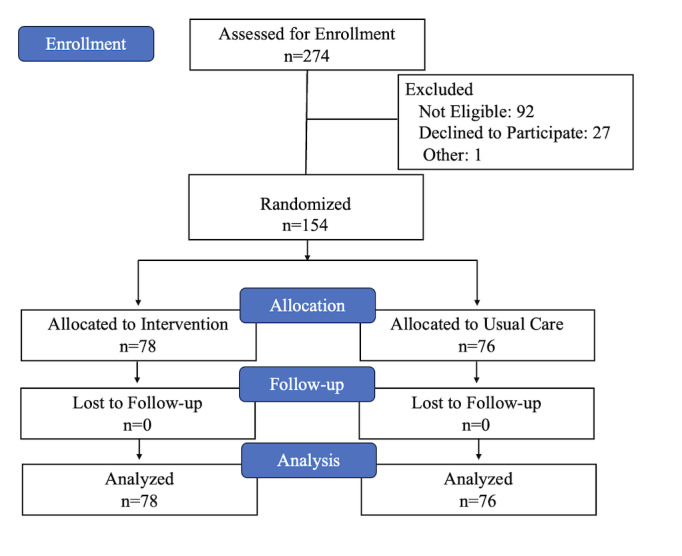
In this randomized controlled trial conducted in 2022, caregivers of adolescents needing a first or second HPV vaccine dose were recruited from an adolescent clinic and three community health centres in Kampala, Uganda. Families (n=154) were randomized 1:1 into intervention versus usual care, stratified by dose (ie, initiation, completion) and language (ie, English, Luganda) within each site. Intervention caregivers received a series of automated, personalized text messages or automated phone calls based on family preference. Five messages were sent before the due date, including both static and interactive educational information, with five follow-up messages for those unvaccinated. Receipt of the needed dose by 24 weeks postenrollment was assessed by χ2, regression, and Kaplan-Meier with log-rank test. All analyses were conducted using intention-to-treat principles.
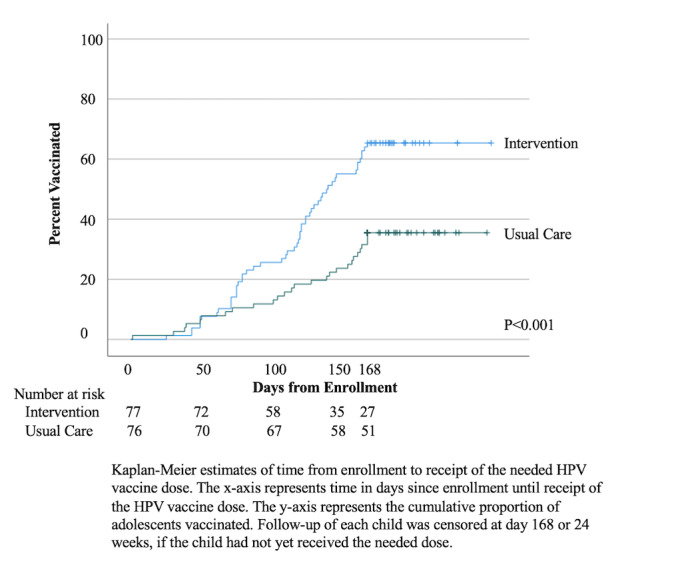
Overall, 154 caregivers were enrolled (51.3% for dose 1; 48.7% for dose 2) and 64.3% (n=99) spoke Luganda. Among individuals in the intervention arm, 62% (48/78) requested SMS text message reminders and 38% (n=30) requested automated phone reminders. There was no significant difference in requested mode by HPV vaccine dose or language. Intervention adolescents were more likely to receive the needed dose by 24 weeks (51/78, 65.4% vs 27/76, 35.5%; P<.001; RR 1.8; 95% CI 1.3-2.6). There was no interaction by dose or language. There was no difference in vaccination between those requesting SMS text message versus phone reminders (32/49, 65.3% vs 19/30, 63.3%; P=.86). The number needed to message for one additional vaccination was 3.4 (95% CI 2.2-6.8). Kaplan-Meier curves demonstrated more timely vaccination in the intervention arm (P<.001).
In this novel trial, SMS text message and automated phone reminders were effective in promoting more timely HPV vaccination in this population.
宫颈癌目前是乌干达女性中的主要癌症。大多数女性被诊断为晚期疾病。人乳头瘤病毒(HPV)疫苗接种是最重要的一级预防措施。虽然在美国关于短信疫苗提醒使用的研究很多,但在撒哈拉以南非洲或其他低收入和中等收入国家的青春期前和青少年人群中尚未证明其使用效果。
这项试点随机对照试验的目的是评估带有嵌入式互动教育信息的疫苗提醒对乌干达坎帕拉HPV疫苗接种及时性的影响。
在2022年进行的这项随机对照试验中,从乌干达坎帕拉的一家青少年诊所和三个社区卫生中心招募需要接种第一剂或第二剂HPV疫苗的青少年的照顾者。家庭(n = 154)按1:1随机分为干预组和常规护理组,在每个地点按剂量(即起始、完成)和语言(即英语、卢干达语)分层。干预组的照顾者根据家庭偏好收到一系列自动的、个性化的短信或自动电话。在到期日前发送五条信息,包括静态和互动教育信息,对未接种疫苗的人发送五条跟进信息。通过χ²检验、回归分析和带有对数秩检验 Kaplan-Meier 法评估入组后24周内所需剂量的接种情况。所有分析均采用意向性分析原则。
总体而言,共招募了154名照顾者(第一剂占51.3%;第二剂占48.7%),64.3%(n = 99)说卢干达语。在干预组中,62%(48/78)要求短信提醒,38%(n = 30)要求自动电话提醒。按HPV疫苗剂量或语言划分,所要求的模式没有显著差异。干预组的青少年在24周内更有可能接种所需剂量(51/78,65.4%对27/76,35.5%;P <.001;RR 1.8;95%CI 1.3 - 2.6)。在剂量或语言方面没有交互作用。要求短信提醒与电话提醒的人群在疫苗接种方面没有差异(32/49,65.3%对19/30,63.3%;P = 0.86)。额外增加一人接种所需发送信息的数量为3.4(95%CI 2.2 - 6.8)。Kaplan-Meier曲线显示干预组的疫苗接种更及时(P <.001)。
在这项新颖的试验中,短信和自动电话提醒有效地促进了该人群中更及时的HPV疫苗接种。