Mitchell Brendon C, Baldwin Keith
Division of Orthopedic Surgery, Children's Hospital of Philadelphia, Philadelphia, PA, USA.
J Pediatr Soc North Am. 2025 Jul 1;12:100234. doi: 10.1016/j.jposna.2025.100234. eCollection 2025 Aug.
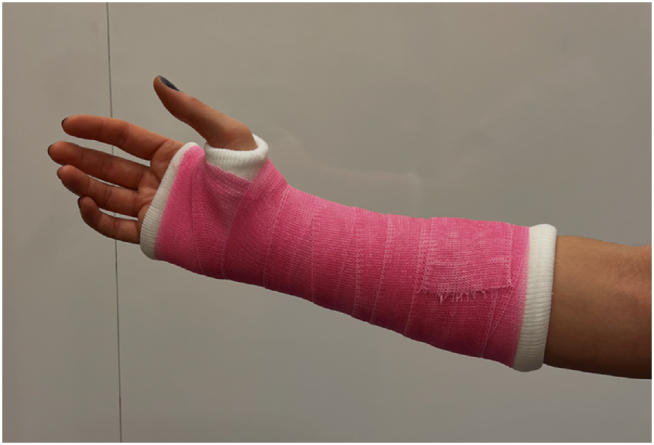
The purpose of this chapter is to thoroughly review the properties and pitfalls of various casting materials used in pediatric fracture care. Additionally, we will examine the unique characteristics of children that influence decision-making regarding the selection of materials for the under- and over-layers of a cast, as well as considerations based on anatomic location and type of cast. Generally, the underlayer of any cast provides cushioning and protects the underlying soft tissues, whereas the overlayer delivers rigid immobilization intended to maintain the alignment of the fracture. Fracture management can be achieved through splinting or casting. While splints offer rigid immobilization, they do not wrap circumferentially around the extremity, in contrast to casts, which are applied in a circumferential manner. The most common overlayer materials for achieving rigid immobilization in casting are plaster of Paris and fiberglass. Both materials can also be used to form a splint. Waterproof casting can be accomplished by using a water-tolerant underlayer (ie Gore-Tex) and a fiberglass overlayer. Proper material selection and careful application of each layer are crucial to providing immobilization in a safe manner that protects the underlying soft tissues.
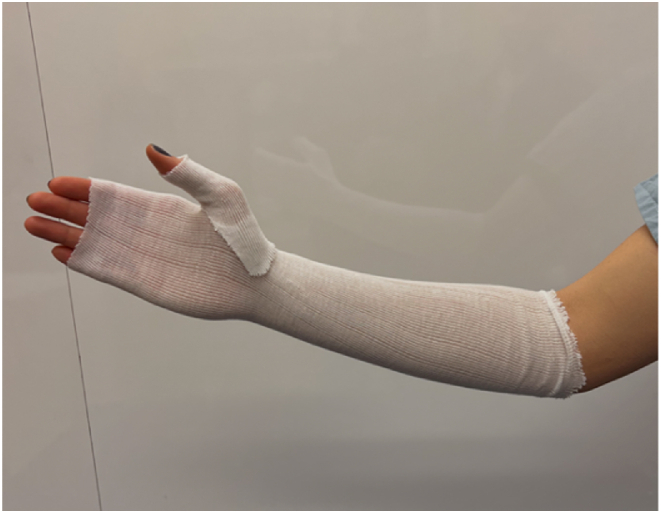
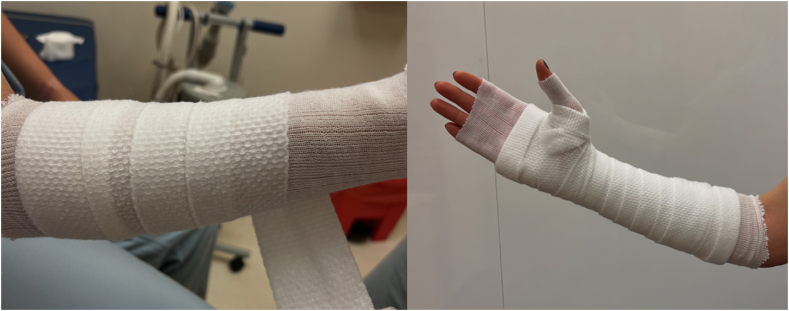
(1)Stockinette made from a synthetic polyester material often serves as the first layer of a cast, providing an initial barrier to the skin.(2)Soft roll (ie Webril) is the primary padding material used in casting, but it can be supplemented with materials like moleskin, silicone, and foam.(3)Fiberglass and plaster of Paris offer rigid immobilization and can be used as a cast or splint, requiring careful padding to avoid soft tissue injury.(4)The art of casting requires a delicate balance of layer thickness and tautness, along with attention to cast edges, material balance, and pressure points on the skin.
本章的目的是全面回顾用于儿童骨折治疗的各种铸造材料的特性和陷阱。此外,我们将研究儿童的独特特征,这些特征会影响在选择石膏内层和外层材料时的决策,以及基于解剖位置和石膏类型的考虑因素。一般来说,任何石膏的内层都提供缓冲并保护其下方的软组织,而外层则提供刚性固定,旨在维持骨折的对线。骨折处理可以通过夹板固定或石膏固定来实现。虽然夹板提供刚性固定,但它们不像石膏那样沿肢体周向包裹。铸造中用于实现刚性固定的最常见外层材料是巴黎石膏和玻璃纤维。这两种材料也可用于形成夹板。防水石膏可以通过使用防水内层(即戈尔特斯)和玻璃纤维外层来完成。正确选择材料并仔细应用每一层对于以安全方式提供固定并保护下方的软组织至关重要。
(1)由合成聚酯材料制成的弹力织物通常用作石膏的第一层,为皮肤提供初始屏障。(2)软卷(即韦布里尔)是铸造中使用的主要填充材料,但可以用绒面革、硅胶和泡沫等材料进行补充。(3)玻璃纤维和巴黎石膏提供刚性固定,可用于制作石膏或夹板,需要仔细填充以避免软组织损伤。(4)铸造技术需要在层厚度和紧绷度之间达到微妙的平衡,同时要注意石膏边缘、材料平衡和皮肤上的压力点。