
基于“全舌”特征的非产褥期乳腺炎诊断:非侵入性生物标志物挖掘与诊断模型构建
Diagnosis of non-puerperal mastitis based on "whole tongue" features: non-invasive biomarker mining and diagnostic model construction.
作者信息
Tu Siyuan, Yin Yulian, Ma Lina, Chen Hongfeng, Ye Meina
机构信息
Department of Breast Surgery, Longhua Hospital, Shanghai University of Traditional Chinese Medicine, Shanghai, China.
出版信息
Front Cell Infect Microbiol. 2025 Jul 28;15:1602883. doi: 10.3389/fcimb.2025.1602883. eCollection 2025.
BACKGROUND
Non-puerperal mastitis (NPM) arises from heterogeneous factors ranging from autoimmune dysregulation to occult infections. To establish a diagnosis, biopsy is reliable but invasive. Imaging exhibits a limited specificity and may cause diagnostic delays, patient discomfort, and suboptimal management. Inspired by non-invasive tongue diagnosis in traditional Chinese medicine, this study integrated tongue-coating microbiota profiling and AI-quantified tongue image phenotyping to establish an objective, non-invasive diagnostic framework for NPM.
METHODS
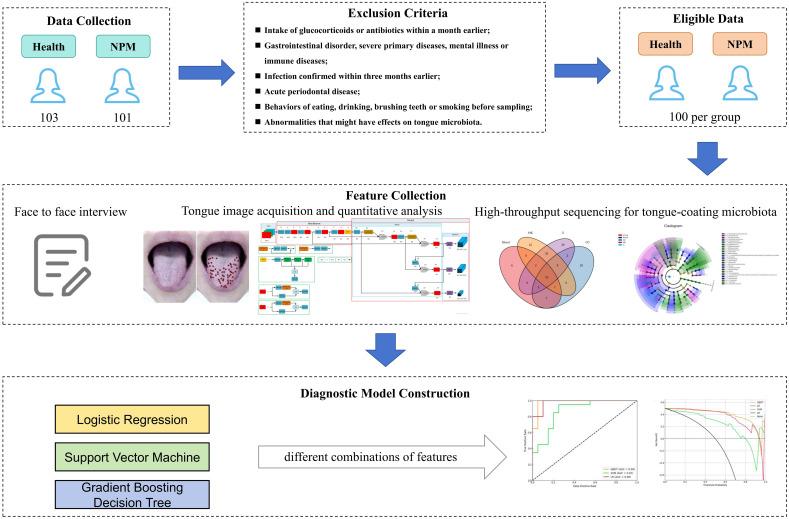
A total of 100 NPM patients from the Breast Surgery Department of Longhua Hospital and 100 healthy volunteers were included. Their clinical characteristics, tongue images, and tongue-coating microbiota data were collected. Features of tongue images (detection, segmentation, and classification) were quantitated and extracted via deep learning. The microbiota composition was assessed using 16S rRNA gene sequencing (V3-V4 region) and bioinformatic pipelines (QIIME2, DADA2). Based on clinical, imaging, and microbial features, three machine learning models-logistic regression (LR), support vector machine (SVM), and gradient boosting decision tree (GBDT)-were trained to distinguish NPM.
RESULTS
The GBDT model achieved a superior diagnostic performance (AUROC = 0.98, accuracy = 0.95, and specificity = 0.95), outperforming the LR (AUROC = 0.98, accuracy = 0.95, and specificity = 0.90) and SVM models (AUROC = 0.87, accuracy = 0.80, and specificity = 0.75). Integration of clinical characteristics, tongue image features, and bacterial profiles (at the genus/family level) yielded the highest accuracy, whereas models using a single class of features showed a lower discriminatory ability (AUROC = 0.90-0.91). Key predictors included (12%), waist-hip ratio (11%), and (6%).
CONCLUSIONS
Integrating clinical characteristics, tongue image features, and tongue-coating microbiota profiles, the multimodal GBDT model demonstrates a high diagnostic accuracy, supporting its utility for early screening and diagnosis of NPM.
背景
非产褥期乳腺炎(NPM)由多种因素引起,从自身免疫失调到隐匿性感染不等。为了确诊,活检可靠但具有侵入性。影像学检查特异性有限,可能导致诊断延迟、患者不适以及管理欠佳。受中医无创舌诊的启发,本研究整合舌苔微生物群分析和人工智能量化舌图像表型,以建立一个客观、无创的NPM诊断框架。
方法
纳入龙华医院乳腺外科的100例NPM患者和100名健康志愿者。收集他们的临床特征、舌图像和舌苔微生物群数据。通过深度学习对舌图像特征(检测、分割和分类)进行量化和提取。使用16S rRNA基因测序(V3-V4区域)和生物信息学流程(QIIME2、DADA2)评估微生物群组成。基于临床、影像学和微生物特征,训练了三种机器学习模型——逻辑回归(LR)、支持向量机(SVM)和梯度提升决策树(GBDT)——以区分NPM。
结果
GBDT模型具有卓越的诊断性能(曲线下面积[AUC] = 0.98,准确率 = 0.95,特异性 = 0.95),优于LR模型(AUC = 0.98,准确率 = 0.95,特异性 = 0.90)和SVM模型(AUC = 0.87,准确率 = 0.80,特异性 = 0.75)。整合临床特征、舌图像特征和细菌谱(属/科水平)可获得最高准确率,而使用单一类别特征的模型显示出较低的鉴别能力(AUC = 0.90 - 0.91)。关键预测因素包括(此处原文缺失具体内容,可能影响完整理解)(12%)、腰臀比(11%)和(此处原文缺失具体内容,可能影响完整理解)(6%)。
结论
整合临床特征、舌图像特征和舌苔微生物群谱,多模式GBDT模型显示出高诊断准确率,支持其在NPM早期筛查和诊断中的应用价值。



 Zotero 插件