Maity Sabyasachi, De Filippis Samantha Michelle, Aldanese Alexander, McCulloch Melissa A, Sandor Alexis P, Perez Cajigas Jan E, Antoniadis Yiorgos, Rochester Te-Keila D T, Carter Lauren Elizabeth, Preisig Alexander M, Kobeissi Julia Ali, Nayak Narendra, Mendoza Jaime E, Nauhria Samal
Department of Cellular & Integrative Physiology, Long School of Medicine, UT Health San Antonio, San Antonio, TX, United States.
Department of Medicine, University of Medicine and Health Sciences, Basseterre, Saint Kitts and Nevis.
Front Med (Lausanne). 2025 Jul 28;12:1587090. doi: 10.3389/fmed.2025.1587090. eCollection 2025.
Emotional intelligence (EI) is a crucial competency for medical professionals, facilitating effective interpersonal relationships between physicians and patients. The ability to evaluate, regulate, and apply emotional understanding plays a significant role in fostering empathy, communication, and stress management. This systematic review aimed to determine the impact of various interventions on medical students' EI development, academic performance, and overall patient care.
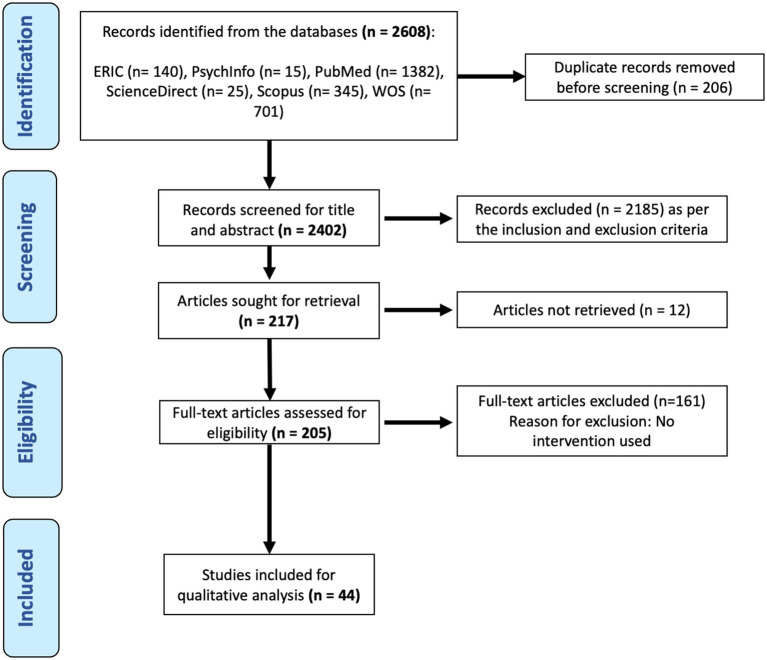
A comprehensive literature search was conducted for studies published from 2021 until 2024, inclusion criteria focused on studies on medical students, employed validated EI assessment tools, and utilized appropriate research designs.
44 articles met the inclusion criteria. The Joanna Briggs Institute (JBI) Critical Appraisal Checklist was applied to assess the quality of included studies. Although a meta-analysis was initially planned, substantial heterogeneity across the studies limited the pooling of quantitative data. Using an inductive coding approach, eight major themes were identified: Narrative and Storytelling Interventions, Reflective Practices and Writing, Communication Skills Training, Emotional Intelligence Enhancement, Experiential Learning and Patient Exposure, Stress, Burnout, and Coping Interventions, Assessment Tools and Structural Interventions, and Personalized Interventions and Diversity Considerations. These themes were subsequently mapped onto Daniel Goleman's model of Emotional Intelligence to provide a structured theoretical framework.
The findings of this review highlight that various interventions hold promise in enhancing EI among medical students, leading to improvements in personal well-being, communication skills, and professional development. The most effective approach appears to be a multifaceted, longitudinal integration of EI-focused strategies throughout medical training, incorporating repeated practice, guided reflection, faculty mentorship, and structured debriefing. The broader implications extend to improved doctor-patient relationships, reduced burnout, and enhanced clinical decision-making, ultimately contributing to higher patient satisfaction and more compassionate healthcare delivery. Future research should focus on refining intervention methodologies and assessing their long-term impact on medical education and practice.
情商(EI)是医学专业人员的一项关键能力,有助于医生与患者之间建立有效的人际关系。评估、调节和应用情绪理解的能力在培养同理心、沟通能力和压力管理方面发挥着重要作用。本系统评价旨在确定各种干预措施对医学生情商发展、学业成绩和整体患者护理的影响。
对2021年至2024年发表的研究进行了全面的文献检索,纳入标准侧重于针对医学生的研究、采用经过验证的情商评估工具以及运用适当的研究设计。
44篇文章符合纳入标准。应用乔安娜·布里格斯研究所(JBI)批判性评价清单来评估纳入研究的质量。尽管最初计划进行荟萃分析,但研究之间存在的实质性异质性限制了定量数据的合并。采用归纳编码方法,确定了八个主要主题:叙事与故事讲述干预、反思性实践与写作、沟通技能培训、情商提升、体验式学习与患者接触、压力、职业倦怠与应对干预、评估工具与结构性干预以及个性化干预与多样性考量。随后将这些主题映射到丹尼尔·戈尔曼的情商模型上,以提供一个结构化的理论框架。
本评价的结果突出表明,各种干预措施有望提高医学生的情商,从而改善个人幸福感、沟通技能和职业发展。最有效的方法似乎是在整个医学培训过程中多方面、纵向整合以情商为重点的策略,包括反复练习、引导反思、教师指导和结构化汇报。更广泛的影响包括改善医患关系、减少职业倦怠和增强临床决策能力,最终提高患者满意度并提供更具同情心的医疗服务。未来的研究应侧重于完善干预方法,并评估其对医学教育和实践的长期影响。