Debracque Coralie, Ceravolo Leonardo, Clay Zanna, Grandjean Didier, Gruber Thibaud
Department of Psychology and Educational Sciences and Swiss Center for Affective Sciences, University of Geneva, Geneva, Switzerland.
Department of Psychology, Durham University, Durham, United Kingdom.
Imaging Neurosci (Camb). 2025 Feb 20;3. doi: 10.1162/imag_a_00480. eCollection 2025.
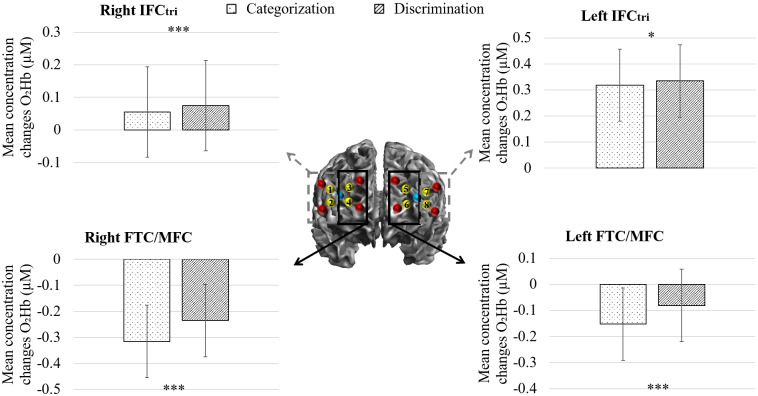
Previous research has highlighted the involvement of frontal regions in human participants while they engaged in the explicit decoding, such as categorization (AB) and discrimination (Anon-A), of affective signals. Given its adaptive value and deep evolutionary history, this human capacity to recognize the affective content in human calls is likely to extend to the vocalizations of other closely related species, such as non-human primates. However, few comparative studies have thus far investigated this process at both the behavioral and neural levels. Here, we aimed to study the role of frontal regions in human participants while they engaged in the explicit affective content decoding of primate calls using functional Near Infrared Spectroscopy (fNIRS). Specifically, we recorded frontal regions of participants while they categorized or discriminated positive and negatively valenced vocal signals produced by four different primates: humans, chimpanzee and bonobo (both great apes species), and rhesus macaques (a more distant species). We also analyzed whether behavioral responses correlated with recorded frontal activations. fNIRS data revealed more activations within the inferior frontal cortex(IFC), the frontopolar (FPC), and middle frontal cortices (MFC) during discrimination compared with categorization. Activity in these regions was modulated by both the species and the type of task, with greater activity during the discrimination of agonistic chimpanzee calls compared with categorization. Categorization was itself characterized by a decrease of frontal activity during the correct recognition of all chimpanzee calls, and of affiliative rhesus macaque and agonistic bonobo vocalizations. Our results also highlighted behavioral differences related to the type of task. Participants discriminated almost all affective cues of all four species vocalizations above chance level. In comparison, they correctly categorized the affective content of most human and great ape vocalizations above chance level, but not those of rhesus macaque calls, highlighting an effect of both phylogenetic relatedness and the type of task. Overall, these findings support the hypothesis of an evolutionary ancient affective recognition processing system situated in the frontal cortex, inherited from our last common ancestor with other great apes.
先前的研究强调了人类参与者在对情感信号进行明确解码(如分类[AB]和辨别[非A])时额叶区域的参与。鉴于其适应性价值和深厚的进化历史,人类识别人类叫声中情感内容的这种能力可能会扩展到其他密切相关物种的发声,如非人类灵长类动物。然而,迄今为止,很少有比较研究在行为和神经层面上对这一过程进行研究。在这里,我们旨在利用功能近红外光谱(fNIRS)研究人类参与者在对灵长类动物叫声进行明确情感内容解码时额叶区域的作用。具体而言,我们记录了参与者在对四种不同灵长类动物发出的正价和负价声音信号进行分类或辨别时的额叶区域,这四种灵长类动物分别是:人类、黑猩猩和倭黑猩猩(均为大型猿类物种)以及恒河猴(一种亲缘关系较远的物种)。我们还分析了行为反应是否与记录的额叶激活相关。fNIRS数据显示,与分类相比,辨别过程中额下回(IFC)、额极(FPC)和额中回(MFC)内的激活更多。这些区域的活动受到物种和任务类型的调节,与分类相比,在辨别黑猩猩的攻击性叫声时活动更强。分类本身的特点是,在正确识别所有黑猩猩叫声、恒河猴的亲和性叫声和倭黑猩猩的攻击性叫声时额叶活动减少。我们的结果还突出了与任务类型相关的行为差异。参与者辨别出所有四种物种叫声的几乎所有情感线索,高于随机水平。相比之下,他们正确分类了大多数人类和大型猿类叫声的情感内容,高于随机水平,但没有正确分类恒河猴叫声的情感内容,这突出了系统发育相关性和任务类型的影响。总体而言,这些发现支持了位于额叶皮层的进化古老的情感识别处理系统这一假设,该系统是从我们与其他大型猿类的最后一个共同祖先继承而来的。