Wouters Olivier J, Denolle Cyprien, Wei Jinru, Papanicolas Irene
Department of Health Services, Policy and Practice, Brown University School of Public Health, Providence, Rhode Island.
Department of Health Policy, London School of Economics and Political Science, London, United Kingdom.
JAMA Health Forum. 2025 Aug 1;6(8):e252043. doi: 10.1001/jamahealthforum.2025.2043.
Little is known about how the prices and affordability of medicines included on the World Health Organization's Model List of Essential Medicines vary across the globe.
To compare the list prices and affordability of essential medicines across high-, middle-, and low-income markets.
This cross-sectional study examined data from 2022 on list prices and volumes of 549 essential medicines in 72 high-, middle-, and low-income markets (covering 87 countries). These data were obtained from IQVIA. The statistical analyses were performed between August 2024 and March 2025.
Laspeyres price indices were used to compare average drug prices across countries, both in nominal and purchasing power parity-adjusted terms. The affordability of 8 essential medicines, used to treat major causes of death and disability globally, was assessed by calculating how many days of minimum wage would be required to pay for 1 month of treatment.
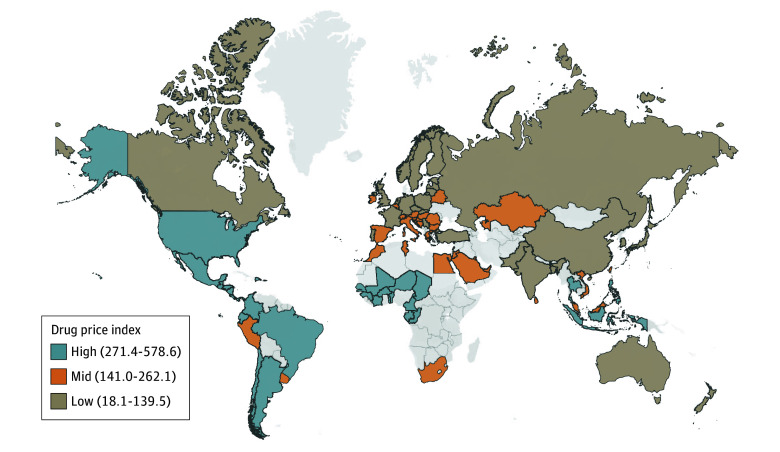
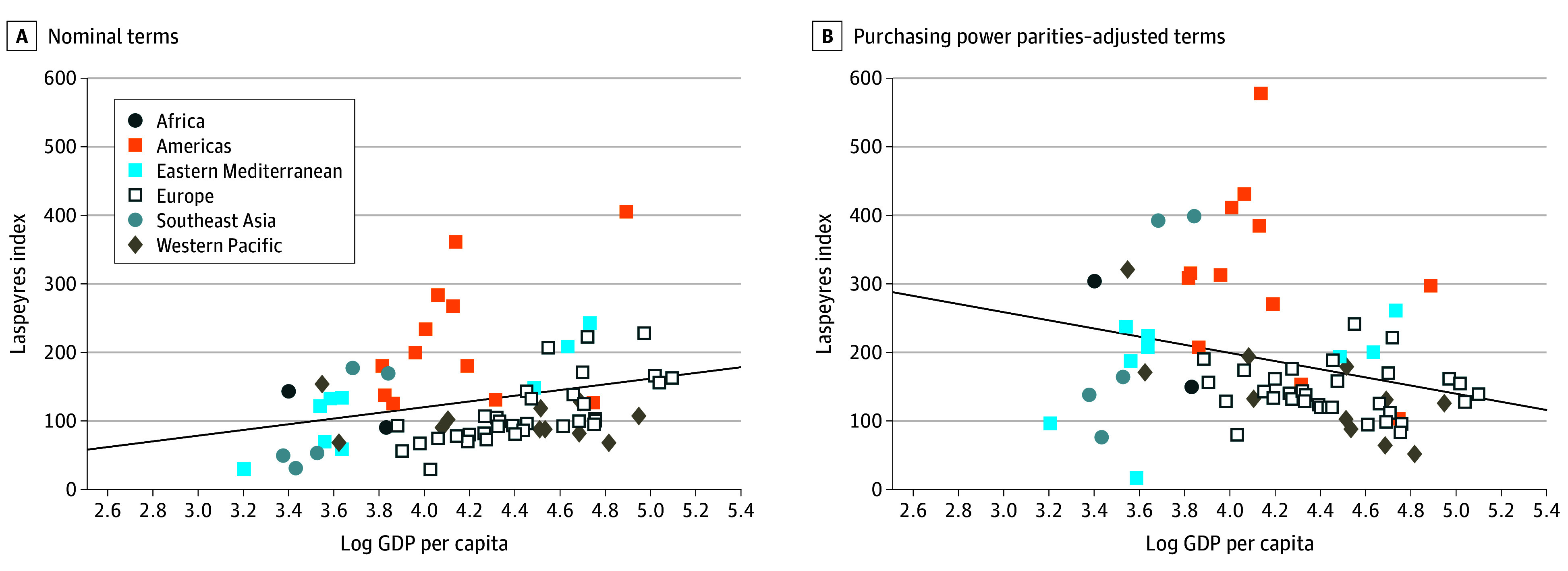
The availability of essential medicines ranged from 225 (41%) in Kuwait to 438 (80%) in Germany (base country). After accounting for purchasing power parities, prices of essential medicines in Lebanon were, on average, 18.1% of those in Germany (Lebanon price index, 18.1 vs Germany price index, 100), while average prices in the US were 3.0 times higher than in Germany (US price index, 298.2). A positive association was observed between countries' gross domestic product per capita (expressed in logarithmic terms) and nominal drug prices (R = 0.30; P = .01), indicating that richer countries generally had higher drug prices. However, when adjusting for the purchasing power of different currencies, an inverse association was observed (R = -0.35; P = .003), suggesting that richer countries had lower real prices. Drug affordability, as measured by the number of days' minimum wage needed to purchase a month's treatment, varied widely, with median affordability highest in Europe and the Western Pacific, and lowest in Africa and Southeast Asia.
The results of this cross-sectional analysis showed significant variation in the prices and affordability of 549 essential medicines across 72 markets in 2022. Strategies to promote equitable drug prices and improve drug affordability are urgently needed.
对于世界卫生组织基本药物示范清单上的药品价格及可负担性在全球范围内的差异,人们了解甚少。
比较高、中、低收入市场基本药物的标价及可负担性。
这项横断面研究分析了2022年72个高、中、低收入市场(涵盖87个国家)中549种基本药物的标价及销量数据。这些数据来自艾昆纬公司。统计分析于2024年8月至2025年3月进行。
采用拉氏价格指数,以名义价格和购买力平价调整后的价格来比较各国的平均药品价格。通过计算支付1个月治疗所需的最低工资天数,评估了用于治疗全球主要死亡和残疾原因的8种基本药物的可负担性。
基本药物的可获得性差异较大,从科威特的225种(41%)到德国(基准国家)的438种(80%)不等。考虑购买力平价后,黎巴嫩基本药物的价格平均为德国的18.1%(黎巴嫩价格指数为18.1,德国价格指数为100),而美国的平均价格比德国高3.0倍(美国价格指数为298.2)。观察到各国人均国内生产总值(以对数形式表示)与名义药品价格之间存在正相关(R = 0.30;P = 0.01),这表明较富裕国家的药品价格通常更高。然而,在调整不同货币的购买力后,观察到负相关(R = -0.35;P = 0.003),这表明较富裕国家的实际价格更低。以购买1个月治疗所需的最低工资天数衡量,药品可负担性差异很大,欧洲和西太平洋地区的可负担性中位数最高,非洲和东南亚地区最低。
这项横断面分析的结果表明,2022年72个市场中549种基本药物的价格和可负担性存在显著差异。迫切需要采取策略来促进药品价格公平并提高药品可负担性。