
新冠疫情在欧洲各部门和地区之间的经济联系。
The economic linkages of Covid-19 across sectors and regions in Europe.
作者信息
Pérez-Sebastián Fidel, Serrano-Quintero Rafael
机构信息
Department of Economics (FAE), University of Alicante, Alicante, Spain.
Department of Economics, BEAT and CREB, University of Barcelona, Barcelona, Spain.
出版信息
SERIEs (Berl). 2025;16(1):5-81. doi: 10.1007/s13209-025-00305-0. Epub 2025 Mar 15.
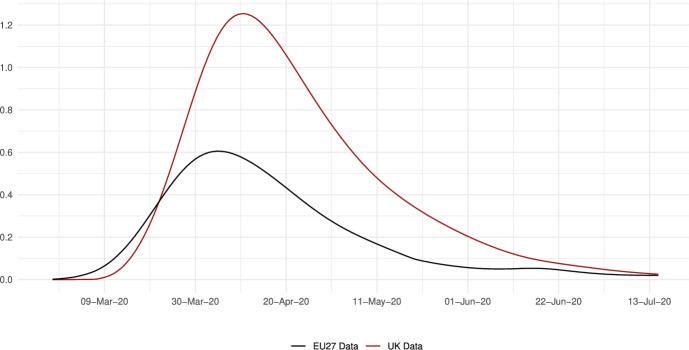
This paper builds a spatial model of trade with supply-chain links to examine the effect of economic links and anti-COVID policies on the spread of the COVID-19 pandemic during the first wave across NUTS2 regions of the European Union (EU) and the UK. We find that the effort to reduce infection rates was more successful in the UK than in the EU, and that the deaths due to the trade vector were 10% on average across Europe. Our results imply that without the policy response in Europe, the number of deaths during the first wave would have been about 4,520,000 higher in the EU and around 1,240,000 greater in the UK, with significant variations across regions. Oberbayern in Germany and South Yorkshire in the UK appear as the most effective in reducing the death burden of COVID-19 at different points during the first wave. Moreover, 42% and 37% of the total deaths in the UK and the EU, respectively, could have been prevented if the policy implemented in these two regions had prevailed throughout Europe.
本文构建了一个具有供应链联系的贸易空间模型,以研究经济联系和抗疫政策对新冠疫情第一波期间在欧盟(EU)和英国的NUTS2地区传播的影响。我们发现,英国在降低感染率方面比欧盟更成功,并且贸易传播导致的死亡在欧洲平均占10%。我们的结果表明,如果欧洲没有政策响应,第一波疫情期间欧盟的死亡人数将比实际高出约452万,英国则高出约124万,且各地区差异显著。德国的上巴伐利亚州和英国的南约克郡在第一波疫情的不同阶段,在减轻新冠死亡负担方面表现最为有效。此外,如果这两个地区实施的政策在全欧洲推广,英国和欧盟分别有42%和37%的总死亡人数本可避免。




 Zotero 插件