Calatayud Agustina, Bedoya-Maya Felipe, Sánchez González Santiago, Giraldez Francisca
Transport Division, Inter-American Development Bank, Washington D.C, 20577, United States.
Transp Policy (Oxf). 2022 Jan;115:4-13. doi: 10.1016/j.tranpol.2021.10.022. Epub 2021 Nov 1.
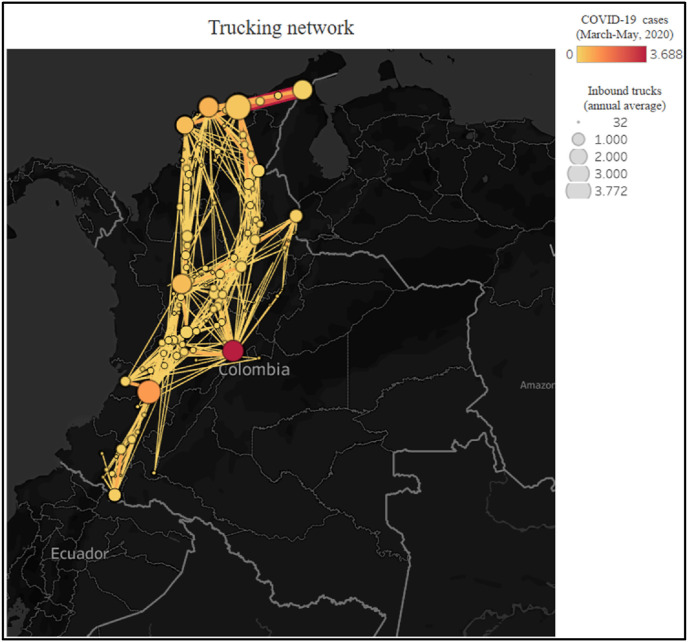
The trucking industry is the backbone of domestic supply chains. In the context of the COVID-19 pandemic, road transportation has been essential to guarantee the supply of basic goods to confined urban areas. However, the connectivity of the trucking network can also act as an efficient virus spreader. This paper applies network science to uncover the characteristics of the trucking network in one major Latin American country -Colombia- and provides evidence on freight networks' ability to spread contagious diseases spatially. Network metrics, official COVID-19 records at the municipality level, and a zero-inflated negative binomial model are used to test the association between network topology and confirmed COVID-19 cases. Results suggest that: (i) the number of COVID-19 cases in a municipality is linked to its level and type of network centrality; and (ii) being a port-city and a primary economic hub in the trucking network is associated with a higher probability of contracting earlier a pandemic. Based on these results, a risk-based approach is proposed to help policymakers implement containment measures.
货运行业是国内供应链的支柱。在新冠疫情背景下,公路运输对于保障向封闭城市地区供应基本物资至关重要。然而,货运网络的连通性也可能成为高效的病毒传播途径。本文运用网络科学揭示一个主要拉丁美洲国家——哥伦比亚的货运网络特征,并提供有关货运网络在空间上传播传染病能力的证据。利用网络指标、市级官方新冠疫情记录以及零膨胀负二项式模型来检验网络拓扑结构与新冠确诊病例之间的关联。结果表明:(i)一个城市的新冠病例数量与其网络中心性的水平和类型相关;(ii)作为港口城市以及货运网络中的主要经济枢纽与更早感染大流行病的较高概率相关。基于这些结果,提出了一种基于风险的方法,以帮助政策制定者实施遏制措施。