Chuaicharoen Pavadee, Wattanawong Oranard, Watthanakulpanich Dorn, Rotejanaprasert Chawarat, Iamsirithaworn Sopon, Adisakwattana Poom, Pan-Ngum Wirichada
Department of Tropical Hygiene, Faculty of Tropical Medicine, Mahidol University, Bangkok, Thailand.
Ministry of Public Health, Nonthaburi, Thailand.
PLoS Negl Trop Dis. 2025 Aug 22;19(8):e0013435. doi: 10.1371/journal.pntd.0013435. eCollection 2025 Aug.
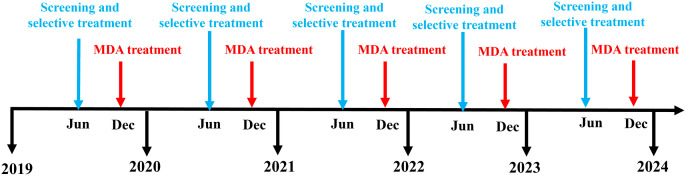
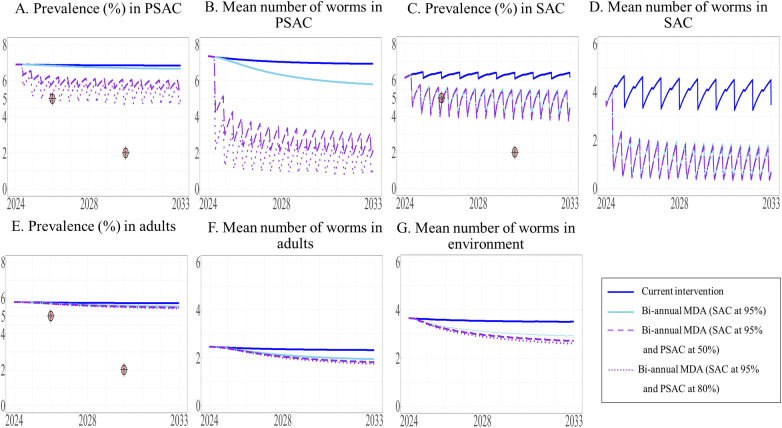
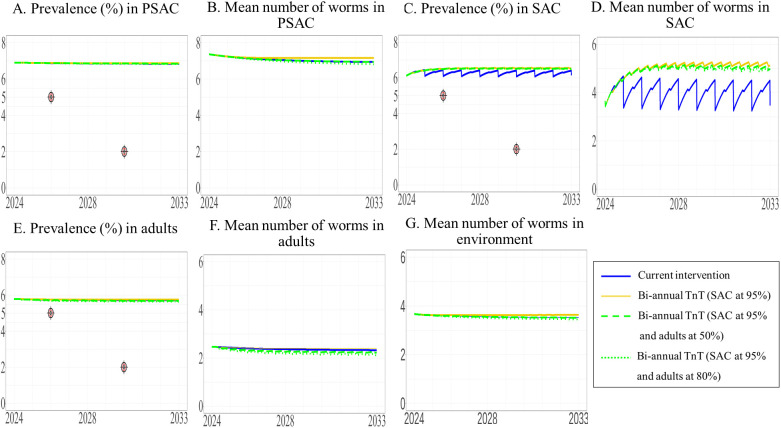
Soil-transmitted helminthiases, caused by soil-transmitted helminths (commonly known as intestinal worms), are considered to be neglected tropical diseases (NTDs). In Thailand, school-age children (SAC) who live in remote areas are at risk of STH. A school-based combined intervention involving test and treat (TnT) and mass drug administration (MDA) programs has been implemented as part of the national STH control program since 2002, with a target to eliminate STH in SAC by 2026. To help achieve this target, we developed an STH transmission dynamic model, calibrated it using STH infection prevalence data from Thailand, and used the model to simulate the effects of the current intervention targeting only SAC and expanded interventions that also cover preschool-age children (PSAC) and adults. We also investigated modified interventions, including biannual MDA and TnT. Our model predicted that neither the current nor a biannual TnT can achieve elimination, even with expanded target populations. However, all biannual MDA treatment scenarios showed a reduced prevalence of STH in SAC, of less than 5%, by 2026. Our model also predicted that biannual MDA targeting SAC and adults would be more effective than targeting SAC and PSAC. Our findings suggest that if community-wide biannual MDA treatment were to be included in the control program, this would be beneficial for eliminating STH in Thailand.
土壤传播的蠕虫病由土壤传播的蠕虫(通常称为肠道蠕虫)引起,被视为被忽视的热带病(NTDs)。在泰国,生活在偏远地区的学龄儿童(SAC)有感染土壤传播蠕虫的风险。自2002年以来,作为国家土壤传播蠕虫控制计划的一部分,已实施了一项基于学校的综合干预措施,包括检测和治疗(TnT)以及群体药物给药(MDA)计划,目标是到2026年消除学龄儿童中的土壤传播蠕虫感染。为了帮助实现这一目标,我们开发了一个土壤传播蠕虫传播动态模型,利用泰国的土壤传播蠕虫感染率数据对其进行校准,并使用该模型模拟当前仅针对学龄儿童的干预措施以及扩大到涵盖学龄前儿童(PSAC)和成人的干预措施的效果。我们还研究了改进的干预措施,包括每半年一次的群体药物给药和检测与治疗。我们的模型预测,即使扩大目标人群,当前的干预措施和每半年一次的检测与治疗都无法实现消除目标。然而,所有每半年一次的群体药物给药治疗方案都显示,到2026年,学龄儿童中的土壤传播蠕虫感染率将降至5%以下。我们的模型还预测,针对学龄儿童和成人的每半年一次群体药物给药比针对学龄儿童和学龄前儿童更有效。我们的研究结果表明,如果在控制计划中纳入社区范围的每半年一次群体药物给药治疗,将有利于在泰国消除土壤传播蠕虫感染。