Cui Yali, Zhang Yanyuan, Wang Lin, Hao Yuanqiang
College of Chemistry and Chemical Engineering, Zhoukou Normal University, Zhoukou 466001, China.
Department of Ophthalmology, Hunan Aerospace Hospital, Hunan Normal University, Changsha 410081, China.
Biosensors (Basel). 2025 Aug 10;15(8):524. doi: 10.3390/bios15080524.
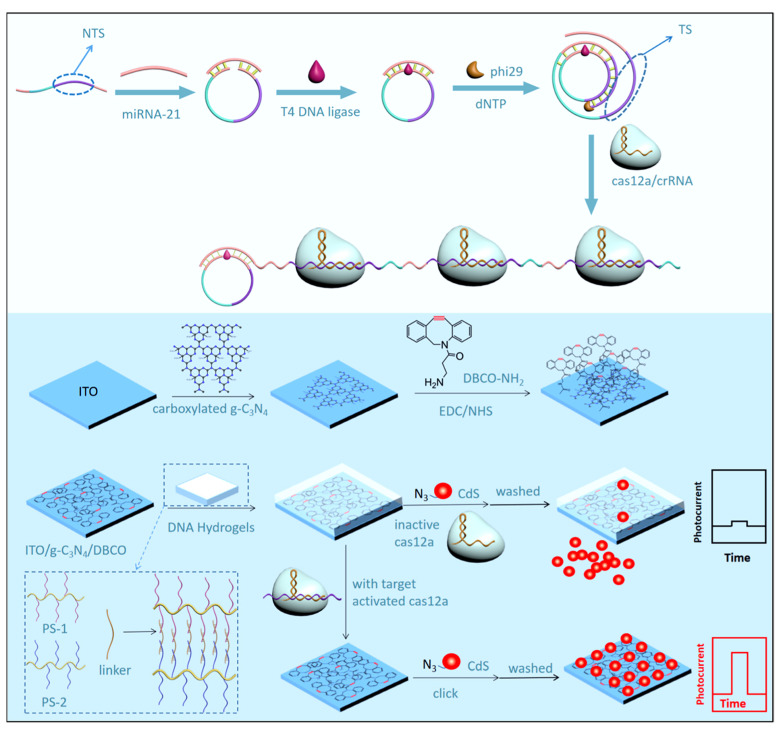
Photoelectrochemical (PEC) sensors have garnered increasing attention due to their high sensitivity, low background signal, and rapid response. The incorporation of hydrogels into PEC platforms has significantly expanded their analytical capabilities by introducing features such as biocompatibility, tunable porosity, antifouling behavior, and mechanical flexibility. This review systematically categorizes hydrogel materials into four main types-nucleic acid-based, synthetic polymer, natural polymer, and carbon-based-and summarizes their functional roles in PEC sensors, including structural support, responsive amplification, antifouling interface construction, flexible electrolyte integration, and visual signal output. Representative applications are highlighted, ranging from the detection of ions, small biomolecules, and biomacromolecules to environmental pollutants, photodetectors, and flexible bioelectronic devices. Finally, key challenges-such as improving fabrication scalability, enhancing operational stability, integrating emerging photoactive materials, and advancing bio-inspired system design-are discussed to guide the future development of hydrogel-enhanced PEC sensing technologies.
光电化学(PEC)传感器因其高灵敏度、低背景信号和快速响应而受到越来越多的关注。将水凝胶纳入PEC平台,通过引入生物相容性、可调孔隙率、抗污性能和机械柔韧性等特性,显著扩展了其分析能力。本综述将水凝胶材料系统地分为四种主要类型——基于核酸的、合成聚合物的、天然聚合物的和碳基的——并总结了它们在PEC传感器中的功能作用,包括结构支撑、响应放大、抗污界面构建、柔性电解质集成和视觉信号输出。重点介绍了代表性应用,范围从离子、小分子和生物大分子的检测到环境污染物、光电探测器和柔性生物电子器件。最后,讨论了关键挑战,如提高制造可扩展性、增强操作稳定性、整合新兴光活性材料以及推进仿生系统设计,以指导水凝胶增强PEC传感技术的未来发展。