
通过质子微束写入技术钻孔的聚二甲基硅氧烷(PDMS)膜:一种用于在类似Transwell装置中研究内皮细胞与基质相互作用的可定制平台。
PDMS Membranes Drilled by Proton Microbeam Writing: A Customizable Platform for the Investigation of Endothelial Cell-Substrate Interactions in Transwell-like Devices.
作者信息
Guarino Vita, Vasco Giovanna, Arima Valentina, Cataldo Rosella, Zizzari Alessandra, Perrone Elisabetta, Gigli Giuseppe, Cesaria Maura
机构信息
CNR NANOTEC-Institute of Nanotechnology, c/o Campus Ecotekne, 73100 Lecce, Italy.
Department of Experimental Medicine, University of Salento, 73100 Lecce, Italy.
出版信息
J Funct Biomater. 2025 Jul 28;16(8):274. doi: 10.3390/jfb16080274.
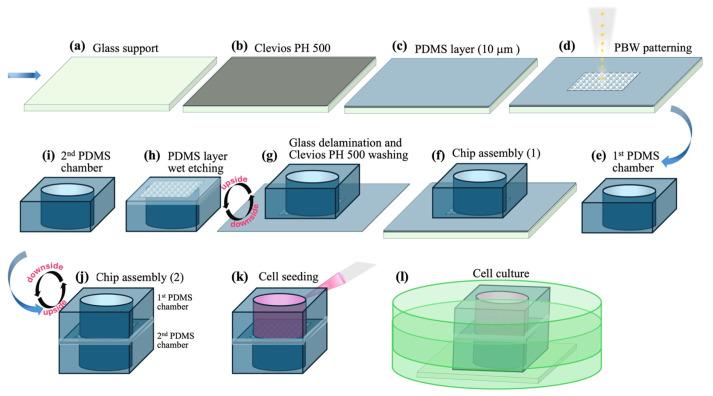
Cell migration assays provide valuable insights into pathological conditions, such as tumor metastasis and immune cell infiltration, and the regenerative capacity of tissues. In vitro tools commonly used for cell migration studies exploit commercial transwell systems, whose functionalities can be improved through engineering of the pore pattern. In this context, we propose the fabrication of a transwell-like device pursued by combining the proton beam writing (PBW) technique with wet etching onto thin layers of polydimethylsiloxane (PDMS). The resulting transwell-like device incorporates a PDMS membrane with finely controllable pore patterning that was used to study the arrangement and migration behavior of HCMEC/D3 cells, a well-established human brain microvascular endothelial cell model widely used to study vascular maturation in the brain. A comparison between commercial polycarbonate membranes and the PBW-holed membranes highlights the impact of the ordering of the pattern and porosity on cellular growth, self-organization, and transmigration by combining fluorescent microscopy and advanced digital processing. Endothelial cells were found to exhibit distinctive clustering, alignment, and migratory behavior close to the pores of the designed PBW-holed membrane. This is indicative of activation patterns associated with cytoskeletal remodeling, a critical element in the angiogenic process. This study stands up as a novel approach toward the development of more biomimetic barrier models (such as organ-on-chips).
细胞迁移分析为深入了解病理状况(如肿瘤转移和免疫细胞浸润)以及组织的再生能力提供了有价值的见解。体外细胞迁移研究常用的工具是利用商业转孔系统,其功能可通过对孔图案进行工程设计来改进。在此背景下,我们提出通过将质子束写入(PBW)技术与在聚二甲基硅氧烷(PDMS)薄层上进行湿法蚀刻相结合来制造一种类似转孔的装置。所得的类似转孔的装置包含一个具有精细可控孔图案的PDMS膜,该膜用于研究HCMEC/D3细胞的排列和迁移行为,HCMEC/D3细胞是一种广泛用于研究脑血管成熟的成熟人脑微血管内皮细胞模型。通过结合荧光显微镜和先进的数字处理,对商业聚碳酸酯膜和PBW打孔膜进行比较,突出了图案排列和孔隙率对细胞生长、自组织和迁移的影响。发现内皮细胞在设计的PBW打孔膜的孔附近表现出独特的聚集、排列和迁移行为。这表明与细胞骨架重塑相关的激活模式,而细胞骨架重塑是血管生成过程中的关键要素。这项研究是朝着开发更具仿生学的屏障模型(如芯片器官)迈出的一种新方法。



 Zotero 插件