Peng Hanyu, Chou Xintong, Zhang Zhen, Qiu Hongyan
Department of Epidemiology and Statistics, School of Public Health and Management, Ningxia Medical University, Yinchuan, 750004, Ningxia Hui Autonomous Region, People's Republic of China.
Key Laboratory of Environmental Factors and Chronic Disease Control, Ningxia Medical University, Yinchuan, 750004, Ningxia Hui Autonomous Region, People's Republic of China.
BMC Public Health. 2025 Aug 27;25(1):2955. doi: 10.1186/s12889-025-24358-9.
Persistent low fertility in China poses critical socioeconomic challenges. Family functioning has been implicated in reproductive decisionmaking, yet its heterogeneity remain underexplored, particularly among young adults. This study employs Latent Profile Analysis (LPA) to identify high and lowfunctioning family profiles among Chinese university students and their parents, and to quantify their associations with marriageandchildbearing attitudes and explicit fertility intentions.
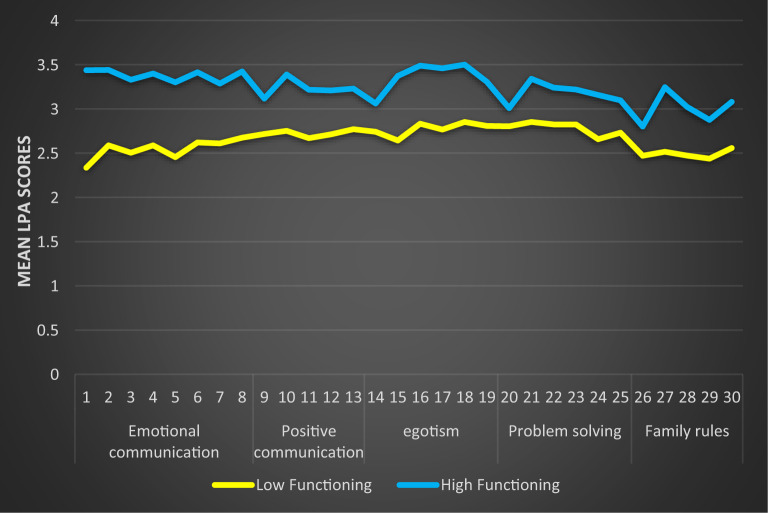
In a crosssectional survey of 484 student-parent pairs from two northwest Chinese universities, we administered a 68item questionnaire incorporating the 30item Chinese Family Assessment Device and standardized measures of fertility intentions and marriageandchildbearing views. LPA classified families into two profiles. Multinomial logistic regression (Models 1-3) tested the effect of family functioning on students' ideal number of children ("0," "1," "≥ 2," vs. "indifferent"), sequentially adjusting for student and parental sociodemographic covariates.
LPA yielded two profiles: lowfunctining (57.0%) and highfunctoning (43.0%) families. In Model 1, lowfunctioning membership increased the odds of intending 0 children (R = 2.90, 95% CI 1.53-5.49, p < 0.01), 1 child (OR = 2.65, 1.51-4.63, p < 0.01), and ≥ 2 children (OR = 3.54, 2.28-5.49, p < 0.001) versus remaining indifferent. Adjusting for student factors (Model 2) attenuated the zerochild effect (p = 0.21) but retained significant associations for 1 child (OR = 2.22, 1.20-4.12, p < 0.05) and ≥ 2 children (OR = 3.08, 1.77-5.35, p < 0.001). In the fully adjusted model (Model 3), lowfunctioning status remained a predictor only of ≥ 2 children (OR = 2.57, 1.40-4.73, p < 0.01). Older parental age independently predicted zerochild intentions (OR = 1.20, 1.08-1.33, p < 0.001), while parental occupation moderated highintention outcomes.
Low family functioning exerts a robust influence on both low and high fertility intentions, although its effect on zerochild plans is largely explained by student and parental characteristics. By uncovering multidimensional familyfunctioning profiles and their differential impacts, this study advances theoretical models of intergenerational value transmission and informs targeted familyeducation and policy interventions aimed at mitigating China's lowfertility trajectory.
中国持续的低生育率带来了严峻的社会经济挑战。家庭功能与生育决策有关,但其异质性仍未得到充分探索,尤其是在年轻人中。本研究采用潜在剖面分析(LPA)来识别中国大学生及其父母中功能良好和功能不良的家庭类型,并量化它们与婚姻和生育态度以及明确生育意愿的关联。
在对来自中国西北两所大学的484对学生-父母进行的横断面调查中,我们发放了一份包含30项中国家庭评估工具以及生育意愿和婚姻生育观标准化测量的68项问卷。LPA将家庭分为两种类型。多项逻辑回归(模型1-3)检验了家庭功能对学生理想子女数量(“0个”、“1个”、“≥2个”与“无所谓”)的影响,并依次调整了学生和父母的社会人口学协变量。
LPA产生了两种类型:功能不良(57.0%)和功能良好(43.0%)的家庭。在模型1中,与持无所谓态度相比,功能不良的家庭类型增加了生育0个孩子(比值比[R]=2.90,95%置信区间[CI]1.53-5.49,p<0.01)、1个孩子(OR=2.65,1.51-4.63,p<0.01)和≥2个孩子(OR=3.54,2.28-5.49,p<0.001)的几率。调整学生因素(模型2)后,生育0个孩子的影响减弱(p=0.21),但生育1个孩子(OR=2.22,1.20-4.12,p<0.05)和≥2个孩子(OR=3.08,1.77-5.35,p<0.001)的关联仍然显著。在完全调整模型(模型3)中,功能不良状态仍然只是生育≥2个孩子的一个预测因素(OR=2.57,1.40-4.73,p<0.01)。父母年龄较大独立预测生育0个孩子的意愿(OR=1.20,1.08-1.33,p<0.001),而父母职业调节了高生育意愿的结果。
家庭功能不良对低生育意愿和高生育意愿都有强烈影响,尽管其对生育0个孩子计划的影响在很大程度上由学生和父母的特征所解释。通过揭示多维家庭功能类型及其不同影响,本研究推进了代际价值传递的理论模型,并为旨在缓解中国低生育趋势的针对性家庭教育和政策干预提供了信息。