
用于去除制药工业废水中环丙沙星的氮掺杂二氧化钛/牧豆树生物炭纳米复合材料
N-doped TiO/prosopis juliflora biochar nanocomposites for removal of ciprofloxacin from pharmaceutical industrial wastewater.
作者信息
Ashebir Hailu, Babaee Saeideh, Worku Abebe, Diale Palesa, Msagati Titus, Nure Jemal Fito
机构信息
Department of Environmental Engineering, Addis Ababa Science and Technology University, Addis Ababa, Ethiopia.
School of Chemical and Metallurgical Engineering, University of the Witwatersrand, 1 Jorissen St, Johannesburg, 2000, South Africa.
出版信息
Sci Rep. 2025 Aug 29;15(1):31795. doi: 10.1038/s41598-025-03330-y.
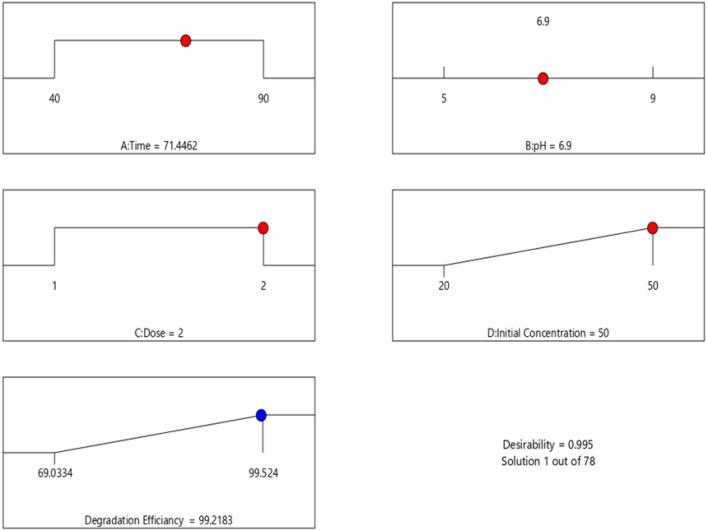
The contamination of aquatic ecosystems by pharmaceutical residues, particularly ciprofloxacin (CIX), can pose severe environmental and public health risks. This study aimed to optimize the photodegradation of CIX from pharmaceutical industrial wastewater using N-doped TiO/Biochar Nanocomposites. A novel N-doped TiO/BC nanocomposite was synthesized via sol-gel techniques and evaluated under UV and sunlight irradiation. Kinetic degradation parameters were optimized using Response Surface Methodology (RSM) with a Central Composite Design (CCD). The optimized conditions included a contact time of 72 min, a pH of 6.9, a nanocomposite dosage of 2 g/L, and an initial CIX concentration of 50 mg/L. Maximum degradation efficiencies of 98.9% and 96.9% were achieved under UV and visible light, respectively. The statistical evaluation confirmed the model's validity and adequacy, with a high F-value (86,345) and significant model terms (p < 0.0001). Additionally, the lack-of-fit test yielded a non-significant value (p = 0.93), indicating an excellent fit of the model to the data. The determination coefficients (R 0.98, adjusted R = 0.93, and predicted R = 0.96) further supported the model's robustness and predictive accuracy. The optimized parameters were applied to real pharmaceutical wastewater, achieving degradation efficiencies of 86.9% and 84.3% for UV and sunlight, respectively. These findings highlight the potential of N-doped TiO/BC nanocomposites for efficient CIX degradation and pharmaceutical pollutant removal by modifying the limitations of pristine TiO. Further, it solves scaling up the process and optimizes photocatalyst selection, stability, and reusability for practical environmental applications.
药物残留,尤其是环丙沙星(CIX)对水生生态系统的污染会带来严重的环境和公共卫生风险。本研究旨在利用氮掺杂二氧化钛/生物炭纳米复合材料优化制药工业废水中CIX的光降解。通过溶胶-凝胶技术合成了一种新型氮掺杂二氧化钛/生物炭纳米复合材料,并在紫外光和太阳光照射下进行评估。使用响应面法(RSM)和中心复合设计(CCD)对动力学降解参数进行了优化。优化条件包括接触时间72分钟、pH值6.9、纳米复合材料用量2 g/L以及初始CIX浓度50 mg/L。在紫外光和可见光下分别实现了98.9%和96.9%的最大降解效率。统计评估证实了模型的有效性和充分性,F值较高(86,345)且模型项显著(p < 0.0001)。此外,失拟检验得出不显著的值(p = 0.93),表明模型与数据拟合良好。决定系数(R = 0.98,调整后R = 0.93,预测R = 0.96)进一步支持了模型的稳健性和预测准确性。将优化后的参数应用于实际制药废水,紫外光和太阳光下的降解效率分别达到86.9%和84.3%。这些发现突出了氮掺杂二氧化钛/生物炭纳米复合材料通过克服原始二氧化钛的局限性实现高效CIX降解和去除药物污染物的潜力。此外,它解决了工艺放大问题,并优化了光催化剂的选择、稳定性和可重复使用性,以用于实际环境应用。




 Zotero 插件