Kara Elodie, Decourtye Jérémy, Dupuy Laurence, Casteret Sophie, Bouchard Philippe, Frydman René, Maurel Marie-Christine
Igyxos Biotherapeutics, Centre INRAE Val de Loire, Nouzilly, France.
Hôpital Foch, Service de Gynécologie Obstétrique, Suresnes, France.
Reproduction. 2025 Sep 15;170(4). doi: 10.1530/REP-25-0212. Print 2025 Oct 1.
Treatment of female and male infertility currently depends on repeated injections of gonadotropins, which can be burdensome for patients and do not always provide successful outcomes. Based on different animal models, CF12 mAb potentiates the effect of both exogenous and endogenous gonadotropins in females and males, suggesting its potential to improve outcomes and reduce the burden of infertility treatments.
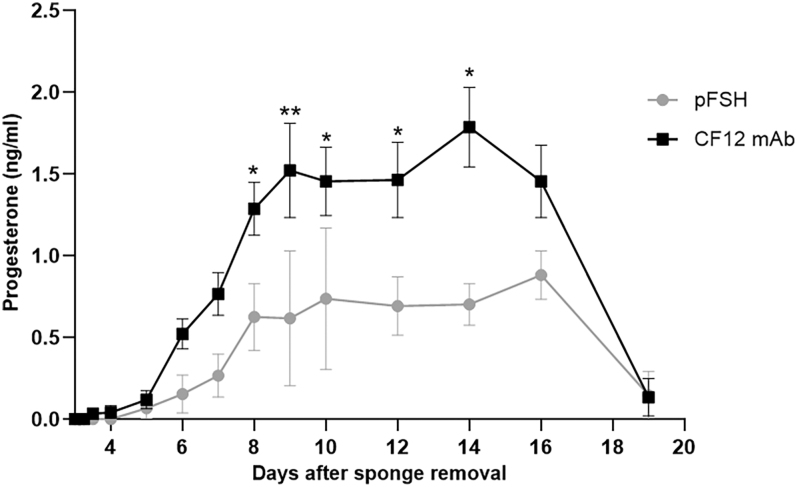
Follicle-stimulating hormone (FSH) and luteinizing hormone (LH) are key for folliculogenesis and spermatogenesis and play a role, together with chorionic gonadotropin (CG), in fertility treatment. In ewes and goats treated with equine CG (eCG), some females secreted antibodies directed against eCG that potentiate its activity and are associated with a higher birth rate. Starting from this observation, we developed CF12, an anti-gonadotropin monoclonal antibody (mAb), to potentiate FSH and LH/CG bioactivity. Following in vitro studies that explored CF12 mAb's impact on FSH, LH, and CG potency on cyclic AMP (cAMP) production in HEK293 cells expressing respective receptors, we proceeded to examine the effects in vivo. We established in immature female and male rats that the effect of CF12 mAb is dose dependent. In an adult male azoospermic rat model, CF12 mAb in combination with gonadotropins completely restored spermatogenesis within one spermatogenesis cycle, whereas treatment with gonadotropin only failed to do so. Ovulation was induced by CF12 mAb alone in all treated primiparous ewes (n = 7; 100%), demonstrating its potentiating effect on endogenous hormones (by comparison, treatment with porcine FSH (pFSH) induced just four ovulations in 11 treated ewes; 36%). CF12 mAb also induced better progesterone secretion compared to the pFSH group. In conclusion, CF12 mAb potentiates the effect of both exogenous and endogenous gonadotropins and could be used to improve the outcome of fertility treatments. The development of a humanized variant of CF12 mAb would be of utmost interest in offering patients an alternative option for the treatment of infertility in both men and women.