Gluba-Sagr Anna, Olszewski Robert, Franczyk Beata, Młynarska Ewelina, Rysz-Górzyńska Magdalena, Rysz Jacek, Surma Stanislaw, Sohum Sheth, Banach Maciej, Toth Peter P
Department of Nephrology, Hypertension and Family Medicine, Medical University of Lodz, 113 Żeromskiego Street, 90-549 Lodz, Poland.
Department of Gerontology, Public Health, and Didactics - National Institute of Geriatrics, Rheumatology and Rehabilitation, Warsaw, Poland.
Am J Prev Cardiol. 2025 Aug 7;23:101073. doi: 10.1016/j.ajpc.2025.101073. eCollection 2025 Sep.
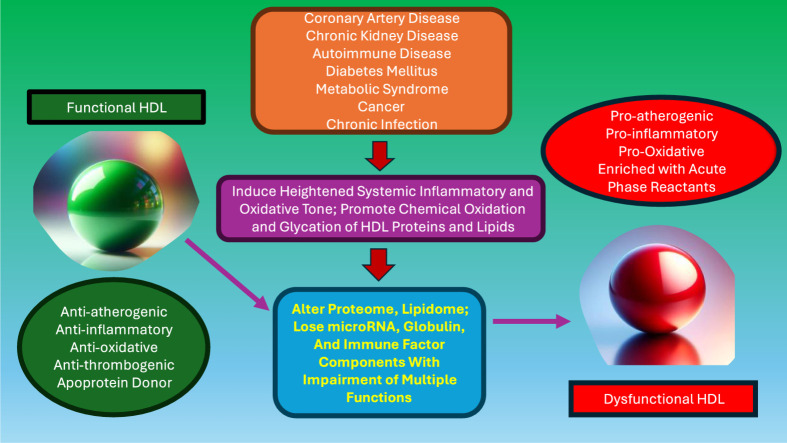
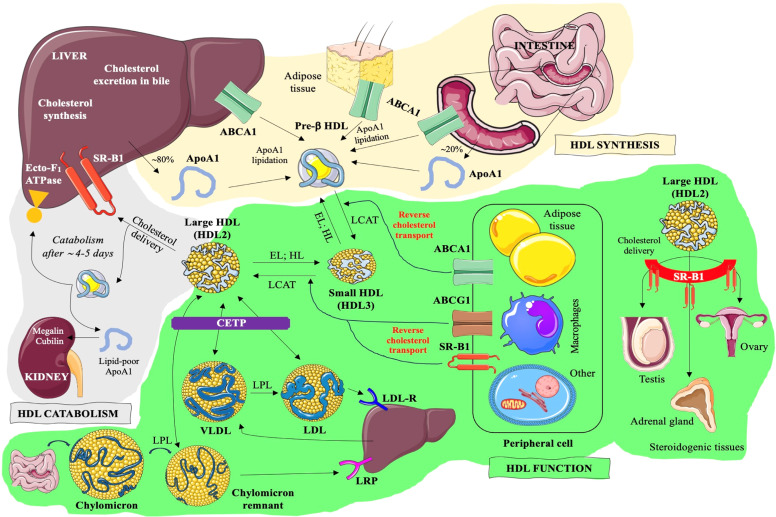
In contrast to low-density lipoproteins which are atherogenic, high-density lipoproteins (HDL) have been conceptualized as beneficial modulators of adverse pathophysiological phenomena along arterial walls. The HDLs are characterized by highly complex and varied molecular cargoes that include apoproteins, enzymes, microRNAs, bioactive lipids and phospholipids, components of complement, and immune factors, among others. These cargo components determine its functionality. Despite the findings of Mendelian inheritance studies which suggest that HDL is not causal in the pathway for atherogenesis, experiments with HDLs show that it can drive reverse cholesterol transport and antagonize inflammation, oxidation, thrombosis, platelet aggregation, endothelial progenitor cell mobilization, potentiate immunity, foster communication between different cell and tissue types, and function as a crucial apoprotein donor amongst the various lipoproteins. These functions are understandably viewed as beneficial and antagonize pathophysiology. Secondary to the complexity of its proteome and lipidome, HDL functionality is profoundly responsive to the metabolic and genetic backgrounds of individuals. Even its size and lipidation status can influence its functionality. As part of the acute phase response, critical antioxidative moieties can be replaced by such acute phase reactants as serum amyloid A and pro-oxidative enzymes. The functionality of HDL is influenced by chronic kidney disease, coronary artery disease, acute myocardial infarction, obesity, insulin resistance, metabolic syndrome, diabetes mellitus, and cancer. Herein we describe many of the alterations in HDL constitution and the resulting changes in functional capacity that can be observed. A unifying theme characterizing these disease states is that they all heighten systemic inflammatory tone and potentiate a pro-oxidative state. These changes clearly associate with profound changes in the functionality and behavior of HDL particles. We are only beginning to comprehend the extraordinary complexity and range of biochemical functions, both beneficial and injurious, that this lipoprotein can regulate. Hence it was extremely premature to think that simply raising HDL cholesterol in serum would beneficially influence cardiovascular morbidity and mortality. We have a long way to go before we develop a more comprehensive and potentially therapeutically relevant understanding of how to better harness its potential for antagonizing disease and block its ability to participate in and adversely influence the course of disease.
与具有致动脉粥样硬化作用的低密度脂蛋白相反,高密度脂蛋白(HDL)被视为动脉壁不良病理生理现象的有益调节因子。HDL的特点是其分子载脂蛋白高度复杂且多样,包括载脂蛋白、酶、微小RNA、生物活性脂质和磷脂、补体成分以及免疫因子等。这些载脂蛋白成分决定了它的功能。尽管孟德尔遗传研究结果表明HDL在动脉粥样硬化发生途径中并非因果关系,但对HDL的实验表明,它可以驱动胆固醇逆向转运,拮抗炎症、氧化、血栓形成、血小板聚集、内皮祖细胞动员,增强免疫力,促进不同细胞和组织类型之间的通讯,并在各种脂蛋白中作为关键的载脂蛋白供体发挥作用。这些功能被认为是有益的,并能拮抗病理生理学过程。由于其蛋白质组和脂质组的复杂性,HDL的功能对个体的代谢和遗传背景有深刻的反应。甚至其大小和脂质化状态也会影响其功能。作为急性期反应的一部分,关键的抗氧化部分可被血清淀粉样蛋白A和促氧化酶等急性期反应物所取代。HDL的功能受慢性肾病、冠状动脉疾病、急性心肌梗死、肥胖、胰岛素抵抗、代谢综合征、糖尿病和癌症的影响。在此我们描述了HDL组成的许多改变以及由此观察到的功能能力变化。这些疾病状态的一个共同特征是它们都会增强全身炎症反应并促进促氧化状态。这些变化显然与HDL颗粒的功能和行为的深刻变化相关。我们才刚刚开始理解这种脂蛋白所能调节的生化功能的非凡复杂性和范围,包括有益的和有害的。因此,认为仅仅提高血清中的HDL胆固醇就能有益地影响心血管发病率和死亡率的想法还为时过早。在我们对如何更好地利用其拮抗疾病的潜力以及阻断其参与和对疾病进程产生不利影响的能力形成更全面且可能具有治疗相关性的理解之前,我们还有很长的路要走。