Miranda Simón, Malnoy Mickael, Aldrey Anxela, Cernadas María José, Sánchez Conchi, Christie Bruce, Vidal Nieves
Research and Innovation Centre, Fondazione Edmund Mach (FEM), Via Mach 1, 38098 San Michele all'Adige, Italy.
Misión Biológica de Galicia, Consejo Superior de Investigaciones Científicas, Avda de Vigo s/n, 15705 Santiago de Compostela, Spain.
Plants (Basel). 2025 Sep 2;14(17):2740. doi: 10.3390/plants14172740.
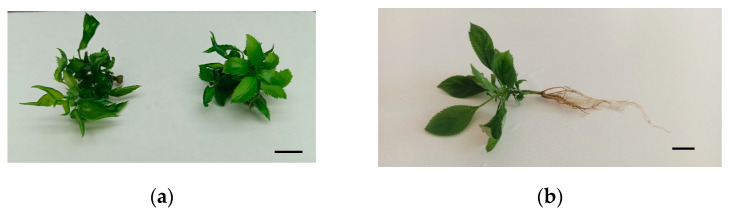
This study aimed to investigate culture conditions for the efficient micropropagation of apple cultivars 'Golden Delicious' and 'Royal Gala' in liquid medium by temporary immersion. RITA bioreactors were used for the multiplication stage whereas RITA or Plantform™ were used for the rooting stage. Murashige and Skoog media (MS) with N-benzyladenine (BA) was used for shoot multiplication and indole-3-butyric acid (IBA) for root induction. During the multiplication phase, we evaluated the mineral medium, BA concentration, immersion frequency, silver nitrate and activated charcoal supplementation and the use of physical supports to hold explants in an upright position. The results demonstrated that longer incubation periods (10 weeks) were better than shorter periods (6 weeks) for decreasing hyperhydricity and increasing the multiplication coefficient (MC). For 'Golden Delicious', the highest MC were obtained either with explants placed directly on the bioreactor basket and immersed six times per day for 60 s in MS with 2.2 µM BA or explants placed between rockwool cubes cultivated with 4.4 µM BA (both yielding MC of 8.9 and 5-10% hyperhydricity). These results were superior to 'Royal Gala', which showed a MC of 7.3 and 23% of hyperhydricity when cultivated in MS with half nitrates, 1.55 µM BA and rockwool cubes. Both varieties rooted efficiently (96-100%), and resulting plantlets were successfully acclimated. This is the first report in the micropropagation of these two commercial fruiting cultivars in temporary immersion, demonstrating the potential of this technology to enhance large-scale plant production for the apple nursery industry.
本研究旨在探究通过液体培养基临时浸没培养法高效微繁殖苹果品种“金冠”和“皇家嘎啦”的培养条件。增殖阶段使用RITA生物反应器,生根阶段则使用RITA或Plantform™。以添加N-苄基腺嘌呤(BA)的Murashige和Skoog培养基(MS)进行芽增殖,用吲哚-3-丁酸(IBA)诱导生根。在增殖阶段,我们评估了矿物培养基、BA浓度、浸没频率、硝酸银和活性炭添加量以及使用物理支撑物使外植体保持直立状态的效果。结果表明,较长的培养期(10周)比较短的培养期(6周)更有利于降低玻璃化程度并提高增殖系数(MC)。对于“金冠”品种,将外植体直接放置在生物反应器篮中,每天浸没6次,每次60秒,培养基为添加2.2 μM BA的MS培养基,或者将外植体置于添加4.4 μM BA的岩棉块之间培养,均可获得最高的MC(均为8.9,玻璃化率为5 - 10%)。这些结果优于“皇家嘎啦”品种,该品种在含半量硝酸盐、1.55 μM BA的MS培养基及岩棉块中培养时,MC为7.3,玻璃化率为23%。两个品种的生根效率均很高(96 - 100%),且所得幼苗成功驯化。这是关于这两个商业结果品种通过临时浸没培养进行微繁殖的首次报道,证明了该技术在提升苹果苗圃产业大规模植物生产方面的潜力。