de Jong Menno J, Awan Malik, Lecomte Nicolas, Puckett Emily E, Crupi Anthony P, Janke Axel
Senckenberg Biodiversity and Climate Research Institute (SBiK-F), Georg-Voigt-Strasse 14-16, 60325 Frankfurt am Main, Germany.
Institute for Ecology, Evolution and Diversity, Goethe University, Max-von-Laue-Strasse. 9, Frankfurt am Main, Germany.
iScience. 2025 Jul 2;28(7):112870. doi: 10.1016/j.isci.2025.112870. eCollection 2025 Jul 18.
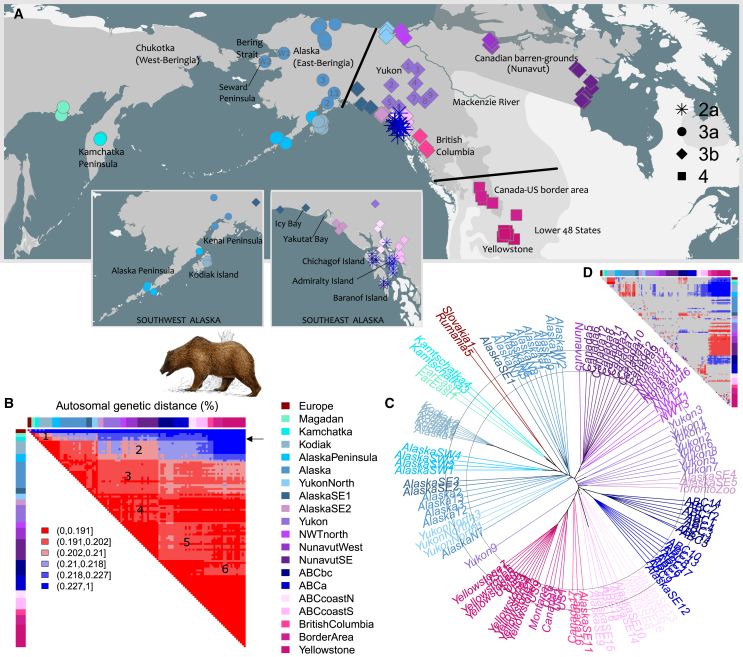
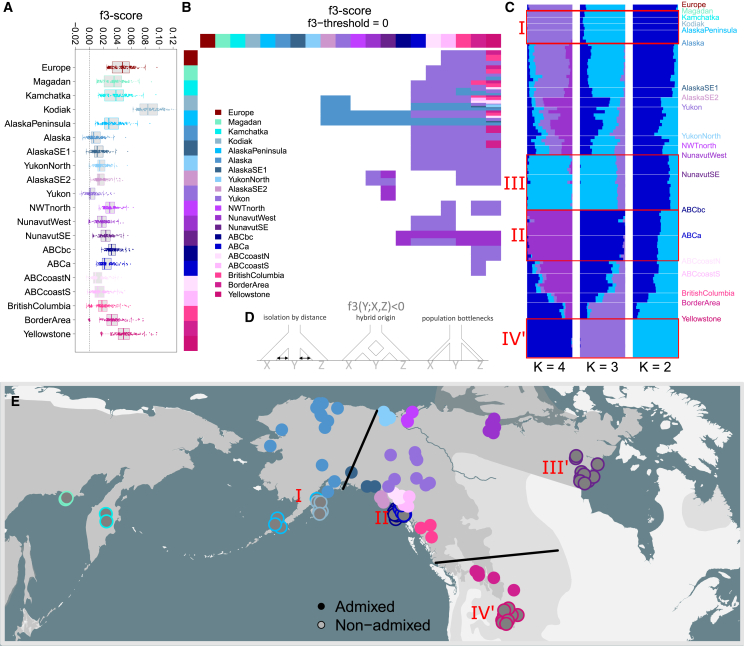
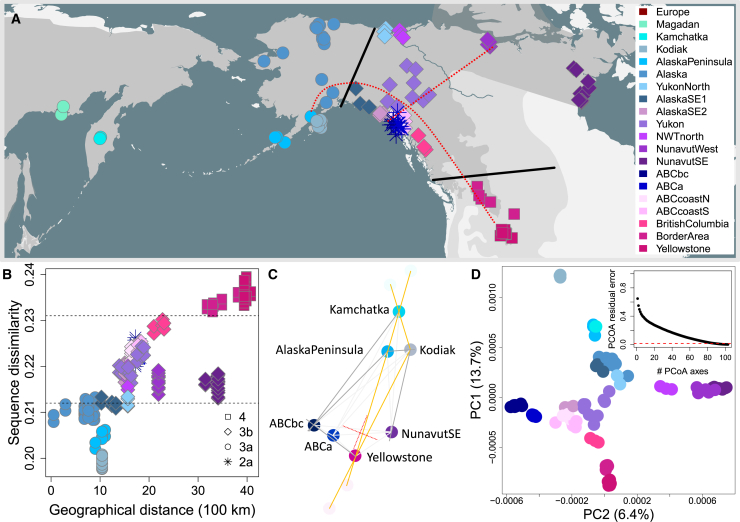
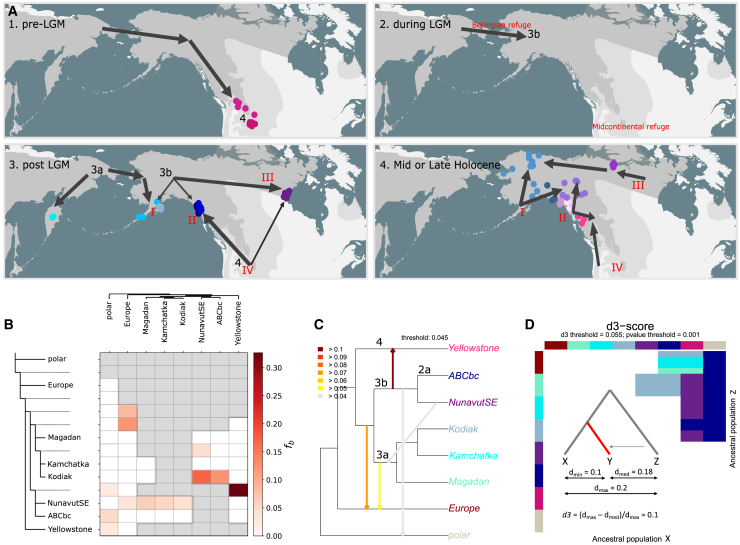
Genetic variation among populations reflects both past demographic events and current population connectivity. We investigate the primary drivers of genetic differentiation in American brown bears () using 108 nuclear genomes. Our analyses reveal that genome-wide distances conform to neither an isolation-by-distance model nor a bifurcating tree structure. Building on previous ancient-DNA and fossil studies, we propose a demographic scenario in which continent-wide admixture during the Late Holocene has obscured, but did not erase, the genetic legacy of earlier colonization waves and subsequent gene flow events. The most persistent signals of these past events are striking genetic similarities between populations now separated by water barriers, including Kamchatka and Southwest Alaska bears. Our findings underscore that convergence to migration-drift equilibrium takes time, making genetic distance an imperfect proxy for present-day population connectivity.
种群间的遗传变异反映了过去的人口事件和当前的种群连通性。我们使用108个核基因组来研究美洲棕熊(Ursus arctos)遗传分化的主要驱动因素。我们的分析表明,全基因组距离既不符合距离隔离模型,也不符合二叉树结构。基于先前的古DNA和化石研究,我们提出了一种人口统计学情景,即全新世晚期的大陆范围混合掩盖了但并未消除早期殖民浪潮和随后基因流动事件的遗传遗产。这些过去事件最持久的信号是现在被水屏障隔开的种群之间惊人的遗传相似性,包括堪察加半岛和阿拉斯加西南部的熊。我们的研究结果强调,向迁移 - 漂变平衡的收敛需要时间,使得遗传距离成为当今种群连通性的不完美代理。