Ames Meghan L, Sundermeir Samantha M, Staffier Kara L, Weeks Bruce, Reznar Melissa M, Hemmingson Tyler, Frattaroli Shannon, Gittelsohn Joel, Karlsen Micaela C
Department of International Health, Johns Hopkins Bloomberg School of Public Health, Baltimore, MD, United States.
Department of Health Policy and Management, Johns Hopkins Bloomberg School of Public Health, Baltimore, MD, United States.
Transl Behav Med. 2025 Jan 16;15(1). doi: 10.1093/tbm/ibaf042.
Lifestyle medicine (LM) is an evidence-based field of medicine that is effective in treating and preventing leading causes of morbidity and mortality. Despite demonstrated impact, few physicians and other healthcare professionals regularly implement LM. Continuing education may be an effective avenue for improving practitioner knowledge, confidence, and practice of LM, but there is a gap in the understanding of how educational content and strategies can be utilized to effectively increase LM adoption. The purpose of this study is to identify educational strategies that facilitate the implementation of LM in health systems (HS).
Eight US HSs participated in this multiple case study. We conducted in-depth, semi-structured interviews (n = 68 total; 6-8 within each HS) with HS employees leading and delivering LM programs. Interviews included questions about LM implementation and educational strategies. Transcripts were analyzed following the framework analysis approach. Strength of endorsement was assessed through quantitative and qualitative analysis.
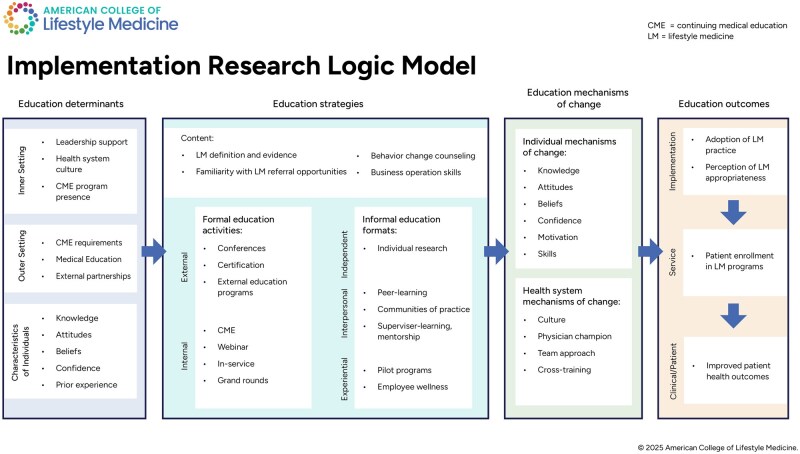
Four topic areas were identified as critical content for effective continuing education in LM. The need for further education in behavior change counseling received the strongest endorsement. Other topics included LM definition and evidence, referral opportunities, and business development skills. Ten types of continuing educational strategies were identified that facilitate LM. There was the strongest endorsement for pilot programs, employee wellness, and interpersonal educational activities, including peer-learning, communities-of-practice, and supervisor-learning/mentorship.
Continuing education can facilitate LM implementation in HSs. Educational strategies should emphasize training that builds skills in behavior change counseling, leverages employee wellness pilot programs, and nurtures interpersonal learning.
生活方式医学(LM)是一个基于证据的医学领域,在治疗和预防发病率和死亡率的主要原因方面很有效。尽管已证明其有影响,但很少有医生和其他医疗保健专业人员经常实施生活方式医学。继续教育可能是提高从业者对生活方式医学的知识、信心和实践的有效途径,但在如何利用教育内容和策略来有效增加生活方式医学的采用方面存在理解差距。本研究的目的是确定有助于在卫生系统(HS)中实施生活方式医学的教育策略。
八个美国卫生系统参与了这项多案例研究。我们对领导和提供生活方式医学项目的卫生系统员工进行了深入的半结构化访谈(总共68次;每个卫生系统内6 - 8次)。访谈包括有关生活方式医学实施和教育策略的问题。按照框架分析方法对访谈记录进行了分析。通过定量和定性分析评估认可程度。
确定了四个主题领域作为生活方式医学有效继续教育的关键内容。行为改变咨询方面的进一步教育需求获得了最强烈的认可。其他主题包括生活方式医学的定义和证据、转诊机会以及业务发展技能。确定了十种有助于生活方式医学的继续教育策略。对试点项目、员工健康以及人际教育活动,包括同伴学习、实践社区和上级学习/指导,获得了最强烈的认可。
继续教育可以促进卫生系统中生活方式医学的实施。教育策略应强调培养行为改变咨询技能、利用员工健康试点项目以及促进人际学习的培训。