Chen Mingjie, Guo Jiajie, Shangguan Yuwen, Sun Zhonghua, He Xueling, Tu Qiang, Yan Qingkai
Department of Cardiology, Bishan Hospital of Chongqing Medical University, Chongqing, 402760, China.
The Second School of Clinical Medicine, Guangzhou Medical University, Guangzhou, 511400, China.
Cardiovasc Diabetol. 2025 Sep 23;24(1):366. doi: 10.1186/s12933-025-02921-3.
The triglyceride-glucose (TyG) index, as a measure of insulin resistance, has been confirmed to be associated with adverse clinical outcomes. The new composite indicator, TyG-A body type index (TyG-ABSI), by integrating the TyG index and the A body type index, has demonstrated superior efficacy in predicting the risk of cardiovascular death in the general population compared to traditional indicators. This study aims to deeply explore the association between TyG-ABSI and all-cause mortality and CVD mortality in the population with cardiovascular kidney-metabolic syndrome (CKM) stages 0-3. The analysis will be conducted from multiple dimensions such as the intensity of indicator correlation and potential influencing mechanisms, in order to comprehensively reveal the relationship between the two.
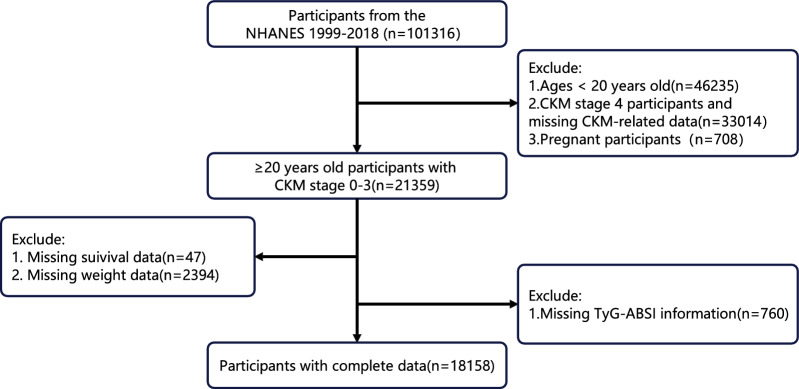
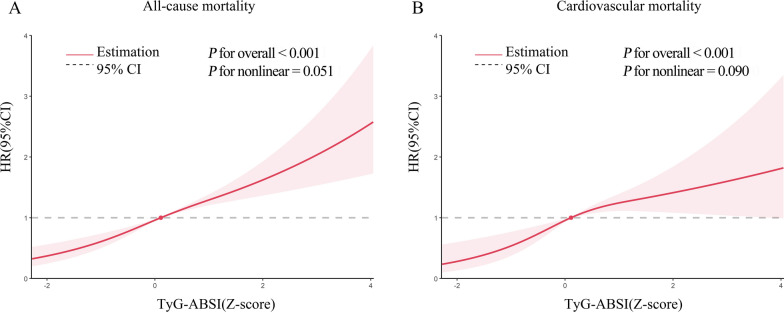
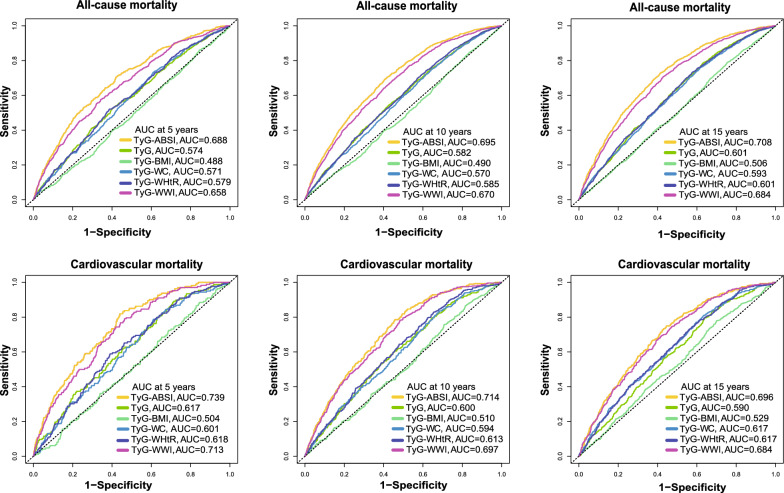
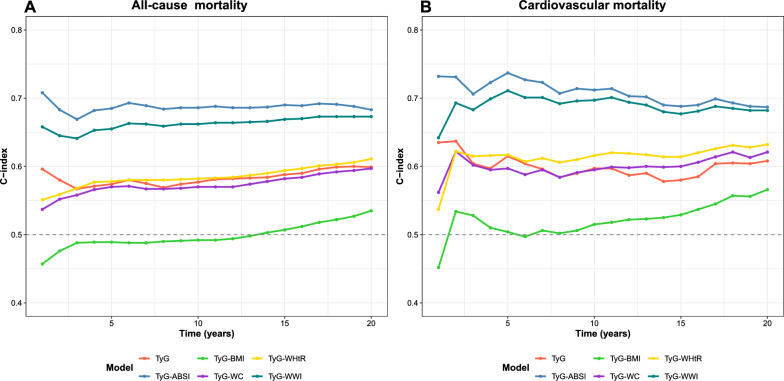
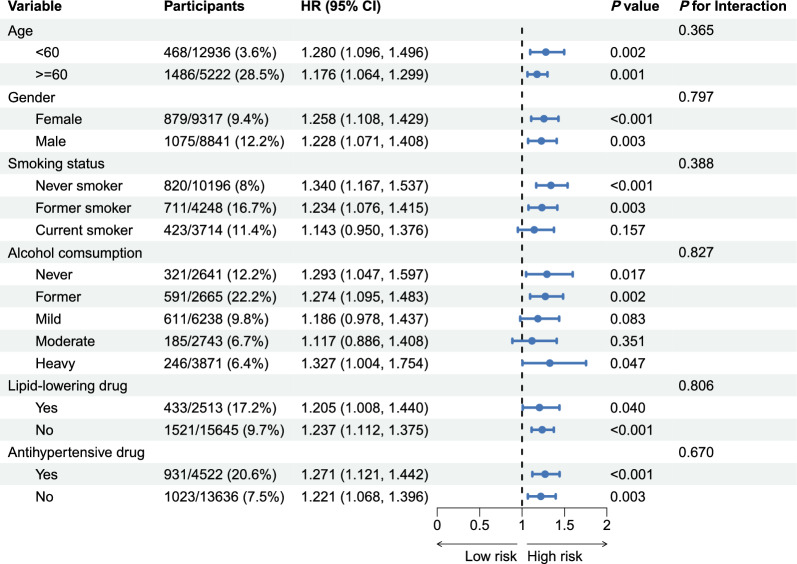
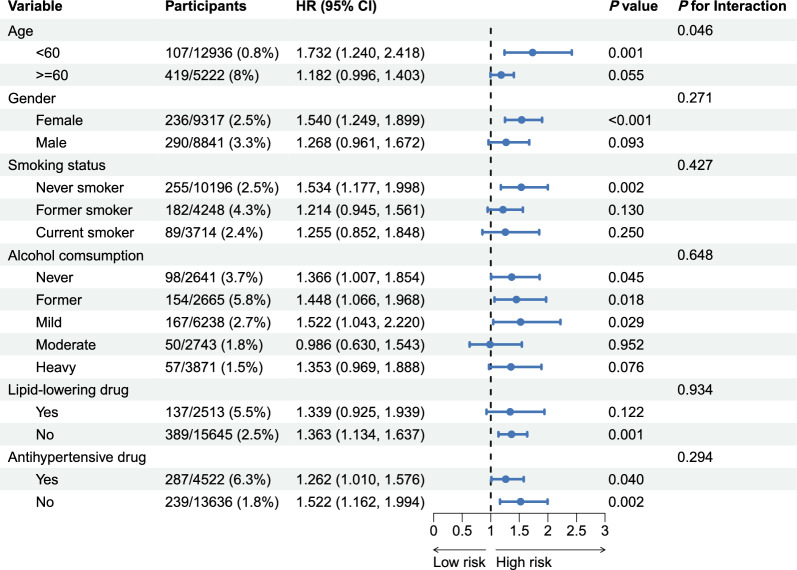
We analyzed data from 13,480 participants in the NHANES cohort (1999-2018) using Cox proportional hazards models and restricted cubic spline functions. The results indicated that elevated TyG-ABSI values were independently associated with a higher risk of all-cause mortality (HR = 1.226, 95% CI 1.104-1.361) and cardiovascular mortality (HR = 1.377, 95% CI 1.149-1.651). Time-dependent receiver operating characteristic (ROC) curves and concordance index evaluations demonstrated that TyG-ABSI yielded more accurate long-term prognostic performance than other TyG-derived metrics. The area under the curve (AUC) of this indicator reached 0.688-0.708 in the prediction of all-cause mortality risk over 5-15 years, and 0.696-0.739 in the prediction of cardiovascular mortality risk. External validation using CHARLS data confirmed the robustness of these findings in predicting all-cause mortality.
Among individuals with CKM stages 0-3, TyG-ABSI demonstrates a stronger association with mortality risk and superior predictive ability compared with other TyG-derived metrics. Its performance suggests a potential role in capturing variations across diverse clinical subgroups, and informing optimal timing for preventive interventions.
甘油三酯-葡萄糖(TyG)指数作为胰岛素抵抗的一种度量指标,已被证实与不良临床结局相关。新的综合指标,即TyG-A体型指数(TyG-ABSI),通过整合TyG指数和A体型指数,与传统指标相比,在预测普通人群心血管死亡风险方面已显示出更高的效能。本研究旨在深入探讨TyG-ABSI与心血管肾脏代谢综合征(CKM)0-3期人群的全因死亡率和心血管疾病死亡率之间的关联。将从指标相关性强度和潜在影响机制等多个维度进行分析,以全面揭示两者之间的关系。
我们使用Cox比例风险模型和受限立方样条函数分析了美国国家健康与营养检查调查(NHANES)队列(1999 - 2018年)中13480名参与者的数据。结果表明,TyG-ABSI值升高与全因死亡率(HR = 1.226,95% CI 1.104 - 1.361)和心血管死亡率(HR = 1.377,95% CI 1.149 - 1.651)的较高风险独立相关。时间依赖性受试者工作特征(ROC)曲线和一致性指数评估表明,与其他基于TyG的指标相比,TyG-ABSI产生了更准确的长期预后表现。该指标在预测5至15年全因死亡风险时曲线下面积(AUC)达到0.688 - 0.708,在预测心血管死亡风险时达到0.696 - 0.739。使用中国健康与养老追踪调查(CHARLS)数据进行的外部验证证实了这些发现在预测全因死亡率方面的稳健性。
在CKM 0 - 3期个体中,与其他基于TyG的指标相比,TyG-ABSI与死亡风险的关联更强且预测能力更优。其表现表明在捕捉不同临床亚组间的差异以及为预防性干预提供最佳时机方面具有潜在作用。