Brigleb Pamela H, Roubidoux Ericka Kirkpatrick, Lazure Lauren, Livingston Brandi, Meliopoulos Victoria A, Sharp Bridgett, Ripperger Tyler, Patrick Shelby, Morris Dorothea R, Tan Shaoyuan, Schultz-Cherry Stacey
Department of Host Microbe Interactions, St. Jude Children's Research Hospital, Memphis, TN 38105, USA.
Sci Adv. 2025 Sep 26;11(39):eaeb3906. doi: 10.1126/sciadv.aeb3906.
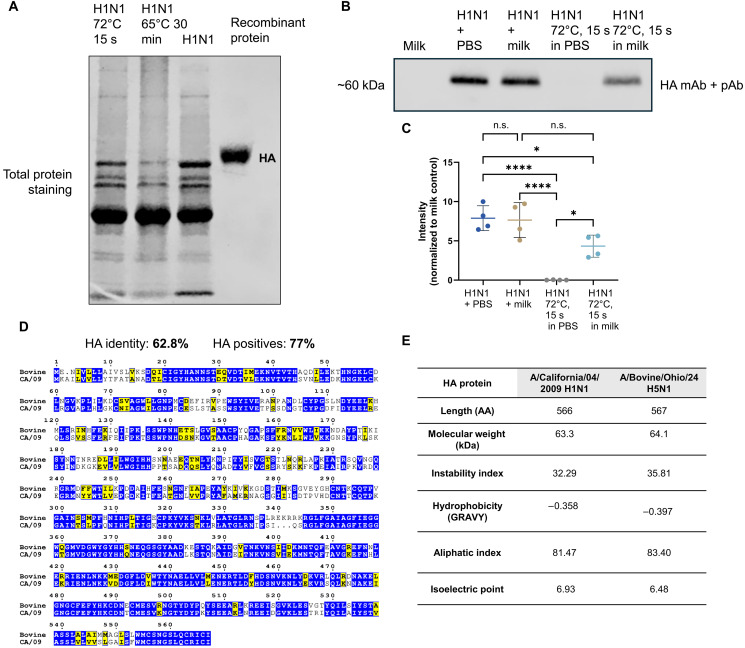
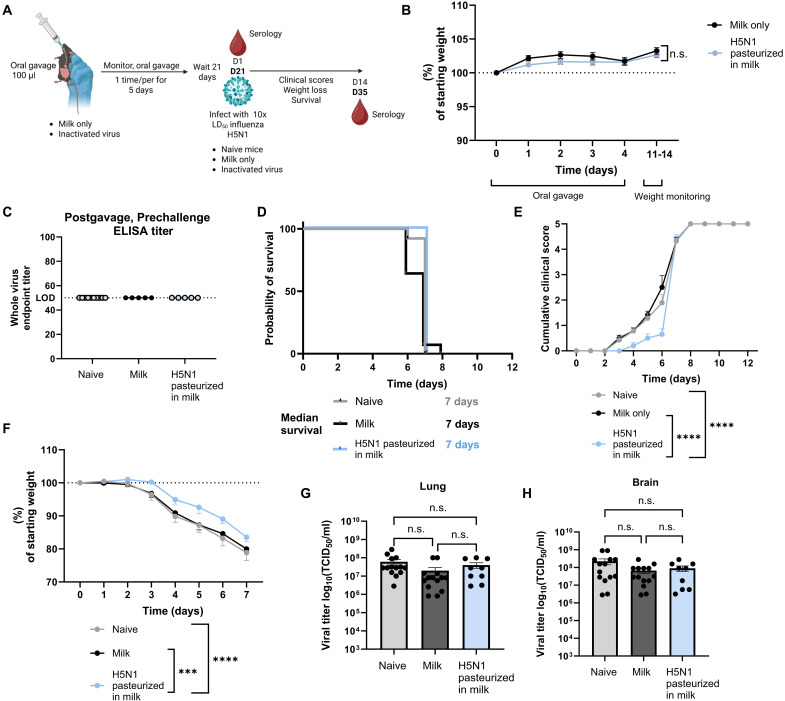
In March 2024, a highly pathogenic avian influenza H5N1 (HPAI) clade 2.3.4.4b virus was identified in US dairy cows, with spillover to cats, poultry, and humans. Up to 30% of commercial pasteurized milk tested contained viral genome copies. The impact of residual viral remnants on host immunity is unknown. Orally ingested proteins can stimulate gut-associated lymphoid tissues, potentially inducing tolerance and altering responses to later infection. We found that milk pasteurization fully inactivated pandemic H1N1 and bovine H5N1 influenza viruses yet preserved hemagglutinin (HA) protein integrity. In mice, repeated oral exposure to inactivated virus did not alter mortality after H5N1 virus challenge. Preliminary data showed that naïve mice exposed to improperly pasteurized milk containing live H5N1 virus developed lethal infection, whereas prior H1N1 infection conferred protection. Mice with preexisting H1N1 immunity remained protected when challenged with bovine H5N1 virus after exposure to H5N1 pasteurized in milk. These findings suggest that pasteurized milk containing inactivated H5N1 virus poses minimal health risks.
2024年3月,在美国奶牛中发现了一种高致病性H5N1禽流感(HPAI)2.3.4.4b分支病毒,该病毒已传播到家猫、家禽和人类身上。检测的商业巴氏杀菌牛奶中,高达30%含有病毒基因组拷贝。残留病毒残骸对宿主免疫力的影响尚不清楚。口服摄入的蛋白质可刺激肠道相关淋巴组织,可能诱导耐受性并改变对后续感染的反应。我们发现,牛奶巴氏杀菌可使大流行性H1N1和牛H5N1流感病毒完全失活,但能保持血凝素(HA)蛋白的完整性。在小鼠中,反复口服暴露于灭活病毒并不会改变H5N1病毒攻击后的死亡率。初步数据显示,初次接触含有活H5N1病毒的未充分巴氏杀菌牛奶的小鼠会发生致命感染,而先前感染过H1N1则可提供保护。在接触牛奶中巴氏杀菌的H5N1后,预先存在H1N1免疫力的小鼠在受到牛H5N1病毒攻击时仍受到保护。这些发现表明,含有灭活H5N1病毒的巴氏杀菌牛奶对健康造成的风险极小。