Liu Shuai, Yang Mengmeng, Xing Tingyan, Yang Ran
School of Artificial Intelligence, China University of Geosciences (Beijing), Beijing 100083, China.
School of Vehicle and Mobility, Tsinghua University, Beijing 100084, China.
Sensors (Basel). 2025 Sep 15;25(18):5748. doi: 10.3390/s25185748.
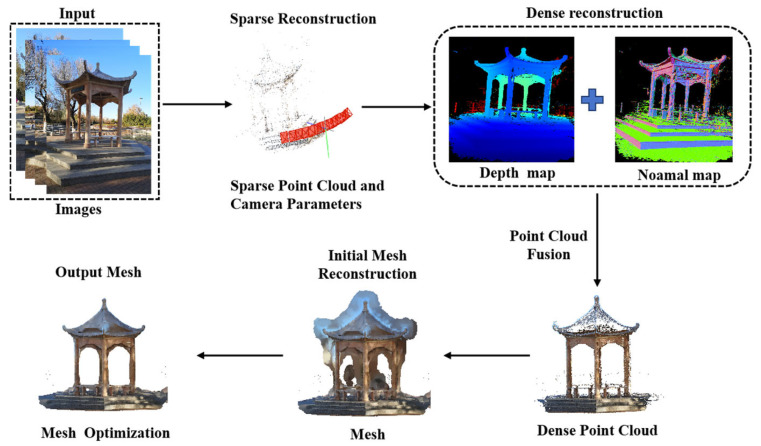
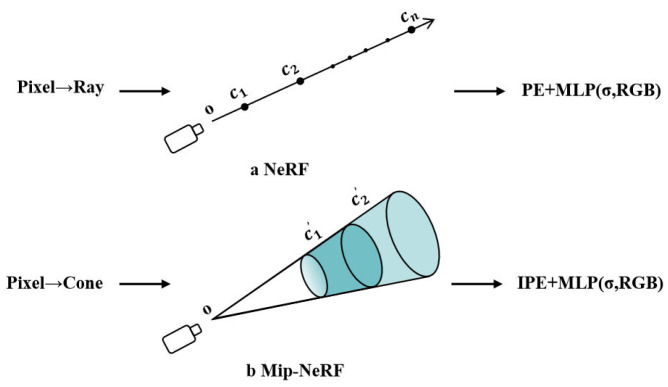
Three-dimensional (3D) reconstruction technology is not only a core and key technology in computer vision and graphics, but also a key force driving the flourishing development of many cutting-edge applications such as virtual reality (VR), augmented reality (AR), autonomous driving, and digital earth. With the rise in novel view synthesis technologies such as Neural Radiation Field (NeRF) and 3D Gaussian Splatting (3DGS), 3D reconstruction is facing unprecedented development opportunities. This article introduces the basic principles of traditional 3D reconstruction methods, including Structure from Motion (SfM) and Multi View Stereo (MVS) techniques, and analyzes the limitations of these methods in dealing with complex scenes and dynamic environments. Focusing on implicit 3D scene reconstruction techniques related to NeRF, this paper explores the advantages and challenges of using deep neural networks to learn and generate high-quality 3D scene rendering from limited perspectives. Based on the principles and characteristics of 3DGS-related technologies that have emerged in recent years, the latest progress and innovations in rendering quality, rendering efficiency, sparse view input support, and dynamic 3D reconstruction are analyzed. Finally, the main challenges and opportunities faced by current 3D reconstruction technology and novel view synthesis technology were discussed in depth, and possible technological breakthroughs and development directions in the future were discussed. This article aims to provide a comprehensive perspective for researchers in 3D reconstruction technology in fields such as digital twins and smart cities, while opening up new ideas and paths for future technological innovation and widespread application.
三维(3D)重建技术不仅是计算机视觉和图形学中的核心关键技术,也是推动虚拟现实(VR)、增强现实(AR)、自动驾驶和数字地球等许多前沿应用蓬勃发展的关键力量。随着神经辐射场(NeRF)和3D高斯点云(3DGS)等新视图合成技术的兴起,3D重建正面临前所未有的发展机遇。本文介绍了传统3D重建方法的基本原理,包括运动结构(SfM)和多视图立体(MVS)技术,并分析了这些方法在处理复杂场景和动态环境时的局限性。本文聚焦于与NeRF相关的隐式3D场景重建技术,探讨了使用深度神经网络从有限视角学习并生成高质量3D场景渲染的优势和挑战。基于近年来出现的与3DGS相关技术的原理和特点,分析了在渲染质量、渲染效率、稀疏视图输入支持和动态3D重建方面的最新进展和创新。最后,深入讨论了当前3D重建技术和新视图合成技术面临的主要挑战和机遇,并探讨了未来可能的技术突破和发展方向。本文旨在为数字孪生和智慧城市等领域的3D重建技术研究人员提供全面的视角,同时为未来的技术创新和广泛应用开辟新的思路和途径。