West C D, Winter S, Forristal J, McConville J M, Davis N C
J Clin Invest. 1967 Apr;46(4):539-48. doi: 10.1172/JCI105555.
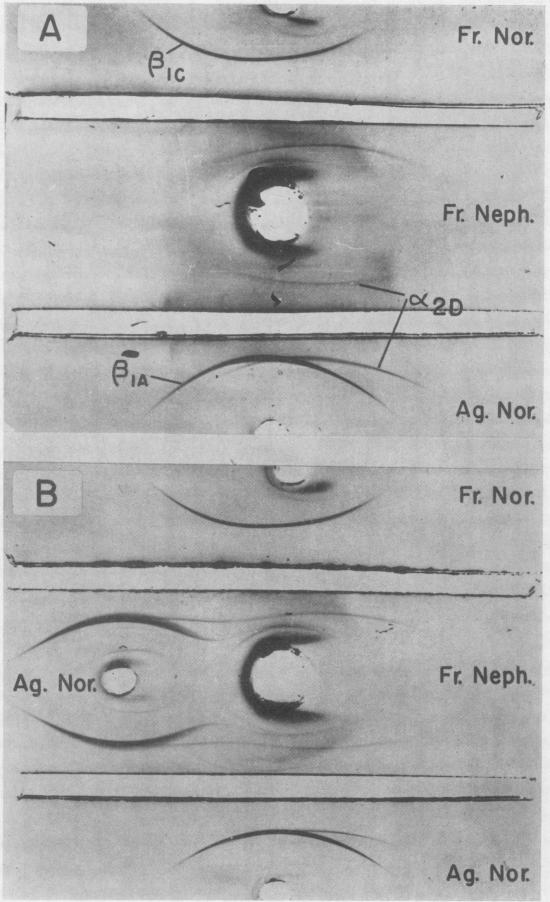
Evidence has been obtained for the presence in vivo of alpha(2D)-globulin, a breakdown product of serum beta(1C)-globulin, in patients with acute and persistent hypocomplementemic glomerulonephritis. The protein has been identified by immunoelectrophoretic analysis, and the amounts present have been determined by direct measurement of specific antigenic determinants present on alpha(2D). beta(1A)-Globulin, another breakdown product of beta(1C)-globulin, may also be present in vivo in severely hypocomplementemic patients, but its levels are much lower than those of alpha(2D)-globulin.Alpha(2D)-globulin has been identified by immunoelectrophoretic analysis of fresh EDTA plasma from patients with hypocomplementemic nephritis as an arc in the alpha(2) region that shows a reaction of identity with the arc representing alpha(2D)-globulin produced by aged normal serum. beta(1A)-Globulin was not seen in these patterns. Measurement of specific antigenic determinants has been carried out in both fresh EDTA plasma and aged serum. In the fresh plasma, the concentration of D antigen, found on both beta(1C)- and alpha(2D)-globulins, has been related to that of B antigen, found only on beta(1C) and taken as a measure of the concentration of this protein. In the hypocomplementemic patients, the concentration of D antigen, in comparison to that of B, was greater than in the normal subjects. Similarly, in aged serum, the level of alpha(2D) was greater than would be expected from the amount of beta(1C) that had been broken down in vitro, measured by the concentration of beta(1A). Calculations indicated that the in vivo alpha(2D) level in severely hypocomplementemic patients ranged from 7.5 to 18% of that which would be found in a pool of aged normal serum in which beta(1C) is completely broken down. The levels tended to be lower in less severely hypocomplementemic patients, and none could be detected in normal plasma. Only small quantities of A and D antigens are detectable in the urine of patients with hypocomplementemic nephritis. The rate of excretion is about equal to that of the normal subject. The study indicates that the low serum levels of beta(1C)-globulin that may be present over long periods in patients with persistent hypocomplementemic glomerulonephritis can be ascribed, in part, to in vivo breakdown of this protein as a result of reaction with immune complexes. The contribution of beta(1C) deposition on immune complexes and of diminished synthesis to the depressed serum levels cannot be assessed by the present study.
在急性和持续性低补体血症性肾小球肾炎患者体内已证实存在α(2D)-球蛋白,它是血清β(1C)-球蛋白的一种分解产物。该蛋白已通过免疫电泳分析得以鉴定,其含量通过直接测定α(2D)上存在的特异性抗原决定簇来确定。β(1A)-球蛋白,β(1C)-球蛋白的另一种分解产物,在严重低补体血症患者体内也可能存在,但它的水平远低于α(2D)-球蛋白。通过对低补体血症性肾炎患者新鲜EDTA血浆进行免疫电泳分析,α(2D)-球蛋白被鉴定为α(2)区域的一条弧,它与由老化正常血清产生的代表α(2D)-球蛋白的弧呈现同一性反应。在这些图谱中未见到β(1A)-球蛋白。已对新鲜EDTA血浆和老化血清中的特异性抗原决定簇进行了测定。在新鲜血浆中,在β(1C)-球蛋白和α(2D)-球蛋白上均发现的D抗原浓度与仅在β(1C)上发现的B抗原浓度相关,B抗原浓度被用作该蛋白浓度的衡量指标。在低补体血症患者中,与B抗原相比,D抗原的浓度高于正常受试者。同样,在老化血清中,α(2D)的水平高于根据体外β(1C)分解量(通过β(1A)浓度测定)所预期的水平。计算表明,严重低补体血症患者体内α(2D)水平在老化正常血清池中β(1C)完全分解时所发现水平的7.5%至18%之间。在低补体血症程度较轻的患者中,该水平往往较低,在正常血浆中则无法检测到。在低补体血症性肾炎患者的尿液中只能检测到少量的A和D抗原。排泄率与正常受试者大致相同。该研究表明,持续性低补体血症性肾小球肾炎患者长期可能存在的低血清β(1C)-球蛋白水平,部分可归因于该蛋白因与免疫复合物反应而在体内发生分解。本研究无法评估β(1C)在免疫复合物上的沉积以及合成减少对血清水平降低的影响。